Jats
.gif)


The Jat people (Jat: जाट, also spelt Jatt: जट्ट), are a 33 million strong ethnic group of people[1][2] native to South Asia mainly in the Punjab region of India and Pakistan as well as in Balochistan, Khyber Pakhtunkhwa, Rajasthan, Haryana, Uttar Pradesh, Uttarakhand , Madhya Pradesh, Gujarat, Maharashtra et all. They are classed various such as an ethnic group, race, tribe and a people.[3][4][5][6] James Tod on the basis of earlier historical evidence enlisted them in the list of Thirty Six Royal Races of India.[7]
The Jat people are considered as the merged descendants of Indo-Aryans, Indo-Scythian tribes of the region, merging to form the Jat people.[8]
An uninformed view is that Jat is a farmer-caste (caste = social group) but Jat is really a race (race = ethnic group). Only a subset of the over 900 million farmers in south Asia are Jats. There are specific Jat DNA markers in the genetic profile, as highlighted in the Jat Genetics section.
The Jat people follow different faiths and are engaged in different professions. They have a discrete and distinct cultural history that can be historically traced back to ancient times.[9][10]
The Jat people were designated by the British Empire as a Martial Race. Martial Races were races & peoples that were naturally warlike and aggressive in battle, and possess qualities like courage, loyalty, self sufficiency, physical strength, resilience, orderliness, hard working, fighting tenacity and military strategy. The British Empire recruited heavily from these Martial Races for service in their Armies. A strategy that is still used today (21st century) in Armies of South Asian countries e.g. The famous Jat Regiment & the Gurkhas.
It would be relevant to know the core concepts of Jat people, their culture and history. Read Learning Jat people's history to understand why Jat people regard it is so important to understand their culture and history.
Contents
- 1 People
- 2 People Demographics
- 3 Military & Political People
- 4 People Background
- 5 Jat People Genetics
- 6 DNA study on Y-STR Haplogroup Diversity in the Jat Population
- 7 "NE Euro" fractions in DNA samples of Jats
- 8 Definition of Jat Status in Jat Blood Law
- 9 Noun Etymology of Jat
- 10 Jat Gotras Namesake
- 11 Mention by Pliny
- 12 James Tod on Jats
- 13 Inscriptions about Takshak and Jats by Col Tod
- 14 Jat Jati Ki Utpatti Aur Vistar
- 15 Political History in South Asia
- 16 Quotes on Jats by World Leaders
- 17 Jat people in Religious history
- 18 Jat People today in South Asia
- 19 Jat people in films & popular culture
- 20 Photo Gallery
- 21 See also
- 22 References
- 23 Online Books - Highly recommended Futher Reading
- 24 Futher Reading
- 25 External links
People

Col. James Tod notes that The Jats hold place amongst the 36 Royal Races of ancient India.[11][12][13][14] Some historians consider Jats, along with Kayasthas and Gujars, out of purview of varna system.[15] The Jat people are an ethnic group[16][17][18] spread over Northern India and Pakistan (mainly in the Punjab region).[19], but also including large numbers living in the EU, US, Canada, Australia and UK. The Jat people have traditionally been mainly agriculturalists and members of the military. Historically, there have been many Jat kings and other leading figures,[20] including several prominent political leaders in Pakistan and India, such as Chaudhary Charan Singh, Chaudhary Bansi Lal, Chaudhari Devi Lal, Aitzaz Ahsan and Chaudhry Pervaiz Elahi. This includes American Senator Satveer Chaudhary (the first South Asian senator in American history).[21]
A large number of Jats have served in the Indian Army and Pakistan Army, including in the Jat Regiment, Sikh Regiment, Rajputana Rifles and the Grenadiers, where they have won many of the highest military awards for gallantry and bravery. The Jat Regiment is one of the longest serving and most decorated infantry regiments of the Indian Army[22] having won 24 battle honours between 1839 and 1947, along with numerous decorations of individual members.[23] Jat people in the Pakistan Army, especially in the Punjab Regiment (Pakistan), have also been highly decorated and won medals of the highest orders or bravery.
The Jat people are one of the most prosperous groups in India on a per-capita basis (Punjab, Haryana, and Gujarat are the wealthiest of Indian states).[24] Traditionally they have been a predominant political class in Punjab.[25]
People Demographics


The census in 1931 in India recorded population on the basis of ethnicity. In 1925, according to Professor Qanungo[26] the population of Jatts was around nine million in South Asia and was made up of followers of three major religions as shown below.
| Religion | Jat Population % |
|---|---|
| Hinduism | 47% |
| Sikhism | 20% |
| Islam | 33% |
Professor B.S. Dhillon, states by taking population statistical analysis into consideration the Jatt population growth of both India and Pakistan since 1925, Professor Quanungo's figure of nine million could be translated into a minimum population statistic (1988) of 30 million.[27]
According to earlier census reports, the Jati or Jat people accounted for approximately 25% of the entire Sindhi-Punjabi speaking area, making it the one of "largest single socially distinctive group" in the region.[28]
Hukum Singh Pawar (Pauria) states, adequate statistics about Jat people population are available in the Census Report of India of 1931, which is the last and the most comprehensive source of information on the Jat people, who were estimated to be approximately ten million in number at that time.[29] From 1931 to 1988 the estimated increase in the Jat people population of the Indian subcontinent including Pakistan respectively is 3.5% Hindu, 3.5% Sikh and 4.0% Muslim.[30] Dr Sukhbir Singh estimates that the population of Hindu Jatts, numbered at 2,210,945 in the 1931 census, rose to about 7,738,308 by 1988, whereas Muslim Jatts, numbered at 3,287,875 in 1931, would have risen to about 13,151,500 in 1988. The total population of Jatts was given as 8,406,375 in 1931, and estimated to have been about 31,066,253 in 1988.
The region-wise break-up of the total Jatt people population (including the Jat Hindu, Jat Sikh and Jat Muslim) is given in the following table. The Jat people, approximately 73%, are located mainly in the Punjab region:[31]
| Name of region | Jat Population 1931 | Jat Population 1988 | Approx Percentage |
|---|---|---|---|
| Punjab region | 6,068,302 | 22,709,755 | 73 % |
| Rajasthan | 1,043,153 | 3,651,036 | 12 % |
| Uttar Pradesh | 810,114 | 2,845,244 | 9.2 % |
| Jammu & Kashmir | 148,993 | 581,477 | 2 % |
| Balochistan | 93,726 | 369,365 | 1.2 % |
| NWFP | 76,327 | 302,700 | 1 % |
| Bombay Presidency | 54,362 | 216,139 | 0.7 % |
| Delhi | 53,271 | 187,072 | 0.6 % |
| CP & Brar | 28,135 | 98,473 | 0.3 % |
| Ajmer-Marwar | 29,992 | 104,972 | 0.3 % |
| Total | 8,406,375 | 31,066,253 | 100 % |
Military & Political People

A large number of Jatt people serve in the Indian Army, including the Jat Regiment, Sikh Regiment, Rajputana Rifles and the Grenadiers, where they have won many of the highest military awards for gallantry and bravery. Jat people also serve in the Pakistan Army especially in the Punjab Regiment, where they have also been highly decorated. The Jat Regiment is an infantry regiment of the Indian Army, it is one of the longest serving and most decorated regiments of the Indian Army[32]. The regiment has won 19 battle honours between 1839 to 1947[33] and post independence 5 battle honours, eight Mahavir Chakra, eight Kirti Chakra, 32 Shaurya Chakras, 39 Vir Chakras and 170 Sena medals[34] Major Hoshiar Singh of Rohtak won the Paramvir Chakra during Indo-Pak war of 1971. Rohtak district, which has a high density of Jat people, has the distinction of producing the highest number of Victoria Cross winners of any district in India.

The Jat people were designated by British officials as a "Martial Race". "Martial Race" was a designation created by officials of British India to describe "races" (peoples) that were thought to be naturally warlike and aggressive in battle, and to possess qualities like courage, loyalty, self sufficiency, physical strength, resilience, orderliness, hard working, fighting tenacity and military strategy. The British recruited heavily from these Martial Races for service in the colonial army.[35]
Traditionally they have dominated as the political class in Punjab.[36]
A number of Jat people belonging to the political classes have produced many political leaders, including the 6th Prime Minister of India, Prime Minister Chaudhary Charan Singh. Moreover, there have been many Jat Kings and warriors throughout history.[37]
The Jat people are one of the most prosperous groups in India on a per-capita basis (Punjab, Haryana, and Gujarat are the wealthiest of Indian states).[38]
People Background

Origin & lineage
The Jat people are considered to be the merged descendants of Indo-Scythian tribes of the region, merging with Indo-Aryans to form the Jat people.[39] DNA studies have proved that Jat people are Indo-Scythian (see Jat DNA Genetics section). The original home of the Jats was in Central Asia near the country we now call Ukraine. Many recent DNA studies have provided scientific confirmation & proof that the Jats came from Ukraine, due to them having many Ukrainian DNA markers & Genes.[40][41] DNA studies have proved that Jat people are Aryo-Scythians.(see Jat DNA Genetics section).
Indo-Aryan lineage
- See main article: Indo-Aryan origin of Jats

The Indo-Aryan origin of Jats has been advocated on the basis of ethnological, physical and linguistic standards by many historians like Ernest Binfield Havell,[42] Qanungo,[43] Chintaman Vinayak Vaidya,[44] Sir Herbert Risley,[45] Thakur Deshraj,[46], Dr Natthan Singh[47], Mangal Sen Jindal[48], etc. Sir Herbert Risley declared the Jats to be the true representatives of the Vedic Aryans.
On the basis of historical facts the Jats are reported to be present in India from 3102 BCE.[49][50] [51] Dr Natthan Singh, Hukum Singh Panwar consider Jats to be the Aryans and their original homeland was 'Saptasindhu'. They had to migrate from India on economic, social and political reasons after Mahabharata war for some period but they returned back to India. During the migration also they did not leave their language and cultural traditions.[52] This view is also supported by Thakur Deshraj, who writes that on the basis of ethnological, physical, cultural and linguistic characteristics that Jats are pure Aryans, who inhabited the areas on the banks of Ganga-Yamuna or Sarswati-Sindhu during Vedic civilization.[53] Thakur Deshraj also highlights that after the great Mahabharata war, Krishna formed a democratic federation or sangha of clans known as Jñātisangha (ज्ञाति-संघ). Initially, Vrishni and Andhaka clans were included in this sangha and later many clans joined it.[54][55][56] Due to political situations, Jats had to migrate from India. They went up to Iran, Afghanistan, Arab, Turkistan . Chandravanshi Kshatriyas known as Yadavas spread to Iran Sindh, Punjab, Saurashtra, Central India and Rajasthan. In north-east the went upto Kashmir, Nepal, Bihar etc. They even went to Mongolia and Siberia. Greeks call themselves descendants of Krishna and Baladeva. China vanshi also consider themselves descendants of Aryans. The same people returned to India in later periods with the names Shaka, Pahllava, Kushan, Yuezhi, Huna, Gujar [57]
According to Maheswari Prasad of Banaras Hindu University, Jats belong to the Proto-Vedic Aryan stock. But being on the periphery of Madhyadesha, the cradle of Vedic culture, they did not undergo the social transformation on the line of varna system and monarchial political organizaion. The power of decision-making remained with elders and clan organizations.[58]
The Sinsinwar Jat rulers of Bharatpur have been recorded as Yadav, by Prakash Chandra Chandawat.[59] Historian U. N. Sharma has mentioned the chronology of Krishna, in which starting from Sindhupal in 64th generation of Krishna to Bharatpur ruler Maharaja Brijendra Singh (1929-1948), all the rulers are mentioned as Yaduvanshi Jats.[60] Sidhu Jats are also Bhattis in origin, and thus Yaduvanshi in origin.
Mikhail Konstantinovich Kudryavtsev researched the origin of the Jats and pointed out that some legends speak of the Jats as having lived in Sind long before the Scythians invaded India, and even of a direct association of Jat chiefs with the heroes of the Mahabharata.[61]
Indo-Scythian lineage
- See main article: Indo-Scythian origin of the Jats


Professor B. S. Dhillon states that the Jats are mainly of Indo-Scythian lineage with composite mixing of Sarmatians, Goths & Jutes in History and study of the Jats. Historian James Tod agreed in considering the Jats to be of Indo-Scythian Stock.[62] Moreover, Sir Alexander Cunningham, Former Director-General of the Archeological Survey of India, considered the Jats to be the Xanthii (a Scythian tribe) of Scythian stock who he considered very likely called the Zaths (Jats) of early Arab writers.[63] He stated "their name is found in Northern India from the beginning of the Christian era." These people were considered by early Arab writers to have descended from Meds and Zaths.[64][65] Sir Cunningham believes they "were in full possession of the valley of the Indus towards the end of the seventh century.[66]
Stephen Fuchs suggests that the Jats probably migrated from Central Asia to India as a "predatory nomadic tribe".[67] Natalya Romanovna Guseva considered the Jats to be the descendants of the Sakas.[68]
- Sir Alexander Cunningham, (Former Director-General of the Archaeological Survey of India) wrote: The Xanthii (a Scythian tribe) are very probably the Zaths (Jats) of the early Arab writers. As the Zaths were in Sindh to the west of the Indus, this location agrees very well with what we know of the settlement of the Sakas (Scythians) on the Indian frontier.[69]
- Sir John Marshall, (Former Director-General of the Archaeological Survey of India) wrote: "These Scythian invaders came principally from the three great tribes of Massagetae (great Jats), Sacaraucae, and Dahae (still exists as a Jat clan of Punjab)[70], whose home at the beginning of the second century B.C. was in the country between the Caspian sea (sea) and the Jaxartes river (Central Asia).[71]
- Arthur Edward Barstow wrote: "Greeks of Bactria (partly modern Afghanistan), expelled by the hordes of Scythians, entered India in the second and first centuries BC and are said to have penetrated as far as Orissa (an Indian province in south-east). Meanwhile the Medii, Xanthii, Jatii, Getae and other Scythian races, were gradually working their way from the banks of the Oxus (River valley in Central Asia) into Southern Afghanistan and the pastoral highland about Quetta (a Pakistani city), whence they forced their way by the Bolan Pass, through the Sulaiman Mountains into India, settling in the Punjab about the beginning of the first century AD. It is from these Scythian immigrants that most of the Jat tribes are at any rate partly descended."[72]
- A. H. Bingley wrote: "It is from these Scythian Immigrants that most of the Jat tribes are at any rate partly descended."[73]
- Professor Joyce Pettigrew wrote: "Another view holds that the Jats came from Asia Minor and Armenia in the successive invasions during the period 600 B.C. to A.D. 600."[74]
- Professor Henry Smith Williams wrote: "The extent of the Scythian invasion has been variously estimated. Some scholars believe that they virtually supplanted the previous population of India (means Punjab), and there seems little doubt that by far the most numerous section of the Punjab population is of Scythian origin."[75]
- Professor Pritam Singh Gill wrote: "There is a general concensus of opinion that Jats, and with them Rajputs and Gujjars were foreigners who came from their original home, near the Oxus, Central Asia."[76]
- Professor Tadeusz Sulimirski wrote: "The evidence of both the ancient authors and the archaeological remains point to a massive migration of Sacian (Sakas)/Massagetan ("great" Jat) tribes from the Syr Daria Delta (Central Asia) by the middle of the second century B.C. Some of the Syr Darian tribes; they also invaded North India."[77]
- Horace Arthur Rose wrote: "Many of the Jat tribes of the Punjab have customs which apparently point to non-Aryan origin. Suffice it to say that both Sir Alexander Cunningham and Colonel Tod agreed in considering the Jats to be of Indo-Scythian Stock. The former identified them with the Zanthi of Strabo (Greek Geographer of the ancient times) and the Jatii of Pliny (Roman writer) and Ptolemy (Another Greek Geographer of the ancient times); and held that they probably entered the Punjab from their home on the Oxus (in Central Asia) very shortly after the Meds or Mands (still exist as one of the Jat clans of the Punjab), who also were Indo-Scythians, and who moved into the Punjab about a century before Christ."[78]
- Sir Henry Miers Elliot wrote: "These ignorant tribes (Jats) pointing to the remote Ghazni (Afghanistan) as their original seat, the very spot we know to have been occupied by the Yuechi, or, as Klaproth says, more correctly, Yuti, in the first centuries of our era, after the Sakas (a Scythian tribe) were repelled back from the frontiers of India, and left the country between India and Persia open for their occupation. The Jat tribes not doubt emigrated, no at all once, but at different times, and it is probable that those in the North-West are among the latest importations."[79]
- I. Sara wrote: "Recent excavations in the Ukraine and Crimea. The finds points to the visible links of the Jat and Scythians."[80]
- Sir Mountstuart Elphinstone Grant Duff wrote: "My conclusion, therefore, is, that the Jats may be of Scythian descent."[81]
- Ujagir Singh Mahil wrote: "Jat were called Scythians; because they were the inhabitants of the ancient country of Scythia. The Jats who invaded the Punjab and conquered India up to Benares were called Indo-Scythians."[82]
- James Francis Katherinus Hewitt wrote: "Further evidence both of the early history and origin of the race of Jats, or Getae, is given by the customs and geographical position of another tribe of the same stock, called the Massagetae, or great (massa) Getae."[83]
- Sir George Fletcher MacMunn (Sir and Lt. General) wrote: "Alexander came to India in his capacity as the holder of the Persian throne. From his camp near Kabul (Afghanistan), the Macedonian (Alexander) summoned those chiefs whom Skylax (Persian general) had conquered in the old time afore, to come and renew their homage to their ancient Persian overlord in the person of himself. Several obeyed his summons, others did not, and it has been surmised that those who did were later arrivals, of Jat or Scythian origin, outside the normal Aryan fold as later comers to India."[84]
- Syed Muhammad Latif wrote: "A considerable portion of the routed army of the Scythians settled in the Punjab, and a race of them, called Nomardy, inhabited the country on the west bank of the Indus (river). They are described as a nomadic tribe, living in wooden houses, after the old Scythian fashion, and settling where they found sufficient pasturage. A portion of these settlers, the descendants of Massagetae, were called Getes, from whom sprung the modern Jats."[85]
- Dr. Gopal Singh wrote: "The Jats of the Panjab, are Scythians in origin and came from Central Asia, whose one branch migrated as far south in Europe as Bulgaria. "[86]
- N. Singh wrote: "The Scythians appear to originate from Central Asia. They reached Punjab between 50 B.C. and A.D. 50. It seems probable that the Scythian ancestors of the Jats entered the Sindh Valley (presently in Pakistan Kashmir) between 100 B.C. and A.D. 100."[87]
- Satya Shrava wrote: "The Jats are none other than the Massagetae (Great Getae) mentioned in Diodorus as an off-spring of the ancient Saka tribe.... a fact now well-known."[88]
- Bakhshish Singh Nijjar wrote: "The Jats are the descendants of Scythians, whose kingdom's capital was Scythia, in the present Ukraine (Ukrainian), Soviet Social Republic, is the constituent Republic of the European USSR (Population 49,757,000) in 1947. Now Ukraine's capital is Kiev, the third leading city in Russia. Before the invasion of the golden herd, 13th century B.C. Scythian, ancient kingdom of indeterminate boundaries, centered in the area north of the Black Sea."[89]
- Rima Hooja suggests that the Jats are "probably descendants of the Scythians who entered India in early historical times".[90]
Identification of the Jats as Getae and Massagetae
- Alexander Cunningham advocated, "Jat is the same word as Getæ, in all probability."[91]
- Steven M. Collins advocates the identification of Massagetaeans as "Great Jits or Jats" of Asia.[92][93]
- Weer Rajendra Rishi advocates that the Jats are none other than the Massagetaeans (Maha/Great Getae).[94]
- Rahul Sankrityayan had identified the Jats as Massagetaeans.[95]
- Arnold Joseph Toynbee wrote: "It may not be fantastic to conjecture that the Tuetonic-speaking Goths and Gauts of Scandinavia may have been descended from a fragment of the same Indo-European-speaking tribe as the homonymous Getae and Thyssagetae and Massagetae of the Eurasian Steppe who are represented today by the Jats of the Panjab."[96]
- Arnold Joseph Toynbee, also wrote: "It had been carried from the Oxus-Jaxartes Basin into the Indus Basin by the Massagetae themselves, together with their tribal name (the Jats), in their Volkerwander- ung in the second century BC"[97]
- George Rawlinson has identified the Massagetaeans as "Great Jits or Jats" of Asia.[98][99][100][101][102][103]
- Sir Richard Francis Burton wrote: "The Massagetae (greater Jats or Goths) are opposed to the Thyssa (or lesser) Getae, and both used the sagaris."[104]
Jat People Genetics
- Main article: Indo-Scythian origin
A recent study of the people of Indian Punjab, where about 40% or more of the population are Jat people, strongly shows that the Jat people are Indo-Scythians.[105] The study involved a genealogical DNA test which examined single nucleotide polymorphisms (mutations in a single DNA "letter") on the Y chromosome (which occurs only in males). Jats share many common haplotypes with Ukrainian people, Germanic people, Slavic people, Baltic peoples, Iranian people, and Central Asian groups.[106] This strongly indicates they originate from near or in Ukraine.[107] It found Jat people share only two haplotypes, one of which is also shared with the population of present-day Turkish people, and have few matches with neighbouring Pakistani populations.[108] This haplotype shared between the two Jat groups may be part of an Indo-Aryan (or Indo-European people) genetic contribution to these populations, where as the haplotypes shared with other Eurasian populations is due to the strong DNA contributions of Indo-European Scythians (Saka, Massagetae) and White Huns.[109] The mitochondrial DNA (mtDNA) female DNA, Jats contain haplogroups typical of Northern India, Pakistan, and West Asia. This indicates that for the female mtDNA, there is very little connection with Central Asian and northwest European populations, even though Jats share many Y-SNP markers with these populations. Therefore, this DNA Study proves that there has been male DNA into the Jat people from Ukrainian Scythians (Saka, Massagetae) and White Huns.[110]
The highlighted DNA Study suggests that there has been male DNA into the Jat people from Ukrainian Scythians (Saka, Massagetae) and White Huns.[111]
DNA study on Y-STR Haplogroup Diversity in the Jat Population
David G. Mahal and Ianis G. Matsoukas[112] conducted a scientific study on Y-STR Haplogroup Diversity in the Jat Population of which brief Conclusion is as under:
The Jats represent a large ethnic community that has inhabited the northwest region of India and Pakistan for several thousand years. It is estimated the community has a population of over 123 million people. Many historians and academics have asserted that the Jats are descendants of Aryans, Scythians, or other ancient people that arrived and lived in northern India at one time. Essentially, the specific origin of these people has remained a matter of contention for a long time. This study demonstrated that the origins of Jats can be clarified by identifying their Y-chromosome haplogroups and tracing their genetic markers on the Y-DNA haplogroup tree. A sample of 302 Y-chromosome haplotypes of Jats in India and Pakistan was analyzed. The results showed that the sample population had several different lines of ancestry and emerged from at least nine different geographical regions of the world. It also became evident that the Jats did not have a unique set of genes, but shared an underlying genetic unity with several other ethnic communities in the Indian subcontinent. A startling new assessment of the genetic ancient origins of these people was revealed with DNA science.
The human Y-chromosome provides a powerful molecular tool for analyzing Y-STR haplotypes and determining their haplogroups which lead to the ancient geographic origins of individuals. For this study, the Jats and 38 other ethnic groups in the Indian subcontinent were analyzed, and their haplogroups were compared. Using genetic markers and available descriptions of haplogroups from the Y-DNA phylogenetic tree, the geographic origins and migratory paths of their ancestors were traced.
The study demonstrated that based on their genetic makeup, the Jats belonged to at least nine specific haplogroups, with nine different lines of ancestry and geographic origins. About 90% of the Jats in our sample belonged to only four different lines of ancestry and geographic origins:
1. Haplogroup L (36.8%)- The origins of this haplogroup can be traced to the rugged and mountainous Pamir Knot region in Tajikistan.
2. Haplogroup R (28.5%): From somewhere in Central Asia, some descendants of the man carrying the M207 mutation on the Y chromosome headed south to arrive in India about 10,000 years ago (Wells, 2007). This is one of the largest haplogroups in India and Pakistan. Of its key subclades, R2 is observed especially in India and central Asia.
3. Haplogroup Q (15.6%): With its origins in central Asia, descendants of this group are linked to the Huns, Mongols, and Turkic people. In Europe it is found in southern Sweden, among Ashkenazi Jews, and in central and Eastern Europe such as, the Rhône-Alpes region of France, southern Sicily, southern Croatia, northern Serbia, parts of Poland and Ukraine.
4. Haplogroup J (9.6%): The ancestor of this haplogroup was born in the Middle East area known as the Fertile Crescent, comprising Israel, the West Bank, Jordon, Lebanon, Syria, and Iraq. Middle Eastern traders brought this genetic marker to the Indian subcontinent (Kerchner, 2013).
5.-9. Haplogroups E, G, H, I, T (9.5%): The ancestors of the remaining five haplogroups E, G, H, I, and T can be traced to different parts of Africa, Middle East, South Central Asia, and Europe (ISOGG, 2016).
Therefore, attributing the origins of this entire ethnic group to loosely defined ancient populations such as, Indo-Aryans or Indo-Scythians represents very broad generalities and cannot be supported. The study also revealed that even with their different languages, religions, nationalities, customs, cuisines, and physical differences, the Jats shared their haplogroups with several other ethnic groups of the Indian subcontinent, and had the same common ancestors and geographic origins in the distant past. Based on recent developments in DNA science, this study provided new insights into the ancient geographic origins of this major ethnic group in the Indian subcontinent. A larger dataset, particularly with more representation of Muslim Jats, is likely to reveal some additional haplogroups and geographical origins for this ethnic group.
"NE Euro" fractions in DNA samples of Jats
.png)
In August 2013, the geneticist Razib Khan wrote in an article for the Discover Magazine:
- "Finally let's move to North India, and the zone stretching between Punjab in the Northwest and Bihar in the East. Though in much of this region Brahmins have higher "NE Euro" fractions, this relationship seems to breakdown as you go northwest. The Jatt community in particular seems to have the highest in the subcontinent. There are inchoate theories for the origins of the Jatts in Central Asia. I had dismissed them, but am thinking now they need a second look. The reasoning is simple. The Jatts of the eastern Punjab have a higher fraction of "NE Euro" than populations to their northwest (Pathans, Kalash, etc.), and Brahmin groups (e.g., Pandits) in their area who are theoretically higher in caste status. This violation of these two trends implies something not easily explained by straightforward social and geographic processes. The connection between ancestry and caste status also seems to break down somewhat in the Northwest, as there is a wide variation in ancestral components."[113]
Definition of Jat Status in Jat Blood Law
The status of being a Jat is defined by the Jat blood (DNA) of the Father and mother of the offspring (Children). The Scythians warriors that invaded the Haryana & Punjab region and India in general were men (males). Each one of them took native women as wives. The children produced from that joining were the first Jats. The Status of being a Jat in Jat Blood Law is decided by the father's Jat blood (the DNA Y chromosome of the father being from Central Asia). If a Jat Man marries a Jat Woman in Jat Blood Law the children from that marriage are given Full Jat status (100% Jat) by Jat Blood Laws. If a Jat Man marries a Non-Jat Woman in Jat Blood Law the children from that marriage are given Half Jat status (50% Jat) by Jat Tribal Blood Laws. If a Jat Woman marries a Non-Jat Man in Jat Blood Law the children from that marriage are given No Jat status (0% Jat) by Jat Blood Laws.
| Father | Mother | Child Status (%) |
|---|---|---|
| Jat | Jat | Full Jat (100 %) |
| Jat | Non-Jat | Half Jat (50 %) |
| Non-Jat | Jat | Non-Jat (0 %) |
| Non-Jat | Non-Jat | Non-Jat (0 %) |
Note: Historically and currently, Pure Jats (Full Jats) are commanded by Jat Law to marry other Pure Jats (Full Jats) to prevent their future offspring (children) losing Full Jat Status and losing (DNA) blood membership of the Jat community. Once blood membership of the Jat community is lost by becoming Half Jat (50 % Jat) or Non-Jat (0 % Jat), it is impossible for future descendents (e.g. grandchildren or great grandchildren) to ever become Jat again (100 %). Historically, Half Jats (50 % Jat) have found it very difficult for themselves to be accepted for marriage by Jat families (100 % Jat families). A decision to marry outside of the Jat community is PERMANENT (DNA) blood wise and can NEVER be undone for any potential children of that individual. Therefore, marrying outside of one's Jat community is almost never done due to the seriousness of the outcome.
Noun Etymology of Jat
Main article: Etymology of Jat
Ancient Central Asian Etymology of Jat
Archaeologists & writers have connected the name with that of the ancient Getae and Massagetae.[114][115]
Sir John Marshall, J.F. Hewitt and S.M Latif identified and believed the word Jat is derived from the ancient Central Asian words for the Massagetae, or great (massa) Getae tribes.[116][117][118]
The following archaeologists & writers have identified the word Jat with the Scythians and their associated tribes. Sir Alexander Cunningham (Xanthii)[119], Sir John Marshall (Massagetae)[120], S.M Latif (Massagetae)[121], J.F. Hewitt (Massagetae)[122], B.S. Dahiya (Dahae)[123], Sir H.M. Elliot (Saka)[124], James Tod (Scythians)[125], Arthur Edward Barstow (Scythians)[126], A.H. Bingley (Scythians)[127], H.A Rose (Scythians)[128], U.S. Mahil (Scythians)[129], I. Sara (Scythians)[130], G Singh (Scythians)[131] and N Singh (Scythians).[132]
The Getae etymology has been taken up in the Jattan Da Ithihas. It has also been mentioned by Jat historian Bhim Singh Dahiya.[133] Jat people have many surnames common to Central Asian & German people even to this day.
Linguistic and Religious Etymology of Jat
The Linguistic and Religious Etymology about the origin of the word, 'Jat' is that it finds mention in most ancient Indian literature like Mahabharata and Rig Veda. Jat historian Thakur Deshraj writes that the word Jat is derived from sanskrit word jñāta (ज्ञात). This later on changed to Jat in prakrart language. Panini's Mention of Aṣṭādhyāyī in the form of shloka as जट झट सङ्घाते confirms it. [134] Deshraj mentions that Krishna formed a federation of Vrishni and Andhaka clans which was known as jñātisaṃgha (ज्ञातिसंघ). Shanti Parva Mahabharata Book XII Chapter 82 gives details about this sangha. [135]
- धन्यं यशस्यम आयुष्यं सवपक्षॊथ्भावनं शुभम
- ज्ञातीनाम अविनाशः सयाथ यदा कृष्ण तदा कुरु Mahabharata (XII.82.27)
- dhanyaṃ yaśasyam āyuṣyaṃ svapakṣodbhāvanaṃ śubham
- jñātīnām avināśaḥ syād yathā kṛṣṇa tathā kuru Mahabharata (XII.82.27)
- माधवाः कुकुरा भॊजाः सर्वे चान्धकवृष्णयः (Andhaka+Vrishni)
- तवय्य आसक्ता महाबाहॊ लॊका लॊकेश्वराश च ये Mahabharata (XII.82.29)
- mādhavāḥ kukurā bhojāḥ sarve cāndhakavṛṣṇayaḥ
- tvayy āsaktā mahābāho lokā lokeśvarāś ca ye Mahabharata (XII.82.29)
Bhim Singh Dahiya has enlisted over sixty clans those are named in the Rig Veda.[136]
The famous Sanskrit scholar Panini (traditionally dated 520-460 BCE, with estimates ranging from the 7th to 4th centuries BCE) has mentioned in his Sanskrit grammar known as Aṣṭādhyāyī in the form of shloka as जट झट सङ्घाते or “Jat Jhat Sanghate”.[137] This means that the terms 'Jat' and 'democratic federation' are synonymous. He has mentioned many Jat clans as settled in Punjab and North west areas.
They are mentioned in the grammar treatise of Chandra of the fifth century in the phrase sentence अजय जर्टो हुणान or “Ajay Jarto Huṇān”, which refers to the defeat of Huns by two Jat rulers under the leadership of Yasodharman. Other Jat ruler who fought with him was Baladitya. The inscriptions of Mandsaur and Bijayagadh theorise on phonetic grounds that Yasodharman, the ruler of Malwa, was a Jat of the Virk gotra (clan).[138][139][140]
Jat Gotras Namesake
- Jata = Zata = Tazata (Pliny.vi.19) (Tazata = Ta-Zata = Massagetae, Ta = great as in Ta-Yue-che)[141]
Mention by Pliny
Pliny[142] mentions The nations of Scythia and the countries on the Eastern Ocean..... There are numerous islands throughout the whole of the Caspian sea: the only one that is well known is that of Tazata.14
14 Ansart suggests that this island is that now called Idak, one of the Ogurtchinski group.
James Tod on Jats
Main article: James Tod on Jats
James Tod is a pioneer historian on Jats who thoroughly scrutinized the bardic records of Rajasthan and Gujarat and also brought to light over a dozen inscriptions on the Jats.
Inscriptions about Takshak and Jats by Col Tod
James Tod discovered many Inscriptions related with Takshak and Jats. You may see them here - Inscriptions about Jats by Col Tod
Jat Jati Ki Utpatti Aur Vistar
- For information on Jats in Hindi language see जाट जाति की उत्पत्ति और विस्तार
Political History in South Asia
Ancient Jat People Kingdoms
Main article: Jat Kingdoms in Ancient India
Some Jatt historians and other writers have mentioned in various references about the ancient Jat kingdoms. Some of them are listed below and the reference with each name indicates source where it is written :
Prof. Maheswari Prasad of Banaras Hindu University has written that one reason for non–occurrence of word Jat as such in ancient literature may be that they were formerly known by other names i.e. their clan names also. Change of nomenclature is a part of the historical process. With the branching of community, its several branches known by different names and when one of them is distinguished by its achievement, other groups also take its name as a general designation. It is therefore quite expected that descendants of many old communities are still present among Jats. A study of Jat gotra names reveals that Jat is a general term for number of cognate clans formerly known by different names.[183]
Note: There are more Ancient Jat People Kingdoms in main article please do not add any new ones to this summary paragraph.
Jat People in the pre-Aurangzeb period
Main article: Jat People in the pre-Aurangzeb period
We do not have the means to form an accurate and comprehensive view of their past, from the early medieval times to commencement of the reign of Aurangzeb when their brethren of Mathura and Bharatpur step by step rose to political prominence. Our sources contain incidental and meager information about the Jats. [184]
It needs no stress that the mind of the people is better and more correctly revealed by their own writings. In case of the Jat people who generally do not have a respectable tradition of history writing, the paucity of any systematic and complete history from their side causes difficulties to a student of their history. The non-Jat sources do provide facts about the Jat activities. The sources consulted include such as Majmal-ut-Tawarikh, Tabkai-i-Akbari, Kamil-ut-Tawarikh, Tarikh-us-Subuktigin, Malfuzat-i-Timuri,Tarikh-i-Sher Shahi etc.
The history of pre-Aurangzeb period reveals that they (the Jats) have shown in all times – whether against Sultan Mahmud of Ghazni, or against Nadir Shah and Ahmad Shah Abdali – the same propensity to fall upon the rear of a retreating army undeterred by the heaviest odds, or the terror-inspiring fame of great conquerors. When encountered they showed the same obstinate and steady courage unmindful of the carnage on the field or of the miseries that were in store for them after defeat". [185][186]
Jat People Kingdoms in Medieval India
Main article: Jat Kingdoms in Medieval India
Gohad
Main article: Gohad

According to the Rajputana Gazetteer, the Jagir of village Bamrauli near Agra, was transferred to the Chauhan and Kachwaha Rajputs of Bairath (near Alwar), during the rule of the Tomar Rajputs in Delhi in the 11th century. During Firuz Shah Tughluq's regime, his satrap in Agra, Muneer Mohammad, forced the Jats of Bamrauli to leave the village in 1367. The Bamraulia Jats moved to the region of Gwalior beyond the Chambal River.
According to Cunningham and William Cook, the Bamraulia Jats founded the city of Gohad near Gwalior in 1505. Later it developed into an important Jat State that continued till Indian Independence. The Jat rulers of Gohad were awarded the title of Rana.
Singhan Deo was the first Jat ruler of the state of Gohad. The chronology of Jatt rulers of Gohad has 17 names: Singhan Deo I, Singhan Deo II, Devi Singh, Udyaut Singh, Rana Anup Singh, Sambhu Singh, Abhay Chander, Ratan Singh, Uday Singh, Bagh Raj, Gaj Singh, Jaswant, Bhim Singh, Girdhar Pratap Singh, Chhatar Singh, Kirat Singh.
The British Government concluded a treaty with Jats and with their help defeated Marathas and won back Gwalior and Gohad from them. The British kept Gwalior with them and handed over Gohad to Jats in 1804.[187]
Gohad was handed over to Marathas under a revised treaty dated 22 November 1805 between Marathas and Britishers. Under this treaty Gohad ruler Rana Kirat Singh was given Dhaulpur, Badi and Rajakheda in exchange with Gohad. Rana Kirat Singh moved to Dhaulpur in December 1805.[188] Sindhias could take over Gohad on 27 February 1806 with the help of Britishers. Thus the Rana Jat rulers of Bamraulia gotra ruled Gohad for 300 years from 1505–1805. [189]
Dholpur
Main article: Dholpur

The present town of Dholpur, which dates from the 16th century, stands somewhat to the north of the site of the older town built in the 11th century by Raja Dholan (or Dhawal) Deo, a Tomara Rajput chieftain; it was named as Dholdera or Dhawalpuri after him.Modern research says in 10 th century Jats took over the control of Dhaulpur. Before jats The Yadav were ruler in buddha time. After that Tomer of Gwaliar Win Dhaulpur but Jats remain there Emperor.
In 1450, Dholpur had a Raja of its own. However, the fort was taken by Sikander Lodi in 1501 and transferred to a Muslim governor in 1504. In 1527, after strenuous resistance, the fort fell to Babur and came under the sway of the Mughals along with the surrounding country. It was assigned by Emperor Akbar to the province of Agra. A fortified sarai built during the reign of Akbar still stands in the town, within which is the fine tomb of Sadik Mohammed Khan, one of his generals.
During the dissensions which followed the death of emperor Aurangzeb in 1707, Raja Kalyan Singh Bhadauria obtained possession of Dholpur. His family retained it until 1761, after which it was taken successively by the Jat Maharaja Suraj Mal of Bharatpur; by Mirza Najaf Khan in 1775; by the Scindia ruler of Gwalior in 1782; and finally, by the British East India Company in 1803. It was restored by the British to the Scindias under the "Treaty of Sarji Anjangaon", but in consequence of new arrangements, was again occupied by the British. Finally, in 1806, the territories of Dholpur, Ban and Rajakhera were handed over to Kirat Singh of Gohad, in exchange for his own state of Gohad, which was ceded to the Scindias.
From this point begins the history of the princely state of Dholpur, a vassal of the British during British Rule. After Independence, it was incorporated into the newly-formed state of Rajasthan.
The rise of Jat People power
Main article: Expansion of the Jat power (1680-1707)
The rise of Jat power has always taken place against tyranny, injustice, economic and social exploitations and was never overawed by claims of racial or tribal superiority. They have always stood in ancient as well as medieval times like rock in the face of invaders seeking to ravage the motherland. Whenever the occasion arose they beat their ploughshares into swords and taking advantage of decrepit political structure, they laid the foundations of political power under several tribal chiefs. [190]
They have shown in all times – whether against Sultan Mahmud of Ghazni, or against Nadir Shah and Ahmad Shah Abdali – the same propensity to fall upon the rear of a retreating army undeterred by the heaviest odds, or the terror-inspiring fame of great conquerors. When encountered they showed the same obstinate and steady courage unmindful of the carnage on the field or of the miseries that were in store for them after defeat. [191]
In 1669 this race of warrior-agriculturists, the Jats, rose against the narrow and over-centralised despotic regime of Aurangzeb. The Jat power under the leadership of Churaman took a big leap forward during the rule of the imbecile successors of Aurangzeb.[192]
The Jat People Uprising of 1669
Main article: The Jat Uprising of 1669
The Jat uprising of 1669 under Gokula in region around Mathura occurred at a time when the Mughal government was by no means weak or imbecile. [193] In fact this period of Aurangzeb’s reign witnessed the climax of the Mughal Empire.[194], [195] during the early medieval period frequent breakdown of law and order often induced the Jats to adopt a refractory course. [196] But, with the establishment of the Mughal rule, law and order was effectively established and we do not come across any major Jat revolt during the century and a half proceeding the reign of Aurangzeb. [197]
Historians have generally ascribed the said Jat rebellion to Aurangzab’s religious discrimination and the oppression of local officers. [198], [199]. [200] These, however seem to have been the contributory causes but neither the sole nor the dominant factors which precipitated the revolt. The real cause of the Jat rebellion of 1669 lay deeper than have been assigned to it so far. [201]
The Jat rebellion of 1669 was essentially the result of the political provocation aggravated by the economic discontent and set ablaze by the religious persecution. [202]
Once their combined efforts proved fruitful under later leaders and bright future prospects appeared ahead. Their circumstantial union assumed a little fixed character. Consideration of common benefit might also have been instrumental in leading the tribal and democratic Jats to prefer, accept and finally adopt the institution of kingship. To such circumstances may be traced the genesis of the Jat state of Bharatpur and the eventual emergence of the principalities of Patiala, Nabha and Jind which were the Jat republicans until India's independence. [203]
Jat people kingdoms in Early modern Era
Bharatpur
- Main article: Bharatpur & Main article: Maharaja Suraj Mal


In the disorder following Aurangzeb's death in 1707, Jat resistance resumed, organized under the leadership of Churaman (1695–1721). The Jat power under the leadership of Churaman took a big leap forward during the rule of the imbecile successor of Aurangzeb. Aurangzeb left behind a host of serious problems for his weak successors to deal with people highly agitated like Jat people. [204] Churaman's nephew, Badan Singh (1722–1756), established a kingdom centered at Deeg, from which he extended his rule over Agra and Mathura.
Badan Singh's eldest son and successor was Maharaja Suraj Mal (1707–1763) . Suraj Mal, described as the "Jat Plato" and the "Jat Ulysses", extended his kingdom to include Agra, Mathura, Dholpur, Mainpuri, Hathras, Aligarh, Etawah, Meerut, Rohtak, Farrukhnagar, Mewat, Rewari and Gurgaon. He was described as the greatest warrior and the ablest statesman that the Jatts had ever produced. The author of Siyar says, Suraj Mal had in his stable twelve thousand horses, mounted by so many picked man, amongst whom on horseback and then wheeling round in order to load under shelter, and these men had by continual and daily practice become so expeditious and so dangerous marksmen, and withal so expert in their evolutions, that there were no troops in India and could pretend to face them in the field. Nor was it thought possible to wage war against such a prince with any prospect of advantage. [205][206]
Suraj Mal moved the capital from Deeg to Bharatpur after 1733. Rustam, a Jat king of the Sogariya clan, had laid the foundation of the modern city of Bharatpur. After him, control passed to his son, Khemkaran and then to Suraj Mal. Khemkaran was a warrior. He was awarded with the title "Faujdar", which is still used by all Sogariyas. The beautiful palace and gardens at Deeg and the Bharatpur fort, both built by Suraj Mal, symbolised the coming of age of the Jat state. Suraj Mal died on 25 December, 1763.
The chronology of Sinsinwar Jat clan rulers of Bharatpur is as under:
- Gokula (? - 1670],
- Raja Ram (1670 - 1688),
- Churaman (1695 - 1721),
- Badan Singh (1722 - 1756),
- Maharaja Suraj Mal (1756 - 1763),
- Maharaja Jawahar Singh (1763 - 1768),
- Maharaja Ratan Singh (1768 - 1769),
- Maharaja Kehri Singh (1769 - 1771),
- Maharaja Nawal Singh (1771 - 1776),
- Maharaja Ranjit Singh (1776 - 1805),
- Maharaja Randhir Singh (1805 - 1823),
- Maharaja Baldeo Singh (1823 - 1825),
- Maharaja Balwant Singh (1825 - 1853),
- Maharaja Jaswant Singh (1853 - 1893),
- Maharaja Ram Singh (1893 - 1900) (Exiled),
- Maharani Girraj Kaur (1900-1918) (regent),
- Maharaja Kishan Singh (1900 - 1929),
- Maharaja Brijendra Singh (1929-1947) (Joined the Indian Union)
During British Rule, the state covered an area of 5,123 sq.km. Its rulers enjoyed a salute of 17 guns. The state acceded unto the dominion of India in 1947. It was merged with three nearby princely states to form the 'Matsya Union', which in turn was merged with other adjoining territories to create the present-day state of Rajasthan.
Dholpur(धोलपुर)
The present town of Dholpur, which dates from the 16th century, stands somewhat to the north of the site of the older town built in the 11th century by Raja Dholan (or Dhawal) Deo, a Tomara Rajput chieftain; it was named as Dholdera or Dhawalpuri after him. +
In 1450, Dholpur had a Raja of its own. However, the fort was taken by Sikander Lodi in 1501 and transferred to a Muslim governor in 1504. In 1527, after strenuous resistance, the fort fell to Babur and came under the sway of the Mughals along with the surrounding country. It was assigned by Emperor Akbar to the province of Agra. A fortified sarai built during the reign of Akbar still stands in the town, within which is the fine tomb of Sadik Mohammed Khan, one of his generals.
During the dissensions which followed the death of emperor Aurangzeb in 1707, Raja Kalyan Singh Bhadauria obtained possession of Dholpur. His family retained it until 1761, after which it was taken successively by the Jat Maharaja Suraj Mal of Bharatpur; by Mirza Najaf Khan in 1775; by the Scindia ruler of Gwalior in 1782; and finally, by the British East India Company in 1803. It was restored by the British to the Scindias under the "Treaty of Sarji Anjangaon", but in consequence of new arrangements, was again occupied by the British. Finally, in 1806, the territories of Dholpur, Ban and Rajakhera were handed over to Kirat Singh of Gohad, in exchange for his own state of Gohad, which was ceded to the Scindias.
From this point begins the history of the princely state of Dholpur, a vassal of the British during the British Raj. After Independence, it was incorporated into the newly-formed state of Rajasthan.
Kuchesar
Main article: Kuchesar
In the mid-eighteenth century the Dalal Jats of Mandoti, Haryana, built the mud fort of Kuchesar in Uttar Pradesh.Mud fort of kuchesar famous for tourism now a days. One line of this family moved to Mohiuddinpur (Meerut). The family still lives there
Ballabhgarh
Main article: Ballabhgarh
The founders of the princely state of Ballabhgarh were Tewatia Jats, who had come from village Janauli, which is more than 2000 years old. The Tewatia Jat Sardar Gopal Singh left Janauli (in Palwal)in 1705 and got settled at Sihi, a village of Tewatia Jats in Ballabgarh at a distance of about 5 kms from Ballabhgarh. Charan Das's son, Balram Singh, rose to be a powerful king in this dynasty. The Princely state of Ballabgarh was founded after his name. He accepted the patronage of Maharaja Suraj Mal. Raja Nahar Singh (1823–1858) was a notable King of this princely state. The forefathers of Jat Raja Nahar Singh had built a fort here around 1739 AD. The small kingdom of Ballabhgarh was only 20 miles from Delhi. The name of the Jat Raja Nahar Singh will always be highly regarded among those who became martyrs by participating in the First War of Indian Independence.
Patiala


Main article: Patiala
Patiala was a state of Siddhu Jatts ancestry in Punjab.[207][208] Its area was 5932 sq. mile and annual income Rs 1,63,00,000/-. The rulers of the erstwhile states of Patiala, Nabha and Jind trace their ancestry to Jat sardar Phul of Siddhu ancestry.[209] Apparently the appellation of dynasty "Phulkian" is derived from their common founder. One of sons of Phul, Ram Singh had son Ala Singh, who assumed the leadership in 1714 when Banda Bahadur was engaged in the fierce battle against the Mughals. Ala Singh carved out an independent principality from a petty Zamindari of 30 villages. Under his successors, it expanded into a large state, touching the Shivaliks in north, Rajasthan in the south and upper courses of the Yamuna and Sutlej rivers while confronting the most trying and challenging circumstances.
Nabha
Main article: Nabha
Nabha was a state of Siddhu Jats.[210] founded by grandson of Chaudhary Phul Singh. Chaudhary Phul Singh had six sons namely, 1.Tiloka 2.Ram Singh 3.Rudh 4.Chunu 5. Jhandu and 6.Takhtmal. Annual income of Nabha state was Rs 1,50,000/-.[211] Phul, was Chaudhri (Governor) of a country located at the south east of Dihli. Phul’s descendants founded 3 States: Patiala, Jind and Nabha. Nabha was founded by the great-grandson of Phul in 1755.[212]
Jind
Main article: Jind
Jind state in Haryana was founded by descendants of Phul Jatt of Siddhu ancestry.[213] Jind was a state of Siddhu Jats founded by grandson of Chaudhary Phul Singh. Chaudhary Phul Singh had six sons namely, 1.Tiloka 2.Ram Singh 3.Rudh 4.Chunu 5. Jhandu and 6.Takhtmal. Tiloka had two sons namely, 1. Gurudutta 2. Sukh Chain. Sukh Chain's descendants ruled Jind state and Gurudatta's descendants ruled Nabha state.Area of the state was 1259 sq mile and annual income of Jind state was Rs 30,00,000/-.[214] According to another version stating descent from Jaisal, founder of the State of Jaisalmer in 1156, the founder of this Sikh dynasty, Phul, was Chaudhri (Governor) of a country located at the south east of Dihli. Phul’s descendants founded 3 States: Patiala, Jind and Nabha.
By the nineteenth century, Jats ruled the states of Bharatpur, Dholpur, Gohad, Kuchesar, Ballabhgarh, Patiala, Nabha and Jind. The Jats established a reputation of being determined and sturdy.
Faridkot (फरीदकोट)
Faridkot state was founded by Jat Sikh of Barar gotra during Akbar's rule. Area of the state was 643 sq mile and annual income was Rs 18,00,000/-. Their ancestor was Rao Khewa.
Mursan
Mursan state of Thenua Jats was located in the Hathras (Mahamaya Nagar) district in Uttar Pradesh. The most well-known ruler of this estate was the Jat nobleman, Raja Mahendra Pratap (1886–1979), who was popularly known as Aryan Peshwa. The third son of Raja Ghansyam Singh, he was adopted by Raja Harnarayan Singh of Hathras.
Mahendra Pratap married a lady from a Jat Sikh family based in the princely state of Jind in Haryana.
Maharaja Ranjit Singh (Punjab)

Maharaja Ranjit Singh (Punjab) (1780–1839) was from Sandhawalia[215] Jat clan of Punjab and became the Sikh emperor of the sovereign country of Punjab and the Sikh Empire. Ranjit Singh's father Maha Singh was the commander of the Sukerchakia misl and controlled a territory in west Punjab based around his headquarters at Gujranwala.
Ranjit Singh succeeded his father at the young age of 12. After several campaigns, his rivals accepted him as their leader, and he united the Sikh factions into one state. He conquered vast tracts of territory on all sides of his kingdom. From the capture of Lahore in 1799, he rapidly annexed the rest of the Punjab and became undisputed ruler of northern India and the land of the five rivers. And even then, to secure his empire, he invaded Afghanistan, and severely defeated the Pathan militias and tribes. Ranjit Singh took the title of Maharaja on April 12 1801 (to coincide with Baisakhi day). Lahore served as his capital from 1799. In 1802 he took the city of Amritsar. In the year 1802, Ranjit Singh successfully invaded Kashmir.
Other states
_by_AC_Lovett_(1862-1919).jpg)
- Saidpur (Bulandshahar)[British sources of 1857 Revolt]
- Peshawa (now in Aligarh)[Now a Days Royal family live in this fort,famous in world for exporting hourse]
- Nanda Devi in Garhwal Nandraj Jat built temple of Nanda Devi. Jat of Garhwal called as Nanda jats
- Dungarpur of Rajasthan - it was jat state in ancient times
- Firozabad, UP - in 1739, Jats of Mahavan attacked on Firozabad and killed the faujdar of Firozabad then ruled over it more than 30 years.
- Alwar - In the age of Maharaja Surajmal, Jawahar singh (son of Maharaja) won the fort of Alwar for a brief period.
- Gwalior - Jat rulers Maharaja Bhim Singh Rana (1707-1756) and Maharaja Chhatar Singh Rana (1757-1782) occupied the Gwalior fort thrice, Maharaja Bhim Singh Rana from 1740 to 1756, and Maharaja Chhatra Singh Rana twice from 1761 to 1767 and 1780 to 1783. During this period they constructed historical monuments in the Gwalior Fort
- Agra- Many years Jats ruled Agra. After a seize of one month Maharaja Suraj Mal captured Agra Fort on 12 June 1761 and it remained in the possession of Bharatpur rulers till 1774. [216] After Maharaja Suraj Mal, Maharaja Jawahar Singh, Maharaja Ratan Singh and Maharaja Kehri Singh (minor) under resident ship of Maharaja Nawal Singh ruled over Agra Fort. There is a haveli in the name Maharaja Nawal Singh in Agra Fort and also a Chhatri of Maharaja Jawahar Singh built in right side of Khasmahal near the Chhatri of Rosanara-Jahanara.[217],[218]
Quotes on Jats by World Leaders
- "If things looked bleak and danger threatened, I would ask nothing better than to have JATS beside me in the face of the enemy" - Field Marshall Sir Claude Auchinleck - World War II - 1945
- "The Jats are not only a Hindu Caste; of course they are a great race" - John Saymore said about Jats in Round About India 1953 in BBC
Jat people in Religious history
Jat People in Islamic History
Main article: Jats in Islamic History
Jat people & their history have been intertwined with Islam, starting from the 7th Century. It has been mentioned of Jats were living in Arabia and being the earliest people of South Asian origin to become Muslims. They were in Muhammad's army in all the battles he fought. They were later appointed as guards of the treasury of the Islamic Caliphate. However, the largest period of integration and conflict began from the 11th century onwards.[219][220] These factors have affected and influenced the Jat people, their history and their culture. These influences include periods of conflict and periods of integration with Jat people, their social institutions and their culture.
Jat people in Shāhnāma
Main article: Jat people in Shāhnāma
According to Dr S.M. Yunus Jaffery, Jatt people have been mentioned in Shāhnāma ("The epic of kings") [221], the national epic of Persia (modern Iran), by Hakīm Abul-Qāsim Firdawsī Tūsī (Persian: حکیم ابوالقاسم فردوسی توسی ), more commonly transliterated as Firdowsi (935–1020), the most revered Persian poet. The Shāhnāma tells the mythical and historical past of Iran from the creation of the world up until the Islamic conquest of Iran in the 7th century. The Shâhnameh recounts the history of Iran, beginning with the creation of the world and the introduction of the arts of civilization (fire, cooking, metallurgy, law) to the Aryans and ends with the Arab conquest of Persia. The scene that has been drawn by Firdowsi in his Shahnama is in the legend of Rostam and Sohrab. Sohrab was in search of Rostam, his father. Both, the father and son had heard the heroic deeds of each other, but none of them wanted to disclose his identification. Sohrab while being in search of his father leads his army to the White Castle (Dazh-e-Safid) in Iran. Hujir, guardian of the castle, sees the army come and goes to meet them. Sohrab asked Hujir about the heroes and war champions of Iran as under:[222][223][224]
Jat People in Majmal-ut-Tawarikh
Majmal-ut-Tawarikh, the first Persian account of the 11th century (1026), refers an interesting legend about the Jat people and Meds. It says that both these people, the descendants of Ham, lived in Sind on the banks of the river Bahar. They indulged in mutual warfare. It so happens that the Jats overpowered the distressing Meds. But realizing the futility of continuous struggle both the Jats and the Meds begged King Dajushan (Duryodhan) to appoint a King to rule over them and thereby ensure perpetual peace. The King nominated his sister Dassal (Duhsala), who governed them with wisdom. But despite its riches, dignity and greatness, there was no Brahman or wise man in the country. Hence from all over Hindustan thirty thousand Brahmans along with their families were sent there by her brother. Perhaps the name of the famous city Brahmanabad points to the place where the Brahman immigrants first settled. [225]They settled there and in time Sind became flourishing. The queen later on made over small portion of her realm to the Jats and appointed one of them, Judrat, as their chief. She made a similar provision for the Meds also. [226] This narrative involving the mythological figures can not be regarded as a historical fact but would imply that the people designated as Jatts were present at the time of war of Mahabharata.[227]
Jat People in Hindu History
Shiva's Locks Legend of Jat people
Main article: Origin of Jats from Shiva's Locks


The mythological account of Origin of Jats from Shiva's Locks was propounded by the author of Deva Samhita. Deva Samhita,[228], [229], [230] is a collection of Sanskrit hymns by Gorakh Sinha during the early medieval period. Devasamhita records an account of the Origin of the Jats in the form of discussion between Shiva and Parvati expressed in shloka (verses). Pārvatī asks Shiva, O Lord Bhutesha, knower of all religions, kindly narrate about the birth and exploits of the Jat race. Who is their father? Who is their mother? Which race are they? When were they born? Having read the mind of Parvati, Shiva said, "O mother of the world, I may tell you honestly the origin and exploits of the Jats about whom none else has so far revealed anything to you.
There is mention of Jats in Deva Samhitā [231] in the form of powerful rulers over vast plains of Central Asia. When Pārvatī asks Shiva about the origin of Jats, their antiquity and characters of Jats, Shiva tells her like this in Sanskrit shloka-15 as under:
- महाबला महावीर्या, महासत्य पराक्रमाः Mahābalā mahāvīryā, Mahāsatya parākramāḥ
- सर्वाग्रे क्षत्रिया जट्टा देवकल्पा दृढ़-व्रता: Sarvāgre kshatriyā jattā Devakalpā dridh-vratāḥ || 15 ||
- Meaning - "They are symbol of sacrifice, bravery and industry. They are, like gods, firm of determination and of all the kshatriyā, the Jats are the prime rulers of the earth."
Shiva explains Parvati about the origin of Jats in Shloka –16 of Deva samhita as under:
- श्रृष्टेरादौ महामाये वीर भद्रस्य शक्तित: Shrishterādau mahāmāye Virabhadrasya shaktitaḥ
- कन्यानां दक्षस्य गर्भे जाता जट्टा महेश्वरी Kanyānām Dakshasya garbhe jātā jattā maheshwarī. || 16 ||
- Meaning – "In the beginning of the universe with the personification of the illusionary powers of Virabhadra and daughter of Daksha's gana's womb originated the caste of Jats."
Pārvatī asks, in the shloka-17 of 'Deva Samhitā' about the origin and exploits of the Jats, whom none else has so far revealed, Shiva tells Parvati that:
- गर्व खर्चोत्र विग्राणां देवानां च महेश्वरी Garva kharchotra vigrānam devānām cha maheshwarī
- विचित्रं विस्मयं सत्वं पौराण कै साङ्गीपितं Vichitram vismayam satvam Pauran kai sāngīpitam || 17 ||
- Meaning - "The history of origin of Jats is extremely wonderful and their antiquity glorious. The Pundits of history did not record their annals lest it should injure and impair their false pride of the vipras and gods. We describe that realistic history before you."
The Brahmanical accounts wrongly interpret word jata as 'locks'. Since Jats were strong followers of Shiva and were his ganas. Word 'Jata' should be understod as a federation in the light of Panini's Ashtadhyayi. The Linguistic and Religious Etymology about the origin of the word, 'Jata' is that it finds mention in most ancient Indian literature like Mahabharata and Rig Veda. Over sixty clans are named in the Rig Veda.[232] In the Mahabharata as they are mentioned ‘Jartas’ in ‘Karna Parva’. The famous Sanskrit scholar Panini (traditionally dated 520-460 BCE, with estimates ranging from the 7th to 4th centuries BCE) has mentioned in his Sanskrit grammar known as Aṣṭādhyāyī in the form of shloka as जट झट सङ्घाते or “Jata Jhata Sanghate”.[233] This means that the terms 'Jata' (जट) and 'democratic federation' are synonymous. He has mentioned many Jat clans as settled in Punjab and North west areas. They are mentioned in the grammar treatise of Chandra of the fifth century in the phrase sentence अजय जर्टो हुणान or “Ajay Jarto Huṇān”, which refers to the defeat of Huns by two Jat rulers under the leadership of Yasodharman. Other Jat ruler who fought with him was Baladitya.
Jat People in Mahabharata period
Main article: Jat people in Mahabharata period
Main article: The Mahabharata Tribes
Jat people find a mention in most ancient Indian literature like Mahabharata and Rig Veda. Over sixty clans are named in the Rig Veda.[234] In the Mahabharata as they are mentioned ‘Jartas’ in ‘Karna Parva’. The famous Sanskrit scholar Panini (traditionally dated 520-460 BCE, with estimates ranging from the 7th to 4th centuries BCE) has mentioned in his Sanskrit grammar known as Aṣṭādhyāyī in the form of shloka as जट झट संघाते or “Jat Jhat Sanghate”.[235] This means that the terms 'Jat' and 'democratic federation' are synonymous.
Jat People in Ramayana period
In Sarg 42 of Kishkindha Kanda in Ramayana - Directions to Westward Party in search of Sita are given as under:
- Then Sugriva went to his father-in-law and Tara's father Sushena. He greeted him and said to the great sage Maareech's son Archismaan who is like Indra and Garud in valor and the other son of Sage Maareech Archishmaalyaa - "You take 200,000 (2 lakh) Vanar under the leadership of Sushena and go to search Vaidehee in west, Saurashtra and Chandrachitra (present day Mathura) Desh. Search for Her in Kukshi Desh where beetle nut, Bakul and Uddaalk trees grow. There you will search Her in dry lands, waters, forests, mountains etc.
- Further, you will find a sea (Arabian Sea) in which many sharks and crocodiles live in. Near that sea, you will find a forest where Ketakee, Tamaal, Kaarikel (coconut) trees grow. After that you will find Murachee and Jatapur cities. Next you go to Avanti (this Avantee is another Avantee), Anglepaa and Alakshitaa.
- After this you will arrive at the mouth of River Indus (Sindhu). Near it is Hem Giri Parvat (Som Giri Parvat) which has numerous summits and on which there are many huge tall trees. Here live flying lions who take Timi named Matsya (fish or sharks) and elephant seals on the trees. You will search this mountain thoroughly.
Here we find mention of Jatapur city means 'the city of Jats' near Avanti and after it is situated Sindhu River.
किष्किन्धाकाण्डे द्विचत्वारिंशः सर्गः ॥४-४२॥ in Ramayana mentions Jat in Sanskrit as under:
- वेलातल निवेष्टेषु पर्वतेषु वनेषु च ।
- मुरची पत्तनम् चैव रम्यम् चैव जटा पुरम् ॥४-४२-१३॥
- कपयो विहरिष्यन्ति नारिकेल वनेषु च ।
- तत्र सीताम् च मार्गध्वम् निलयम् रावणस्य च ॥४-४२-१२॥
- अवंतीम् अंगलेपाम् च तथा च अलक्षितम् वनम् ।
- राष्ट्राणि च विशालानि पत्तनानि ततः ततः ॥४-४२-१४॥
- सिंधु सागरयोः चैव संगमे तत्र पर्वतः ।
- महान् हेम गिरिः नाम शत शृंगो महाद्रुमः ॥४-४२-१५॥
Jat in Rajatarangini
Rajatarangini[236] tells that Jaṭṭa (जट्ट), the minister for peace and war of the lord of Dārvvābhisāra, and prone to pious work, set up the image of the eight faced Mahadeva during the reign of king Jayasimha (1128 - 1155 AD).
Jat People today in South Asia

Today, besides agriculture, Jats are engaged in blue and white-collar jobs, trade and commerce. Though they continue to be a rural populace, their presence in towns and district headquarters can be noted due to migration, which undoubtedly explains their distance from agriculture and animal husbandry.[237]
Jat people are considered a Forward class in the vast majority of states in India, with a few exceptions in a small number of areas were they are Other Backward Class (OBC). In Rajasthan, the Jats are classified as OBC, except in Bharatpur District and Dhaulpur District. [238] In Rajasthan the Jat people are a wealthy & rich section of society but the BJP in 1999 in order to win their votes gave them OBC for political reasons.[239] Some specific clans of Jats are classified as OBC in some states. Eg. Muslim Jats in Gujarat[240] and Mirdha Jats (except Muslim Jats) in Madhya Pradesh.[241] Land reforms, particularly the abolition of Jagirdari and Zamindari systems, Panchayati Raj and Green revolution, to which Jat people have been major contributors, have immensely contributed to the economic betterment of the Jat people. Despite this propsperity they who are mostly farming dominant social group and would not normally regard them to be inferior to anyone have been demanding OBC status.
Adult franchise has created enormous social and political awakening among Jats. Consolidation of economic gains and participation in the electoral process are two visible outcomes of the post-independence situation. Through this participation they have been able to significantly influence the politics of north India. Economic differentiation, migration and mobility could be clearly noticed amongst Jats.[242]
Life and culture of Jat People
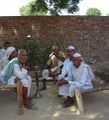
A Jat Chaupal in Uttar Pradesh

Jat Chaupal in Rajasthan

Ghud Chadhi ceremony of Jat marriage

Rajasthani woman's dress, Pomachā and khārā ghāgharā
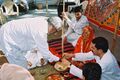
The ceremony of 'Manda Ropana' on the marriage ceremony at bride's house
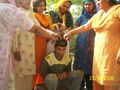
The ceremony of 'Haldi Rasm' on the marriage ceremony at bridegroom's house

The ceremony of 'Jhol Ghalna' on the marriage ceremony at bride's house
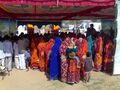
Jat women in tradional dress performing bhāt ceremony

Jat women performing 'Chak Poojana' ceremony, at both bride and bridegroom's houses

Toran ceremony

Neem jhunwari ceremony

Thapa lagana ceremony after sat fere


The Jat people's lifestyle was designed to foster a martial spirit.[243] Whenever they lost their kingdoms, Jat people retired to the country-side and became landed barons and the landlords with their swords girded round their waists.[244] They would draw the sword out of the scabbard at the command of their panchayat to fight with the invaders. Jat people have a history of being brave and ready fighters.[245] They are fiercely independent in character and value their self respect more than anything, which is why they offered heavy resistance against any foreign force that treated them unjustly. [246] They are known for their pride, bravery and readyness to sacrifice their lives in battle for their people and kinsmen.[247] In the government of their villages, they appear much more democratic. they have less reverence for hereditary right and a preference for elected headmen.[248]
Jat People Organizations
Main article: Jat Organizations Main article: Khap
The Jats have always organized themselves into hundreds of patrilineage clans, Panchayat system or Khap. A clan was based on one small gotra or a number of related gotras under one elected leader whose word was law. [249]The big Jat clans now are so big that individual in them are only related to each other by individual that lived typically hundreds years ago. Mutual quarrels of any intensity could be settled by orders of Jat elders. In times of danger, the whole clan rallied under the banner of the leader. The Jat Khap or Panchayat "system is territorial and highly democratic. District and a number of Khaps form a 'Sarva Khap' embracing a full province or state. Negotiations with anyone were done - at 'Sarva Khap' level.
In addition to the conventional Sarva Khap Panchayat, there are regional Jat Mahasabhas affiliated to the All India Jat Mahasabha to organize and safeguard the interests of the community, which held its meeting at regional and national levels to take stock of their activities and devise practical ways and means for the amelioration of the community.[250]
Social customs of Jat People
Main article: Jat social customs

All Jats, irrespective of their official or financial positions in life, have equal social status (except the royal family of Patiala who are Sidhu/Bhatti Rajput in origin).
The only criterion of superiority is age. The Jat people are ethnically and culturally required to MUST marry within their community. With the advancement of modern civilization, as people are becoming less dependent upon and more tolerant towards each other, the joint family system is going out of vogue. It is still prevalent in the less advanced areas
Religion
Main article: Jat Religions
Jat people follower many religions, these include Islam, Hinduism and Sikhism. Jat Hindus only believe in that they are a ethnic group and race. All DNA studies confirm this.
Jat Sikhs and Jat Muslims believe they are a ethnic group and race. If a Jat does not follow a religion and is atheist then the Jat is also a ethnic group and race. All DNA studies confirm this.
Language
Main article: Jat languages
Jat people usually speak Punjabi, Hindi, Rajasthani, Haryanvi, Malvi and Sindhi or Gujarati. Jat people who following Sikhism or Islam as a religion mostly speak Punjabi and its various dialects (such as Maajhi, Malwi, Doabi, Seraiki, Pothohari, and Jhangochi).
List of Jat People Clans
Main article: Jat clans
The Jat people clan names are unique in South Asia. However, some of their clan names do overlap with the Rajputs and Gujars.[251] List of Jat Clans have been compiled by many Jat historians like Ompal Singh Tugania,[252] Bhaleram Beniwal[253][254] Dr Mahendra Singh Arya and others,[255] Thakur Deshraj,[256] Dilip Singh Ahlawat,[257] Ram Swarup Joon[258] etc. The above lists have more than 2700 Jat gotras. Thakur Deshraj, Ram Swarup Joon and Dilip Singh Ahlawat have mentioned history of some of Jat gotras. Some websites of Jats have also prepared list of Jat Gotras with details of history and distriburion.[259]
Famous Jat People
Main article: List of famous Jat people
The Jats have produced famous personalities in all the fields of life such as Rajas, Politicians, Generals, Administrators, Actors, Freedom fighters, Reformers, Technocrats, Players, Industrialists and Businessmen.
Jat people in films & popular culture

There are many proverbs about Jat people in literature:
- Zameen Jatt di maa hundi hai (The land is the Jat’s mother).
- When a Jat goes wild, only God himself, can stop him.
- When a Jat gets angry, run 3 miles and then run 2 more.
- Jat people have a volatile temper.
- A Jat is most happy when he's fighting or making money, preferably both at the same time.
- A Jat will shoot first and ask questions later.
- Lahore da shaukeen bojje vicch gajran (Indulgent man of Lahore carrying carrots in his pockets).
- Kheti khasman seti (Farming depends on the owner who trusts personal supervision).
- Jat marā jab jāniye jab chālisa hoy. (Consider a Jat dead only after forty days of his death).
- Pagadi sambhāl jattā. (Hold the turban O Jat !). A slogan given to save the honour of Jats.
- Jat people are computer characters (Jat Lancer) in the computer game Age of Empires III: The Asian Dynasties.[260]
- Maula Jat is one of the most popular films in the history of Pakistani cinema. It has been described as a kind of Pakistani/Western style movie, the story mostly revolves around the clashes between Maula Jat.[261]
- Many Punjabi songs are written around evey day life of Jat people.
- The 1975 Hindi film Pratigya had a popular song Main Jat Yamla Pagla shot on Dharmendra a Jat himself and acted as a Jat person role in the film.[262]
- Ghulami (1985), Indian Hindi movie by Dharmendra, focuses on the caste and feudal system in Rajasthan and a rebellion started by Dharmendra, as a Jat youth, against the Jagirdars.
- Veer Tejaji is a Rajasthani language movie, based on the life of Tejaji, made in the 1980’s. It shows the life of Jats and their position in the society in eleventh century.
- Heer Ranjha is one of the four popular tragic romances of the Punjab. It tells the story of the love of Heer and her lover Ranjha.Heer Saleti is an extremely beautiful woman, born into a wealthy Jat family of the Sial clan. Ranjha (whose first name is Dheedo; Ranjha is the surname), also a Jat, is the youngest of four brothers and lives in the village 'Takht Hazara' by the river Chenab.
Photo Gallery
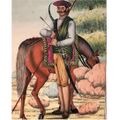
A Sepoy at ease Lucknow, C1850. Watercolor on English paper . Inscribed-"and Indian from the Jat Tribe. and the Tribe has invented this type of dress and attire. Credit:- Arts of Hindustan.

See also
- Categories of Jats
- Indian History Time Line
- Indo-Scythian origin of Jats
- Indo-Aryan origin of Jats
- Jat Belt
- Jat Regiment
- List of Events in Jat History
- Migration of Jats
References
- ↑ Jat people Ethnic Code: CNN25 - Joshua Project
- ↑ Calvin Kephart, Races of Mankind (Their Origin and Migration), Peter Owen Ltd., London, 1961
- ↑ Calvin Kephart, Races of Mankind (Their Origin and Migration), Peter Owen Ltd., London, 1961
- ↑ Surjit Mansingh, Historical Dictionary of India, Vision Books, 1998, pp. 203-204. ISBN 8170943094.
- ↑ Sir Herbert Risley: The People of India
- ↑ Mahil, Ujagir Singh (1954). Antiquity of Jat race. Atma Ram.
- ↑ James Todd, Annals and Antiquities of Rajasthan, Volume I,: Chapter 7 Catalogue of the Thirty Six Royal Races, pp. 127-131
- ↑ Bhim Singh Dahiya, Jats the Ancient Rulers, Dahinam Publishers, Sonepat, Haryana.
- ↑ Sir Herbert Risley: The People of India
- ↑ History of Medieval India - Vaidya
- ↑ James Todd, Annals and Antiquities of Rajasthan, Volume I,: Chapter 7 Catalogue of the Thirty Six Royal Races,pp.127
- ↑ Tod.II.256
- ↑ THE KIPLING SOCIETY
- ↑ Historical Evidence Chapter 1:Scythic Origin of the Rajput Race by Mulchand Chauhan
- ↑ Dr Mohan Lal Gupta:Rajasthan Jñānkosh, Rajasthani Granthagar, Jodhpur, 2008, ISBN 81-86103-05-8, p.244
- ↑ History and study of the Jats. Professor B. S. Dhillon, year=1994, Beta Publishers, ISBN 1895603021
- ↑ Jat people Ethnic Code: CNN25 - Joshua Project
- ↑ Calvin Kephart, Races of Mankind (Their Origin and Migration), Peter Owen Ltd., London, 1961
- ↑ The Jats - Their Origin, Antiquity and Migration. 1993, ISBN 81-85253-22-8
- ↑ History of the Jatt Clans - H.S. Duleh.
- ↑ Minnesota's Jat connection The Economic Times, October 25, 2007]
- ↑ Army's Jat Regiment Best Marching Contingent in Republic Day 2007 Parade | India Defence
- ↑ The Jat Regiment.
- ↑ Haryana Online
- ↑ History of Punjab politics: Jats do it!
- ↑ Kalika Ranjan Qanungo: History of the Jats, Delhi 2003. Edited and annotated by Dr Vir Singh
- ↑ History and study of the Jats. Professor B. S. Dhillon, year=1994, Beta Publishers, ISBN 1895603021
- ↑ The People of Asia by Gordon T. Bowles. Weidenfeld and Nicolson, London. 1977, p. 158.
- ↑ Census of India 1931, Vol.I, Pt.2; Delhi:1933.Encly. Brit. Vol.12, 1968 Jats, p.969
- ↑ Dr. Sukhbir Singh q. in "Suraj Sujan", August, September and October Issuies, 1990, Maharaja Suraj Mal Sansthan, C-4, Janakpuri, New Delhi.
- ↑ Hukum Singh Pawar (Pauria):The Jats - Their Origin, Antiquity and Migration. 1993, ISBN 81-85253-22-8
- ↑ http://www.india-defence.com/reports/2849.
- ↑ http://www.bharat-rakshak.com/MONITOR/ISSUE3-4/bajwa.html .
- ↑ http://www.india-defence.com/reports/2849.
- ↑ Glossary of the tribes the Punjab and NWFP, H A Rose
- ↑ History of Punjab politics: Jats do it!
- ↑ History of the Jatt Clans - Dr H.S Duleh.
- ↑ Haryana Online
- ↑ Prof. B.S. Dhillon: History and Study of the Jats,ISBN: 1895603021
- ↑ YHRD - Y Chromosome Haplotype Reference Database.
- ↑ [1]
- ↑ Ernest Binfield Havell (1918). The history of Aryan rule in India. Harrap. p. 32.
- ↑ Qanungo: History of the Jats
- ↑ Chintaman Vinayak Vaidya: History of Medieval Hindu India
- ↑ Risley, Herbert; Crooke, William. Crooke, William. ed. The people of India (2, reprint ed.). Asian Educational Services. p. 33. ISBN 81-206-1265-5.
- ↑ Thakur Deshraj: Jat Itihasa
- ↑ Dr Natthan Singh: Jat - Itihas (Hindi), Jat Samaj Kalyan Parishad Gwalior, 2004 (Page 38)
- ↑ Mangal Sen Jindal: History of Origin of Some Clans in India
- ↑ Dr Natthan Singh: Jat - Itihas (Hindi), Jat Samaj Kalyan Parishad Gwalior, 2004 (Page 9)
- ↑ Chintaman Vinayak Vaidya: Mahabharata a criticizm, Bombay 1904 (Page 55-78)
- ↑ Hukum Singh Panwar:The Jats:Their Origin, Antiquity and Migrations, p.181
- ↑ Dr Natthan Singh: Jat - Itihas (Hindi), Jat Samaj Kalyan Parishad Gwalior, 2004 (Page 38)
- ↑ Thakur Deshraj: Jat Itihasa, Page 64
- ↑ Shanti Parva Mahabharata Book XII Chapter 82
- ↑ ठाकुर गंगासिंह: "जाट शब्द का उदय कब और कैसे", जाट-वीर स्मारिका, ग्वालियर, 1992, पृ. 6
- ↑ किशोरी लाल फौजदार: "महाभारत कालीन जाट वंश", जाट समाज, आगरा, जुलाई 1995, पृ 7
- ↑ Thakur Deshraj: Jat Itihas, Delhi, 1992, p. 30
- ↑ Maheswari Prasad: The Jats — Their role & contribution to the socio-economic life and polity of North & North-West India, Vol. I, ed. Dr. Vir Singh, ISBN 81-88629-17-0.
- ↑ Dr. Prakash Chandra Chandawat: Maharaja Suraj Mal aur unka yug, Jaypal Agencies Agra, 1982
- ↑ UN Sharma :Jaton ka Navin Itihas
- ↑ Kudryavtsev, Mikhail Konstantinovich (1964). On the Role of Jats in Northern India's Ethnic History.
- ↑ Tod, J., (Lt. Col.), Annals and Antiquities of Rajasthan, Vol.1, Routledge & Kegan Paul Ltd., London, 1972 (reprint), first published in 1829, pp. 623.
- ↑ Sir Alexander Cunningham, (Sir, Major-General, and former Director-General of the Archeological Survey of India), Coins of the Indo-Scythians, Sakas, and Kushans, Indological Book House, Varanasi, India, 1971, first published in 1888, pp. 33.
- ↑ Sir Alexander Cunningham, (Sir, Major-General, and former Director-General of the Archeological Survey of India), Coins of the Indo-Scythians, Sakas, and Kushans, Indological Book House, Varanasi, India, 1971, first published in 1888, pp. 33.
- ↑ Rose, H.A., A Glossary of the Tribes and Castes of the Punjab and North-West Frontier Province, Reprinted by the Languages Dept., Patiala, Punjab, 1970, first published in 1883, pp. 362-363, (Vol. II), 58 (Vol. I).
- ↑ Alexander Cunningham, The Ancient Geography of India: The Buddhist Period, Including the Campaigns of Alexander, and the Travels of Hwen-Thsang (1871), pp. 290-291.
- ↑ Fuchs, Stephen (1973). The Aboriginal Tribes of India (1st ed.). Macmillan Publishers (Holtzbrinck Publishing Group). p. 129. ISBN 0333900227, 9780333900222.
- ↑ Author: Наталья Романовна Гусева (1994). Book: Индия в зеркале веков: религия, быт, культура. Publisher: Российская академия наук, Ин-т этнологии и антропологии им. Н.Н. Миклухо-Маклая. Page: 49. Quote: " Саки были тем этногенетическим пластом, на основе которого сформировались джаты, составляющие и в наше время подавляющую маооу населения Пенджаба. "
- ↑ Sir Alexander Cunningham, (Sir, Major-General, and former Director-General of the Archeological Survey of India), Coins of the Indo-Scythians, Sakas, and Kushans, Indological Book House, Varanasi, India, 1971, first published in 1888, pp. 33.
- ↑ Dahiya, B.S., Jats: The Ancient Rulers, Sterling Publishers Pvt. Ltd., New Delhi, India, 1980, pp. 23.
- ↑ Sir John Marshall, (Sir, Hon. Fellow of King's College, Cambridge University, and formerly Director-General of Archaeology in India), A Guide to Taxila, Cambridge University Press, London, 1960, pp. 24.
- ↑ Barstow, A. E., The Sikhs: An Ethnology, Reprinted by B.R. Publishing Corporation, Delhi, India, 1985, first published in 1928, pp. 105-135, 63, 155, 152, 145.
- ↑ Bingley, A. H., Handbooks for the Indian Army: Sikhs, Compiled Under the Orders of the Government of India, Printed at the Government Central Printing Office, Simla, India, 1899, pp. 8-9, 3.
- ↑ Professor J. Pettigrew, Robber Noblemen: A Study of the Political System of the Sikh Jats, Routledge & Kegan Paul Ltd., London, 1975, pp. 25, 238.
- ↑ Professor H. S. Willliams, The Historians' History of the World, 21 Vols., The Outlook Company, New York, 1905, Vol. 2, pp. 481.
- ↑ Professor P. S. Gill, Heritage of Sikh Culture, New Academic Publishing Co., Jullundur, Punjab, 1975, pp. 12-13.
- ↑ Professor T. Sulimirski, The Sarmatians, Praeger Publishers, New York, 1970, pp. 113-114.
- ↑ Rose, H. A., A Glossary of the Tribes and Castes of the Punjab and North-West Frontier Province, Reprinted by the Languages Dept., Patiala, Punjab, 1970, first published in 1883, pp. 362-363, (Vol. II), 58 (Vol. I).
- ↑ Sir H. M. Elliot, Encyclopaedia of Caste, Customs, Rites and Superstitions of the Races of Northern India, Vol. 1, Reprinted by Sumit Publications, Delhi, 1985, first published in 1870, pp. 133-134.
- ↑ Sara, I., The Scythian Origins of the Sikh-Jat, The Sikh Review, March 1978, pp. 26-35.
- ↑ Elphinstone, M. (Hon.), The History of India, Reprinted by Kitab Mahal Private Ltd., Allahabad, India, 1966, first published in 1874, pp. 226-229, 16-17, 12.
- ↑ Mahil, U. S., Antiquity of Jat Race, Atma Ram & Sons, Delhi, India, 1955, pp. 2, 9,14.
- ↑ Hewitt, J. F., The Ruling Races of Prehistoric Times in India, South-Western Asia and Southern Europe, Archibald Constable & Co., London, 1894, pp. 481-487.
- ↑ MacMunn, G. (Sir and Lt. General), The Martial Races of India, Reprinted by Mittal Publications, Delhi, India, 1979, first published in 1932, pp. 21-22.
- ↑ Latif, S. M., History of the Panjab, Reprinted by Progressive Books, Lahore, Pakistan, 1984, first published in 1891, pp. 56.
- ↑ Dr. Singh, G., A History of the Sikh People (1469-1978), World Sikh University Press, Delhi, India, 1979, pp. 11-12.
- ↑ Singh, N., Canadian Sikhs, Canadian Sikhs' Studies Institute, 21 Jay Avenue, Nepean, Ontario, Canada, 1994, pp. 164.
- ↑ Shrava, Satya (1981). The Sakas in India. New Delhi: Pranava Prakashan, 1981.
- ↑ Nijjar, B. S. (2008). Origins And History Of Jats And Other Allied Nomadic Tribes Of India. Atlantic Publishers & Dist. ISBN 8126909080, 9788126909087.
- ↑ Hooja, Rima (2006). A History of Rajasthan. Rupa Publications, India. p. 431. ISBN 8129108909, 9788129108906.
- ↑ Cunningham, Arch. Survey Reports, II, 54 ff.
- ↑ Collins, Steven M. (2005). Israel's Tribes Today (illustrated ed.). Book 4 of Lost tribes of Israel, Steven M. Collins.Bible Blessings. ISBN 0972584935, 9780972584937.
- ↑ Israel's Tribes Today - The Two Houses of Israel Information Center
- ↑ Rishi, Weer Rajendra (1982). India & Russia: linguistic & cultural affinity. Roma Publications. p. 95.
- ↑ Rishi, Weer Rajendra (1982). India & Russia: linguistic & cultural affinity. Roma Publications. p. 95. "Some of the Indian writers including Rahul Sankrityayan and Ujagar Singh Mahil in his book "Antiquity of Jat Race" say that Jats inhabiting the northern India are the descendants of Massagetae, or Malta (great) Getae or Jat."
- ↑ Toynbee, Arnold Joseph (1939). A Study of History. Volume 2. London: Oxford University Press. p. 435.
- ↑ Royal Institute of International Affairs; Toynbee, Arnold Joseph (1962). A Study of History (2 ed.). Volume 10. Oxford University Press. p. 54.
- ↑ Rawlinson, George (1873). The sixth great Oriental monarchy: or, The geography, history, & antiquities of Parthia. Longmans, Green, and co. p. 118
- ↑ Rawlinson, George (1893). The story of Parthia. G. P. Putnam's sons. p. 110.
- ↑ Rawlinson, George (2004). The Seven Great Monarchies of the Ancient Eastern World (2, illustrated ed.). Volume 3 of The Seven Great Monarchies of the Ancient Eastern World, Or: The History, Geography and Antiquities of Chaldaea, Assyria, Babylon, Media, Persia, Parthia, and Sassanian, Or the New Persian Empire, George Rawlinson. Gorgias Press LLC. p. 66. ISBN 1593331711, 9781593331719.
- ↑ Rawlinson, George (2007). Parthia. Cosimo, Inc. p. 110. ISBN 160206136X.
- ↑ Rawlinson, George (2010). The Seven Great Monarchies of the Ancient Eastern World: Or, The History, Geography and Antiquities of Chaldæa, Assyria, Babylon, Media, Persia, Parthia, and Sassanian Or New Persian Empire. Volume 3. Nottingham Society. p. 66.
- ↑ Rawlinson, George (2012). The Seven Great Monarchies Of The Ancient Eastern World, Vol 6. (of 7): Parthia The History, Geography, And Antiquities Of Chaldaea, Assyria, Babylon, Media, Persia, Parthia, And Sassanian or New Persian Empire, With Maps and Illustrations. Tredition. ISBN 3847205145, 9783847205142.
- ↑ Burton, Richard Francis (Sir) (2008). The Book of the Sword. Cosimo, Inc. p. 90. ISBN 1605204366, 9781605204369.
- ↑ YHRD - Y Chromosome Haplotype Reference Database
- ↑ YHRD - Y Chromosome Haplotype Reference Database
- ↑ YHRD - Y Chromosome Haplotype Reference Database
- ↑ YHRD - Y Chromosome Haplotype Reference Database
- ↑ YHRD - Y Chromosome Haplotype Reference Database
- ↑ YHRD - Y Chromosome Haplotype Reference Database
- ↑ YHRD - Y Chromosome Haplotype Reference Database
- ↑ Y-STR Haplogroup Diversity in the Jat Population Reveals Several Different Ancient Origins
- ↑ Author: Razib Khan. Article: What the Harappa Ancestry Project has resolved. Magazine: Discover Magazine. Published: 04 August 2013.
- ↑ The Geats of Beowulf by J. A. Leake, Published 1967, Pages 68, 172, ISBN 029904050
- ↑ History and study of the Jats by B. S. Dhillon, Published 1994, ISBN 1895603021
- ↑ Sir John Marshall, (Sir, Hon. Fellow of King's College, Cambridge University, and formerly Director-General of Archaeology in India), A Guide to Taxila, Cambridge University Press, London, 1960, pp. 24.
- ↑ Hewitt, J.F., The Ruling Races of Prehistoric Times in India, South-Western Asia and Southern Europe, Archibald Constable & Co., London, 1894, pp. 481-487.
- ↑ Latif, S.M., History of the Panjab, Reprinted by Progressive Books, Lahore, Pakistan, 1984, first published in 1891, pp. 56.
- ↑ Sir Alexander Cunningham, (Sir, Major-General, and former Director-General of the Archeological Survey of India), Coins of the Indo-Scythians, Sakas, and Kushans, Indological Book House, Varanasi, India, 1971, first published in 1888, pp. 33.
- ↑ Sir John Marshall, (Sir, Hon. Fellow of King's College, Cambridge University, and formerly Director-General of Archaeology in India), A Guide to Taxila, Cambridge University Press, London, 1960, pp. 24.
- ↑ Latif, S.M., History of the Panjab, Reprinted by Progressive Books, Lahore, Pakistan, 1984, first published in 1891, pp. 56.
- ↑ Hewitt, J.F., The Ruling Races of Prehistoric Times in India, South-Western Asia and Southern Europe, Archibald Constable & Co., London, 1894, pp. 481-487.
- ↑ Dahiya, B.S., Jats: The Ancient Rulers, Sterling Publishers Pvt. Ltd., New Delhi, India, 1980, pp. 23.
- ↑ Sir H.M. Elliot, Encyclopaedia of Caste, Customs, Rites and Superstitions of the Races of Northern India, Vol. 1, Reprinted by Sumit Publications, Delhi, 1985, first published in 1870, pp. 133-134.
- ↑ Tod, J., (Lt. Col.), Annals and Antiquities of Rajasthan, Vol.1, Routledge & Kegan Paul Ltd., London, 1972 (reprint), first published in 1829, pp. 623.
- ↑ Barstow, A.E., The Sikhs: An Ethnology, Reprinted by B.R. Publishing Corporation, Delhi, India, 1985, first published in 1928, pp. 105-135, 63, 155, 152, 145.
- ↑ Bingley, A.H., Handbooks for the Indian Army: Sikhs, Compiled Under the Orders of the Government of India, Printed at the Government Central Printing Office, Simla, India, 1899, pp. 8-9, 3.
- ↑ Rose, H.A., A Glossary of the Tribes and Castes of the Punjab and North-West Frontier Province, Reprinted by the Languages Dept., Patiala, Punjab, 1970, first published in 1883, pp. 362-363, (Vol. II), 58 (Vol. I).
- ↑ Mahil, U.S., Antiquity of Jat Race, Atma Ram & Sons, Delhi, India, 1955, pp. 2, 9,14.
- ↑ Sara, I., The Scythian Origins of the Sikh-Jat, The Sikh Review, March 1978, pp. 26-35.
- ↑ Singh, G., A History of the Sikh People (1469-1978), World Sikh University Press, Delhi, India, 1979, pp. 11-12.
- ↑ Singh, N., Canadian Sikhs, Canadian Sikhs' Studies Institute, 21 Jay Avenue, Nepean, Ontario, Canada, 1994, pp. 164.
- ↑ Bhim Singh Dahiya, Jats the Ancient Rulers, Dahinam Publishers, Sonepat, Haryana.
- ↑ Thakur Deshraj: Jat Ithas, Delhi, 1992, pp. 96, 101
- ↑ Thakur Deshraj: Jat Ithas, Delhi, 1992, pp. 30
- ↑ Bhim Singh Dahiya, Aryan Tribes and the Rig Veda, Dahinam Publishers, 16 B Sujan Singh Park, Sonepat, Haryana,India,1991
- ↑ Dr Mahendra Singh Arya, Dharmpal Singh Dudi, Kishan Singh Faujdar & Vijendra Singh Narwar: Ādhunik Jat Itihasa (The modern history of Jats), Agra 1998, Page-1
- ↑ CV Vaidya, History of Medieval Hindu India
- ↑ Bijayagadh Stone Pillar Inscription of Vishnuvardhana
- ↑ Mandasor Pillar Inscription of Yashodharman
- ↑ Bhim Singh Dahiya: Jats the Ancient Rulers (A clan study)/The Jats, p. 25
- ↑ Natural History by Pliny Book VI/Chapter 19
- ↑ The Mauryas: Their Identity, Vishveshvaranand Indological Journal, Vol. (1979), p.112-133.- by B.S. Dehiya.
- ↑ Bhim Singh Dahiya, Jats, The Ancient Rulers
- ↑ Dr Natthan Singh: Jat - Itihas (Hindi), Jat Samaj Kalyan Parishad Gwalior, 2004, Pages-111,113,116
- ↑ Ram Swarup Joon: History of the Jats, Rohtak, India (1938, 1967
- ↑ A K Mittal, 'Political and Cultural history of India', page 126
- ↑ Rahul Sankrityan, 'Bauddha darshan', page 19
- ↑ Dr Atul Singh Khokhar, 'Jāton kī utpati evaṃ vistār (Jart tarangiṇī)(Origin and expansion of Jats), page 113
- ↑ , Bhaleram Beniwal: Jāt Yodhāon ke Balidān, Jaypal Agencies, Agra 2005, Pages 68-72
- ↑ Jatt-Saka Empires of Ancient India
- ↑ Bird’s Eye View of Jatt History
- ↑ The Mauryas: Their Identity, Vishveshvaranand Indological Journal, Vol. (1979), p.112-133.- by B.S. Dehiya.
- ↑ Bhim Singh Dahiya, Jats, The Ancient Rulers
- ↑ Dr Natthan Singh: Jat - Itihas (Hindi), Jat Samaj Kalyan Parishad Gwalior, 2004, Pages-111,113,116
- ↑ Ram Swarup Joon: History of the Jats, Rohtak, India (1938, 1967
- ↑ A K Mittal, 'Political and Cultural history of India', page 126
- ↑ Rahul Sankrityan, 'Bauddha darshan', page 19
- ↑ Dr Atul Singh Khokhar, 'Jāton kī utpati evaṃ vistār (Jart tarangiṇī)(Origin and expansion of Jats), page 113
- ↑ , Bhaleram Beniwal: Jāt Yodhāon ke Balidān, Jaypal Agencies, Agra 2005, Pages 68-72
- ↑ Jatt-Saka Empires of Ancient India
- ↑ Bird’s Eye View of Jatt History
- ↑ K P Jayaswal, 'An Imperial history of India C 700 BC – C 770 AD'
- ↑ Bhim Singh Dahiya, Jats, The Ancient Rulers
- ↑ Ram Swarup Joon: History of the Jats, Rohtak, India (1938, 1967
- ↑ , Bhaleram Beniwal: Jāt Yodhāon ke Balidān, Jaypal Agencies, Agra 2005, Pages 81-86
- ↑ Jatt-Saka Empires of Ancient India
- ↑ K P Jayaswal,An Imperial history of India C 700 BC – C 770 AD
- ↑ Bhim Singh Dahiya, Jats, The Ancient Rulers
- ↑ Ram Swarup Joon: History of the Jats, Rohtak, India (1938, 1967
- ↑ , Bhaleram Beniwal: Jāt Yodhāon ke Balidān, Jaypal Agencies, Agra 2005, Pages 81-86
- ↑ Jatt-Saka Empires of Ancient India
- ↑ Bhim Singh Dahiya, Jats, The Ancient Rulers
- ↑ , Bhaleram Beniwal: Jāt Yodhāon ke Balidān, Jaypal Agencies, Agra 2005, Pages 79-81, 110
- ↑ CV Vaidya, History of Medieval Hindu India
- ↑ Fleet, John F. Corpus Inscriptionum Indicarum: Inscriptions of the Early Guptas. Vol. III. Calcutta: Government of India, Central Publications Branch, 1888, 254
- ↑ Thakur Deshraj: Jat Itihas (Hindi), Maharaja Suraj Mal Smarak Shiksha Sansthan, Delhi, 1934, 2nd edition 1992 (Page 707)
- ↑ Bijayagadh Stone Pillar Inscription of Vishnuvardhana
- ↑ Bhim Singh Dahiya, Jats, the Ancient Rulers, A clan study in the Pre Islamic period, 1982, Sterling Publishers New Delhi
- ↑ Thakur Deshraj, Jat Itihas (Hindi), Maharaja Suraj Mal Smarak Shiksha Sansthan, Delhi, 1934, 2nd edition 1992 page 87-88
- ↑ Dilip Singh Ahlawat, Jat Viron Ka Itihas
- ↑ , Bhaleram Beniwal: Jāt Yodhāon ke Balidān, Jaypal Agencies, Agra 2005, P. 100
- ↑ Maheswari Prasad, Jats in Ancient India,Jats, I, Ed. Dr Vir Singh, 2004, p. 21
- ↑ G.C.Dwivedi, The Jats, Their role in the Mughal Empire, Ed. Dr Vir Singh, Delhi, 2003, p. 7
- ↑ Qanungo, Jats,30
- ↑ G.C.Dwivedi, The Jats, Their role in the Mughal Empire, Ed. Dr Vir Singh, Delhi, 2003, p.11-12
- ↑ Dr. Ajay Kumar Agnihotri (1985) : "Gohad ke jaton ka Itihas" (Hindi), p.63
- ↑ Dr. Ajay Kumar Agnihotri (1985) : "Gohad ke jaton ka Itihas" (Hindi), p.71
- ↑ Dr. Ajay Kumar Agnihotri (1985) : "Gohad ke jaton ka Itihas" (Hindi)
- ↑ Preface by Ram Niwas Mirdha in G.C. Dwivedi’s, The Jats, Their role in the Mughal Empire, Ed. Dr Vir Singh, Delhi, 2003
- ↑ Qanungo, Jats,30], [G.C.Dwivedi, The Jatts, Their role in the Mughal Empire, Ed. Dr Vir Singh, Delhi, 2003, p.11-12
- ↑ G.C.Dwivedi, The Jats, Their role in the Mughal Empire, Ed. Dr Vir Singh, Delhi, 2003, p.55-56
- ↑ Girish Chandra Dwivedi, The Jats – Their role in the Mughal empire, Ed by Dr Vir Singh. Delhi, 2003, p. 15
- ↑ J.N.Sarkar, History of Auranzeb (Calcutta): 1912, I, Introduction, XI-XIII
- ↑ F.X. Wendel, Memoires des Jats, 10
- ↑ J.N. Sarkar, History of Auranzeb (Calcutta): 1912, I, Introduction, XXVIII f.
- ↑ Girish Chandra Dwivedi, The Jats – Their role in the Mughal empire, Ed by Dr Vir Singh. Delhi, 2003, p. 15
- ↑ K.R. Qanungo, History of Jats (Calcutta: 1925), p. 34
- ↑ U.N.Sharma, Itihas, p.88
- ↑ Thakur Deshraj, Jat Itihas, p. 629
- ↑ Girish Chandra Dwivedi, The Jats – Their role in the Mughal empire, Ed by Dr Vir Singh. Delhi, 2003, p. 15
- ↑ Girish Chandra Dwivedi, The Jats – Their role in the Mughal empire, Ed by Dr Vir Singh. Delhi, 2003, p. 25
- ↑ Bingley, Sikhs, p. 12
- ↑ G.C.Dwivedi: The Jats, Their role in the Mughal Empire, Ed Dr Vir Singh, 2003, p.55
- ↑ Siyar IV, p. 28
- ↑ K.R. Qanungo, History of the Jats, Ed. Dr Vir Singh, Delhi, 2003, p. 97
- ↑ History of the Jatt Clans - Dr H.S Duleh.
- ↑ Historical Sikh Events: Phulkian Misl
- ↑ Dr Mahendra Singh Arya, Dharmpal Singh Dudi, Kishan Singh Faujdar & Vijendra Singh Narwar: Ādhunik Jat Itihasa (The modern history of Jats), Agra 1998
- ↑ History of the Jatt Clans - Dr H.S Duleh.
- ↑ Dr Mahendra Singh Arya, Dharmpal Singh Dudi, Kishan Singh Faujdar & Vijendra Singh Narwar: Ādhunik Jat Itihasa (The modern history of Jats), Agra 1998
- ↑ Genealogy of the ruling chiefs of Nabha
- ↑ History of the Jatt Clans - Dr H.S Duleh.
- ↑ Dr Mahendra Singh Arya, Dharmpal Singh Dudi, Kishan Singh Faujdar & Vijendra Singh Narwar: Ādhunik Jat Itihasa (The modern history of Jats), Agra 1998
- ↑ History of the Jatt Clans - H.S Duleh (Translation from original Punjabi work "Jattan da Itihas" by Gurjant Singh).
- ↑ Dr. Prakash Chandra Chandawat: Maharaja Suraj Mal aur unka yug, Jaypal Agencies Agra, 1982, Pages 197-200
- ↑ Agra Gazeteer 1884, page 620
- ↑ Jatbandhu Agra, 25 January 2005
- ↑ Mujmat ut-Tawarikh, Ed. Vol.I
- ↑ Dr S.Jabir Raza, The Jats - Their Role and Contribution to the Socio-Economic Life and Polity of North and North West India. Vol I, 2004, Ed Dr Vir Singh
- ↑ Dr S.M. Yunus Jaffery:The Jats - Their Role and Contribution to the Socio-Economic Life and Polity of North and North West India, Vol.I, 2004. Page 36-37, Ed. by Dr Vir Singh, Publisher - M/S Originals (an imprint of low priced publications), A-6, Nimri commercial Centre, Near Ashok Vihar, Phase-IV, Delhi-110052
- ↑ Farhang-e-Namha-ye-Shah Nama, compiled by Dr Mansur RastgarFasayi, Published by Moassea-e-Motaleat o Thqiqat-e-Farhangi, Tehran 1370 AH/1991 AD, pages 1090-1094
- ↑ Dr S.M. Yunus Jaffery:The Jats - Their Role and Contribution to the Socio-Economic Life and Polity of North and North West India, Vol.I, 2004. Page 36-37, Ed. by Dr Vir Singh, Publisher - M/S Originals (an imprint of low priced publications), A-6, Nimri commercial Centre, Near Ashok Vihar, Phase-IV, Delhi-110052.
- ↑ Dr S.M. Yunus Jaffery of Delhi university under the title "The Jat in Shah Nama of Firdowsi" is based on the Persian text of Shah Nama by Abdul Qasim bin Ishaq bin Sharaf Shah Firdowsi Tusi, published by Mohammad Ramazani, Mossisa-e-khavar, Tehran 1310 A.H./1931 AD. Dr S.M. Yunus Jaffery has given English Version as well as Persian versions in his article.
- ↑ K.R.Qanungo, History of the Jats, Ed Dr Vir Singh, Delhi, 2003, p. 16
- ↑ Majmal al-tawarikh in Elliot, I, p. 104-105
- ↑ G.C. Dwivedi, The Jats, Their role in the Mughal Empire, Delhi, Ed Dr Vir Singh, 2003, p. 7
- ↑ Y.P.Shastri, op.cit., p.40-41
- ↑ Dr Ram Swarup Joon, History of the Jats (Eng), 1967, p.14-15
- ↑ Thakur Deshraj, Jat Itihas, 1934, p. 85-86
- ↑ Thakur Deshraj, Jat Itihas (Hindi), Maharaja Suraj Mal Smarak Shiksha Sansthan, Delhi, 1934, 2nd edition 1992 page 87-88.
- ↑ Bhim Singh Dahiya, Aryan Tribes and the Rig Veda, Dahinam Publishers, 16 B Sujan Singh Park, Sonepat, Haryana,India,1991
- ↑ Dr Mahendra Singh Arya, Dharmpal Singh Dudi, Kishan Singh Faujdar & Vijendra Singh Narwar: Ādhunik Jat Itihasa (The modern history of Jats), Agra 1998, Page-1
- ↑ Bhim Singh Dahiya, Aryan Tribes and the Rig Veda, Dahinam Publishers, 16 B Sujan Singh Park, Sonepat, Haryana,India,1991
- ↑ Dr Mahendra Singh Arya, Dharmpal Singh Dudi, Kishan Singh Faujdar & Vijendra Singh Narwar: Ādhunik Jat Itihasa (The modern history of Jats), Agra 1998, Page-1
- ↑ Kings of Kashmira Vol 2 (Rajatarangini of Kalhana)/Book VIII (i) ,p.217
- ↑ K L Sharma:The Jats - Their Role and Contribution to the Socio-Economic Life and Polity of North and North West India, Vol.I, 2004. Ed. by Dr Vir Singh,p.13
- ↑ Central List Of Other Backward Classes: Rajasthan (National Commission for Backward Classes)
- ↑ BBC: Why the Gujjars are so aggrieved, May 31, 2007
- ↑ Central List Of Other Backward Classes: Gujarat(National Commission for Backward Classes)
- ↑ Central List Of Other Backward Classes: Madhya Pradesh (National Commission for Backward Classes)
- ↑ K L Sharma:The Jats - Their Role and Contribution to the Socio-Economic Life and Polity of North and North West India, Vol.I, 2004. Ed. by Dr Vir Singh,p.14
- ↑ Glossary of the tribes and castes of the Punjab and NWFP, H A Rose
- ↑ Professor Kalika Ranjan Qanungo: History of the Jats, Delhi 2003.
- ↑ Professor Kalika Ranjan Qanungo: History of the Jats, Delhi 2003.
- ↑ Professor Kalika Ranjan Qanungo: History of the Jats, Delhi 2003. Edited and annotated by Dr Vir Singh,p.2
- ↑ Mangal sen Jindal (1992): History of Origin of Some Clans in India (with special Reference to Jats), Sarup & Sons, 4378/4B, Ansari Road, Darya Ganj, New Delhi-110002 ISBN 81-85431-08-6, Page-17, 36.
- ↑ Professor Kalika Ranjan Qanungo: History of the Jats, Delhi 2003. Edited and annotated by Dr Vir Singh, p.3
- ↑ Maheswari Prasad:The Jats - Their role & contribution to the socio-economic life and polity of North & North-West India, Vol.I Ed. Dr Vir Singh, ISBN 81-88629-17-0, p.27
- ↑ B.K. Nagla, "Jats of Haryana: A sociplogical Analysis", The Jats, Vol. II, Ed Dr Vir Singh, p.308
- ↑ Marshall, J., (Sir, Hon. Fellow of King's College, Cambridge University, and formerly Director-General of Archaeology in India), A Guide to Taxila, Cambridge University Press, London, 1960, pp. 24.
- ↑ Dr Ompal Singh Tugania: Jat samudāy ke pramukh Ādhār bindu, Jaypal Agencies, Agra 2004
- ↑ Bhaleram Beniwal: Jāton kā Ādikālīn Itihāsa, Jaypal Agencies, Agra 2005.
- ↑ Bhaleram Beniwal: Jāt Yodhaon ke Balidān, Jaypal Agencies, Agra 2005
- ↑ Dr Mahendra Singh Arya, Dharmpal Singh Dudi, Kishan Singh Faujdar & Vijendra Singh Narwar: Ādhunik Jat Itihasa (The modern history of Jats), Agra 1998
- ↑ Thakur Deshraj: Jat Itihasa (Hindi), Maharaja Suraj Mal Smarak Shiksha Sansthan, Delhi, 1934, 2nd
- ↑ Dilip Singh Ahlawat: Jat viron ka Itihasa
- ↑ Ram Swarup Joon: History of the Jats, Rohtak, India (1938, 1967)
- ↑ List of Jat Gotras on Jatland
- ↑ Age of Empires III: The Asian Dynasties
- ↑ The Hot Spot Online
- ↑ [2]
Online Books - Highly recommended Futher Reading
- History of the Jats - On line book on Jatland Wiki by Ram Swarup Joon
- ठाकुर देशराज जाट इतिहास - Online book on Jatland Wiki.
- जाट वीरों का इतिहास - लेखक दलीपसिंह अहलावत- Online book on Jatland Wiki.
- वीरभूमि हरयाणा - लेखक स्वामी ओमानन्द सरस्वती - Online book on Jatland Wiki.
- History and study of the Jats - On line book on Jatland Wiki By Professor B.S Dhillon
Futher Reading
- aa (RigVeda)
- Bamshad, M., T. Kivisild, et al., Genetic evidence on the origins of Indian caste populations Journal: Virus Research, Volume 75 issue 2, Year 2001 Pages 95-106 [3]
- Basu et al., Ethnic India: a genomic view, with special reference to peopling and structure Journal: Genome Research, Volume 13, Year 2003, Pages 2277-2290
- Cann, R., Genetic clues to dispersal in human populations: retracing the past from the present Journal: Science, Volume 291, Year 2001, Pages 1742-1748
- Cordaux, R., R. Aunguer, G. Bentley, I. Nasidze, S.M. Sirajuddin, and M. Stoneking, Independent origins of Indian caste and tribal paternal lineages, Journal: Current Biology, Volume 14, Year 2004, Pages 231-235
- Update on the Aryan Invasion Debate by Koenraad Elst, Published: 1999, ISBN 81-86471-77-4 Book, Article
- Hemphill & Christensen, The Oxus Civilization as a Link between East and West: A Non-Metric Analysis of Bronze Age Bactrain Biological Affinities, Paper read at the South Asia Conference, November 1994, Madison, Wisconsin
- Hemphill, B.E., Lukacs, J.R., and Kennedy, K.A.R., Biological adaptions and affinities of the Bronze Age Harappans, Journal: Harappa Excavations 1986-1990(ed. R.Meadow), Year 1991, Pages 137-182
- In Studies in the Archaeology and Palaeoanthropology of South Asia (Chapter: A Reassessment of the Theories of Racial Origins of the People of the Indus Valley Civilization from Recent Anthropological Data, Pages 99-107) by Kenneth A.R. Kennedy, Published: 1984
- The Indo-Aryans of Ancient South Asia (Chapter: Have Aryans been identified in the prehistoric skeletal record from South Asia?, Pages 49-54) by Kenneth A.R. Kennedy, Published: 1995
- Deep common ancestry of Indian and western-Eurasian mitochondrial DNA lineages by Toomas Kivisild, et al, Published: 1999 [4]
- The Place of the Indian mtDNA Variants in the Global Network of Maternal Lineages and the Peopling of the Old World by Toomas Kivisild, et al, Published: 1999, [5]
- An Indian Ancestry: a Key for Understanding Human Diversity in Europe and Beyond by Toomas Kivisild, et al, Published: 2000 [6]
- The origins of southern and western Eurasian populations: an mtDNA study by Toomas Kivisild, et al, Published: 2000, [7]
- The Genetics of Language and Farming Spread in India, by Toomas Kivisild, et al, Published: 2003 [8]
- The Genetic Heritage of the Earliest Settlers Persists Both in Indian Tribal and Caste Populations by Toomas Kivisild, et al, Published: 2003, [9], [10]
- Where west meets east: the complex mtDNA landscape of the southwest and Central Asian corridor
- The Real Eve: Modern Man's Journey out of Africa by Stephen Oppenheimer, Year 2003 [11]
- Inferring Human History: Clues from Y-Chromosome Haplotype, P Underhill [12]
- The Journey of Man: A Genetic Odyssey by S Wells, Published: 2003
- Excavating Y-chromosome haplotype strata in Anatolia
- Introduction to haplogroups and haplotypes http://www.le.ac.uk/genetics/maj4/SurnamesForWeb.pdf
- High-resolution analysis of Y-chromosomal polymorphisms reveals signatures of population movements from Central Asia and West Asia into India
- The human Y chromosome: an evolutionary marker comes of age|accessdate=2006-04-21
- Minimal Sharing of Y-Chromosome STR Haplotypes Among Five Endogamous Population Groups from Western and Southwestern India
- Negligible Male Gene Flow Across Ethnic Boundaries in India, Revealed by Analysis of Y-Chromosomal DNA Polymorphisms
- Origin, Diffusion, and Differentiation of Y-Chromosome Haplogroups E and J: Inferences on the Neolithization of Europe and Later Migratory Events in the Mediterranean Area
- Written in blood, Journal: New Scientist, Volume 170, Issue 2291, Date 19 May 2001, Pages=17
- Y-Chromosomal DNA Variation in Pakistan
- Phylogeography of Y-Chromosome Haplogroup I Reveals Distinct Domains of Prehistoric Gene Flow in Europe
- Contrasting patterns of Y chromosome variation in Ashkenazi Jewish and host non-Jewish European populations
- Genomic diversities and affinities among four endogamous groups of Punjab (India) based on autosomal and mitochondrial DNA polymorphisms
- A prehistory of Indian Y chromosomes: Evaluating demic diffusion scenarios
- Polarity and Temporality of High-Resolution Y-Chromosome Distributions in India Identify Both Indigenous and Exogenous Expansions and Reveal Minor Genetic Influence of Central Asian Pastoralists
- The Vikings and Baron Dupuytren’s disease
- The Genetic or Mythical Ancestry of Descent Groups: Lessons from the Y Chromosome
- Rattan Singh Bhangoo. Prachin Panth Parkash, Punjabi, Published in 1841.
- Bal Kishan Dabas - Political and Social History of the Jats". Sanjay Prakashan, 2001. ISBN 81-7453-045-2
- Dharampal Singh Dudee - Indian Army History: France to Kargil. 2001.
- Dharampal Singh Dudee - Navin Jat History. Shaheed Dham Trust, Bhiwani, Haryana, India.
- Dr Kanungo - History of the Jats.
- Dr Natthan Singh. Jat-Itihas. Jat Samaj Kalyan Parishad, Gwalior, 2004.
- Hukum Singh Panwar (Pauria) - The Jats:Their Origin, Antiquity and Migrations. Manthan Publications, Rohtak, Haryana. ISBN 81-85235-22-8
- K. Natwar Singh. Maharaja Suraj Mal.
- Dr. Prakash Chandra Chandawat. Maharaja Suraj Mal Aur Unka Yug (1745-1763). Jaypal Agencies, Agra. 1982. (in Hindi)
- (Dr) Raj Pal Singh. Rise of the Jat Power. Harman Pub. House. ISBN 81-85151-05-9
- Adhunik Jat Itihas - Dharmpal Singh Dudee & Dr Mahinder Singh Arya. Jaypal Agency, Agra. 1998.
- Ram Swaroop Joon - History of the Jats.
- Shashi Prabha Gupta. Demographic Differentials Among the Rajputs and the Jats: A Socio-Biological Study of Rural Haryana. Classical Pub. House. ISBN 81-7054-180-8
- Thakur Deshraj:Jat Itihas - Maharaja Suraj Mal Smarak Shiksha Sansthan, Delhi. 1936. (in Hindi)
- Girish Chandra Dwivedi - The Jats - Their Role in the Mughal Empire. Surajmal Educational Society, New Delhi, India. ISBN- 81-7031-150-0.
- Dr. Atal Singh Khokkar. Jaton ki Utpati evam Vistar. Jaipal Agencies, 31-1 Subashpuram, Agra, UP, India 282007. 2002.
- Chaudhary Kabul Singh. Sarv Khap Itihasa (History of the Jat Republic). Shoram, Muzzafarnagar, U.P. India. 1976.
- Nihal Singh Arya. Sarv Khap Panchayat ka Rastriya Parakram (सर्वखाप पंचायत का राष्ट्रीय कार्यक्रम) (The National Role of the Jat Republic of Haryana). Arya mandal, B 11 Om Mandal, Nangloi, New Delhi, India. 1991
- Mangal Sen Jindal. History of Origin of Some Clans in India (with special Reference to Jats). Sarup & Sons, 4378/4B, Ansari Road, Darya Ganj, New Delhi-110002. ISBN 81-85431-08-6
- Dr Vir Singh. The Jats - Their Role and Contribution to the Socio Economic Life and Polity of North and North West India. Surajmal Educational Society, D K Publishers, New Delhi, India. 2004. ISBN 81-88629-16-2
External links
- Y-STR Haplogroup Diversity in the Jat Population Reveals Several Different Ancient Origins David G. Mahal and Ianis G. Matsoukas
- Click here to see: Art of the Scythians
- Click here to read about: The Scythians history on the Sikh road
- Scythians migrations
- Jat Community Online Directory & Monthly Magzine
- JatHistory
- Euroasian Nomads
- Scythic Heritage of Jat/Rajput
- Video on Jats the Ancient Rulers
Back to History