Jat social customs

The social customs of Jats are those of Vedic Aryans. All Jats, irrespective of their official or financial positions in life, have equal social status. The only criterion of superiority is age. The Jats are required to marry within their community. Boys and girls of the same gotra are considered brothers and sisters to each other. It is therefore, prohibited to marry a girl of ones own gotra, of the gotra of ones another, as that would amount to incest. Marriage within the same village is not permitted even if the boy and girl qualify for marriage according to gotra restriction. Marriages within the same Gohand are discouraged. Widow marriage is not only permitted and practiced but is also a social obligation. Widows are looked upon with sympathy and not despised as evil beings as is done amongst Rajputs, Brahmins and Baniyas. The Joint family system was popular among the Jats and large families used to share the same house and hearth. With the advancement of modernity, as people are becoming less dependent upon and less tolerant towards each other, the joint family system is going out of vogue. It is still prevalent in the less advanced areas.
Equal social status
All Jats, irrespective of their official or financial positions in life, have equal social status. The only criterion of superiority is age. If two Jats sit on a bed the elder, even if he is a poor farmer will sit towards the head of the bed, and the younger, even if he is a very well to do, or is a senior civil or military officer, will sit towards the foot of the bed. If a number of Jats are sharing the same 'hooka' it is the duty of the youngest to hold the 'hooka' and pass it around in turn to the others. The system is thus of a very socialistic nature.
Jat marriages

Marriage within community
The Jats are required to marry within their community. This tradition is as par Manusmriti[1] which tells us in chaper 3 shloka 4 that dwija should marry within their caste:
- गुरुणानुमत: स्नात्वा समावृत्तो यथाविधि ।
- उद्वहेत द्विजो भार्यां सवर्णां लक्षणान्विताम् ।।4।।
Meaning - A dwija should marry a girl of same varna (savarna ) after taking permission from the guru, taking bath and performing the samapavartana sanskara (the vedic ritual performed on the return of a disciple to his household after finishing his studies)
A Jat boy marrying a non- Jat girl though not encouraged or approved, is nevertheless acceptable- A Jat girl marrying a non Jat boy is, however, taboo, and, should it happen it is considered a permanent blot of disgrace on the girl's family. Boys and girls of the same gotra are considered brothers and sisters to each other. It is therefore, prohibited to marry a girl of ones own gotra, of the gotra of ones another, as that would amount to incest. Marriage within the same village is not permitted even if the boy and girl qualify for marriage according to gotra restriction. Marriages within the same Gohand are discouraged. [2]
Utility of Gotras in Jat marriages
Manusmṛti or Manusmriti (Sanskrit: मनुस्मृति), also known as Mānava-Dharmaśāstra (Sanskrit: मानवधर्मशास्त्र), is the most important and earliest metrical work of the Dharmaśāstra textual tradition of Hinduism.[3] Sagotra i.e. same gotra marriages are banned under the traditional matrimonial system. According to the Hindu marriage traditions commonality of four gotras of mother, father, father’s mother (dadi) and mother’s mother (nani) are avoided for marriages. This has been advocated necessary for proper health and morality of the society. Manava dharmashastra, chapter-3, shloka-5 mentions that[4]-
अस पिण्डा च या मातुर गोत्रा च या पितुः । as piṇdā ca yā mātura gotrā ca yā pituḥ
सा प्रशस्ता द्विजातीनां दार, कर्माणि मैथुने ।। sā praśastā dvijātīnām dāra, karmāṇi maithune
Meaning – The girl who is not from mother’s clan of six generations and who is not of father’s gotra is suitable for marriage amongst dvijati people (Brahmana, Kshatriya and vaishya). [5]
Satyartha Prakasha by Maharshi Dayanand Saraswati also explains in Chapter IV shloka-4 that The girl who is not from mother’s clan of six generations and who is not of father’s gotra is suitable for marriage:
- असपिण्डा च या मातुरसगोत्रा च या पितुः
- सा प्रशस्ता द्विजातीनां दारकर्मणि मैथुने ।। 4 ।।
Satyartha Prakasha has given eight reasons for not marrying in the same gotra. It also explains why it is useful to marry a girl of far off place.
- दुहिता दुर्हिता दूरेहिता भवतीति ।। निरू. ।।
- In Sanskrit a daughter is called duhitri (from Du - distant, Hit - good), because the marriage of a girl to a man who comes from a distant country or distant part of the same country is productive of good.
The advantages and disadvantages of distant and near marriages respectively are[6]:-
- Any two persons who have, in their childhood, lived near each other, played and quarreled together, loved one another, noticed each other's faults, imperfections, ebullitions of temper and misbehaviors, and perhaps sometimes, even each other undressed, if married to each other, can never love each other to the extent desired.
- The marriage of near relatives does not improve the race from want of interchange of fluids and essences (such as blood) of the body, it rather deteriorates it,. This is analogous to the addition of water to water, no new quality being produced.
- As the addition of sugar and such medicines as ginger, improves the taste and quality of milk, so does the marriage of people, who are not related to each other (either on father's or on mother's side), improve the race.
- As in the case of an invalid, change of climate and diet very often effects a cure, so does marriage with foreigners or distant people improve the health of the parties and prove beneficial in every other respect.
- When the parties are nearly related to each other and live amongst their people, the sorrows and joys of one family will affect the other and there will be many occasions for family disputes to arise; while marriages among distant people and consequent separation from relatives lengthen the thread of mutual love. This is not the case when they live near their people.
- When marriages are contracted with people of foreign or distant countries, things and news from those countries can be easily obtained (and consequently relations between different countries become closely established). This not possible when people marry near relatives or persons living near their homes, or, in their own country.
- If the bride's people do not live very far from her husband's home, there is a possibility of her parents becoming poor, as whenever she visits her parents, they will have to give her something or other by the way of a present.
- If their people live near at hand, on any slight friction taking place between the husband and the wife, she, feeling assured that her people will support her, will at once leave her husband and go to her parents. That may become the cause of mutual reviling and wrangling, for, women, as a rule, are so easily offended and pleased.
These systems have a number of advantages. Racial purity is maintained. Within the bounds of the community, maximum cross breeding takes place which promotes good health and prevents physical degeneration as it occurs in certain communities who marry first cousins. Boys have a sanctimonious regard for the girls of the same village or Gohand as they consider them as future wives. This also cuts down mutual squabbles of sexual origin.
Jats differ in two traditions from Rajput community. Firstly they do not wear the sacred thread janeu. Secondly Jats permit the remarriage of widows. [7]
Marriage traditions


Jat marriage ceremonies are traditionally conducted in according with vedic rituals. These rituals have evolved since traditional times and differ in many ways. The Jats attach a lot of importance to weddings and the ceremonies are very colourful and extend for several days. The following steps are involved in a wedding:
- Sagai सगाई - Engagement. Sagai is an agreement or promise to marry, and also refers to the time between proposal and marriage. In traditional families boy or girl had no say in engagement. That was purely a duty left to parents. Important considerations in the selection is the health, the reputation of the family, and area of the land which the selected family owns for cultivation. This system is changing now-a-days.
- Aṃgūthī pahanānā (अंगूठी पहनाना) - Engagement ring. When engagement is fixed bridegroom comes with relatives to the house of bride and presents the engagement ring. It is a ring worn by a woman on her left-hand ring finger indicating her engagement to be married. It represents a formal agreement to future marriage.
- Bhāt nūtanā भात नूतना - Inviting maternal uncles for bhāt by the mother of bride or groom about a month prior to marriage.
- Mugdaṇā मुगदणा - green and dried twigs of khejri tree brought from farm on a cart on the day of baan which are worshiped by mother or sister of a boy or girl prior to marriage.
- Bān baiṭhānā बान बैठाना - Ganesha pujan ceremony at the beginning of a marriage.
- Pīthī lagānā पीठी लगाना - paste made of grounded barley, turmeric and ghee used as a fairness cream.
- Banorī बनोरी - After the Bān baiṭhānā the bride or groom do not take food at their home. First meals are at priest's house known as baman banori. Subsequent meals at close relative's house.
- Ratijkā रातिजका - Keeping awake all night. On the first night prior to marriage all family members sing songs, dance and worship deities without sleeping.
- Mehandī lagānā मेहन्दी लगाना - Another name for wedding in India is “hāth pīle karanā” or simply translated, making hands yellow. Mehandi (henna) is applied to the bride’s hands and feet. In the right hand, a round spot is left open for Hathlewā.
- Khīchaḍī खीचड़ी - The function at the time of a boy's marriage in which all relatives and villagers are invited on lunch one day before the phera ceremony, a recipe made of daal and rice, kheechad gotra.I think khichari is not a tradition on the occasion of marriage, rather it is a tradition ceremonised on the day before the 'kharach'
- Meḷ मेळ - gettogether ceremony on previous day of marriage by the side of bridegroom
- Māndā मांडा - a pole made of khejadi tree put on the day of marriage of a girl. Earlier this pole used to be of bamboo. This tradition seems to be extension of tradition explained in Mahabharata (1.63.17)[8] where a king of the name of Uparichara, of the Paurava race, called also Vasu, conquered the kingdom of Chedi under instructions from Indra. Indra also gave the king, for his gratification, a bamboo pole for protecting the honest and the peaceful. After the expiry of a year, the king planted it in the ground for the purpose of worshipping the giver thereof, viz., Sakra. From that time forth, all kings following Vasu's example, began to plant a pole for the celebration of Indra's worship.
- Mandap मंडप - The wedding is normally conducted under a mandap, a canopy traditionally with four pillars, and an important component of the ceremony is the sacred fire (Agni) that is witness to the ceremony.
- Bhāt भात - also called Mayero, maternal uncles bring gifts for the mother.
- Chāk Pūjā चाक पूजा - Worship of Potter's wheel. Jats marriages start with the function of Chak Pooja, which means the worship of the potter's wheel. It is done in Jats of all the states. The analysis our marriage customs tells step by step how they evolved and developed these traditions. Now in the history of Gutians in Sumerian civilization we find that the potter's wheel was invented by them and they made it a custom to remember it for generations to come. This still persists in Jats and it indicates the linkages between Jats and the Gutians of Sumer. [9]
- Sarpech सरपेंच - musculine ornament worn in front on the turban. It was often extended into a golden band set with emeralds, rubies, diamonds.
- Barāt nikasī बरात निकासी - Departure of wedding procession. The groom leaves for the wedding venue riding a decorated horse. This is a very colorful and grand ceremony. The groom is dressed in a sherwani (long jacket) and 'churidars' (fitted trousers). On his head he wears a 'safa' (turban) with a 'kalgi' (brooch) pinned onto it. Before he departs all his relatives apply the ceremonial 'tilak' on his forehead. The barāt is headed by the dancing of the congregated folks. Accompanied by the rhythm of the north Indian dholak the barāt finally reaches the place of the wedding.
- Ghuḍ chadhī घुड चढी - Horseriding. This is a vedic tradition of Jats in which the groom rides a horse and goes to bride's house. It seems to be adopted from vedic times. Jāt word in Latvian language means cavalier. यह जाट की वेदिक संस्कृति है। घोड़े पर सवार होकर दुल्हा राजा बन जाता है। यहाँ से जान (सेना) दुल्हन के घर के लिये रवाना होती है। दुल्हन पक्ष स्वागत हेतु पड़जान भेजता है। दुल्हा राजा दुल्हन के घर के द्वार पर तोरण मारता है। विजय की प्रतीक जांटी की हरी टहनी (झंडा) दुल्हन के घर पर टांगी जाती है। लाटवियन भाषा में जाट का अर्थ घुड़सवार होता है। [10]
- Chāwal chaḍhanā चावल चढाना - Rice offering. It is an Aryan tradition. Rice is also called as "akshat (अक्षत)" in sanskrit, which means an unbroken grains of rice known as pinda. Rice is a very important grain in almost all the rituals in India and also in Foreign Countries. This can be attributed to the fact that rice is the first known food grain to be cultivated and even in india wheat was introduced from the middle east quite later on and as a result rice is the grain used by all the Hindus in their rituals. Rice is a smbol of prosperity.[11]
- Sehḷā सेळा - barati's reception ceremony.
- Toran तोरण - a symbol of victory put on the door of dulhan on arrival of baraat,Been comes and touches it with his sward or a neem or Zhaadi [berry] stick.
- Var mālā वरमाला - The groom is led to a small stage where he is “attacked” by the bride with flowers. Following this, the groom and bride exchange garlands, known asVar mālā, signifying their acceptance of each other as husband and wife. Then, the groom’s mother-in-law measures the groom’s chest, and pokes and prods him to make sure he is tough enough to defend her daughter. She than puts kajal on the groom to ward off evil spirits. This is followed by aarti.
- Hathlewā हथलेवा - After being led to the wedding mandup, the bride and groom have their hands tied together. The Pandit does a puja to Lord Ganesha and than puts a coin & mehendi on the groom’s right hand where the round empty spot is (where no mehendi was put) and ties his hand with the brides. This puja is done schedule in advance based on an auspicious time & date.
- Gaṃjoḍa गंजोडा - The priest ties the end of the groom's dhoti or the kurta; whichever he is wearing, with that of the bride's saree, the knot signifying the sacred wedlock.
- Pherā फेरा - Ceremony performed during marraige when the couple take Vachan in front of Agni devata
- Sātphere सातफेरे - Seven rounds around fire. The groom and the bride then circle the holy fire seven times, making seven promises to be fulfilled in the married life, after which they are considered to be 'married' to each other. This ritual is called "phere".
- Kanyā Dān कन्या दान - the bestowing of a girl in marriage. Kanyā Dān is performed by the father of the bride in presence of a large gathering that is invited to witness the wedding. The father pours out a libation of sacred water symbolizing the giving away of the daughter to the bride groom. The groom recites Vedic hymns to Kama, the God of love, for pure love and blessings. As a condition for offering his daughter for marriage, the father of the bride requests a promise from the groom for assisting the bride in realizing the three ends : dharma, artha, and kama. The groom makes the promise by repeating three times that he will not fail the bride in realizing dharma, artha and kama.
- Thāpā lagānā थापा लगाना - Imprint of hand of bride or bridegroom in mehandi or haldi are marked on wall.
- Kanwar Kalevā कंवर कलेवा - ceremony of offering breakfast to bridegroom by bride's side during marriage in which bridegroom along with close friends and associates relish the royal breakfast
- Rangbarī रंगबरी - the ceremony of showing ornaments and clothes of a bride
- Samthuṇī समटुणी - function to honour the baraatis and guests in marriage
- Dāt दात - utensils, clothes, ornaments etc offered to bridegroom and his relatives by bride side in marriage.
- Jhūnwārī झूंआरी - paying respect to a relative by putting tilak on forhead and offering gift
- Vidāī विदाई - A send off. This is considered to be the most emotional ritual, when the bride leaves her parents' home and makes her way to her husband's. Family and friends, who also shower her with blessings and gifts, give her a tearful farewell. The male members of the bride's family bid farewell to the groom by applying the traditional 'tilak' (vermilion) on his forehead and shower him with gifts. The couple leaves in a decorated car.
- Kānkaḍ doraḍā कांकड़ डोरड़ा - the secred threads put on the hands of bride and bridegroom in marriage are removed and put at the boundary of village when bridegroom returns with bride to his village.
- Dwār Rukāī द्वार रुकाई - stop the couple at door. After leaving the groom’s father-in-law’s house, the couple come home. They are stopped at the entrance of the house by either the groom’s sister or his father’s sister. There, in an earthen vessel, the sister/aunt uses a mixture of salt and water to ward off evil spirits from the groom. After this, the pot is thrown on the ground and destroyed. After this, the couple enter the house.
- Griha Pravesh गृह प्रवेश - When the bride arrives at her new home, her mother-in-law, who welcomes her with the traditional Aarti. At the entrance, she puts her right foot onto a tray of vermilion powder mixed in water or milk, symbolizing the arrival of good fortune and purity. With both her feet now covered in the red powder paste, she kicks over a vessel filled with rice and coins to denote the arrival of fertility and wealth in her marital home.
- Chandvā चँदवा - canopy made of a cloth on bride-bridegroom to give shelter.
- Mūh Dikhāī मूह दिखाई - A post-wedding rituals, amidst much laughter to make the new member feel comfortable. Literally translated, it means 'show your face', but this is a ritual, which helps to introduce the newly wed to members of her husband's family! Each member of the groom's family comes in turn to make an acquaintance with the new bride and offers her some gifts.
- Kangana कान्गना Before marriage a thread of cotton(Kangana) with red and yellow colour is tied on hands of bribe and groom with 7 knots. On next morning of wedding day, ladies ask bribe and groom to open each other's knots. Bribe can use two hands but male is asked to use one hand only.
- Mel मेल - शादी के अगले दिन दुल्हा दुल्हन के बीच की शरम या झिजक को खोलने के लिये उनके बीच कुछ खेळ करवाये जाते है! उनमे परमुख है सुटकी खेलना इस खेल के लिये ज़ाल के पेड की लकडी ले कर एक दूसरे को सात सात सुटकी मारते है!
- Pesgarā पेसगारा - the function on next day of return of barat by the side of bridegroom from marriage
- Muklāvā मुकलावा - gona, second part of marriage after which the bride starts living with his husband
- Sinjhārā सिंझारा - function in which gifts are offered to a young lady prior to marriage and after marriage also on the occasion of previous day of Teej and Gangaur
- Ānkhaḍlī आंखड़ली - song is sung when the husband of daughter comes first time to his in-laws
- Badhawā बधावा - Song is sung when daughter is sent to sarural(in-laws).
- Jākhḍī जाखड़ी - Song sung to welcome Batawoo, husbands of their daughters
- Jandi kaṭna or Jandiān, the cutting of a twig of the jand tree.— The bridegroom, before setting out for the marriage, cuts with a sword or talwar a twig from a jand tree anywhere in the vicinity. He then makes offerings to Brahmans. This ceremony ensures the success of his marriage. In those parts of the Gurgaon District which adjoin the Jaipur, Alwar and Nabha States it is customary to fix a small wooden bird on the outer door of the bride's house, and before the bridegroom is welcomed by the women standing there he is required to strike it with his stick. This ensures the happiness of the marriage. The rite is reminiscent of the old Tar Pariksha or test of the bride. The bird is made of jand wood. This is almost the only trace of any jandiān ceremony in the southern Punjab. In Hissar the jandian rite is rare, though that of Jathera is said to be almost universal. But in that District the observances are local, rather the tribal and the Bagri Jats do not perform the jandian in Hisar though they would observe it in the Bagar.
- Chhatra. — In connection with the observance, common at Hindu weddings, of the tika, there is a curious custom called the chhatra (ram) or chhedna (to bore — the ram's ear). In this a ram is hired, 8 paisa (Nanak-shahi) being paid to its owner. The bridegroom cuts off a small piece of its ear and rubs this piece on the cut till the blood flows. He then places the piece in the centre of a chapati, with some rice and, smearing his thumb with the mixture, imprints a tika or mark with it on his forehead. The chapati is then offered at a shrine, food is distributed and the Lāgis each receive at least 14 paisa (Nanak-shahi). In some cases the ram or goat is also sacrificed.
- Karewa (करेवा) is the practice of Widow marriage in the form of Nata, Choodi Pehnana, Chadar dalana etc which was very much in vogue in Jats in the past.
Widow marriages
Widow marriage is not only permitted and practiced but is also a social obligation. One year after the death of her husband the widow is asked in the presence other and her late husband's near relatives, whether she would like to remarry and so, with whom. Her choice is expected to be limited to the brothers or first cousins of her late husband. The boy, thus chosen, is obliged, by custom a tradition to accept. Widows with children and those past their youth do not normally remarry. The burden of their support is however automatically taken on by the nearest relatives of the deceased.
The young and childless widows invariably remarry and are encouraged and even persuaded to remarry even when they don't feel inclined to do so in their state of emotional disturbance.
Widows are looked upon with sympathy and not despised as evil beings as is done amongst Rajputs, Brahmins and Baniyas. That is the main reason why a Jatni is never heard of as a prostitute. It is incomprehensible how such a humane custom was ever selected by the Brahmins as the main reason for branding the Jats as irreligious and low. It is not only a very civilized custom but is also fully in keeping with the dictates of the Shastras. The custom of “karewa” (marital alliance with the widow of one’s brother)kept the Jats distinctly from the Brahminical social order.
Children's ceremonies


- Sāthia साथिया (Swastika) - when a male child is born in Rajasthan, signs of Swastika (called Sathia in Rajasthani language) are made on door by using clay and cowdung. One pair of sathia is maid on the door of house for each male child born. One pair consists of Swastika symbol on the left and Sun symbol on the right. Bhim Singh Dahiya[12] and R. Sankrityayana have mentioned that the paramount god of the Sakas was the Sun (Surya). This is known, not only from the Greek writers, but also from the Sun-god statues wearing the long boots of the Sakas, found in India. thus the symbol of Sun in Sathia clearly indicates their Saka origin from Persia.
- Pīḷapotrā पीळापोतड़ा - on the birth of a male child nai (barber) is sent to maternal side with a cloth coloured with turmeric to give a message of birth of a male child.
- Chhati छटी - Chhati is observed after six days of the birth of a child, when the household, friends, and guests are served rice and curry. In Rajasthan they are offered dāl-chūrmā.

- Jaḷwā जळवा - Function done after about a month of the delivery. In that function new mother worships at the Well and gifts are exchanged between relatives and new mother and after that function the mother starts doing routine houshold works. This rite is also called Kua poojan ki rasam .After birth of child a women is not allowed to do any kind of work unless she completes this tradition. This is done after 45 days from birth of child. During first few weeks of delivery she eats only sweet food like Halwa Goond sweet fruits etc.
- Chhuchhak छुछक - a ceremony performed by maternal side after a month of his birth
- Karṇa chhedan कर्ण छेदन - Karṇa chhedan saṃskār is performed of a boy during teens, when a particular vein of the ears is penetrated with a needle and a little gold ornament called murkī is worn through it. This particular penetration has got medical significance since it saves the person from many future ailments, particularly of testicles.
Joint families
The Joint family system was popular amongst the Jats and large families use to share the same house and hearth. With the advancement of modern civilization, as people are becoming less dependant upon and less tolerant towards each other, the joint family system is going out of vogue. It is still prevalent in the less advanced areas.
Death customs
- Dah-sanskar दाह -संस्कार - the ritual of reducing the dead body to ashes.
- Fool-chugna फूल-चुगना - the ritual to collect ashes of a dead person on third day of dah-sanskar. These are carried to Ganga River and thrown in it.
- Mausar मौसर - mausar or mratyubhoj (मृत्युभोज) or kharch (खर्च) is the ritual after death of a person in which all relatives and villagers are invited on food on the twelfth day of death.
- Gangeḍā गंगेड़ा - गंगा जल वितरण: a ritual performed on thirteenth day of a dead person by his son in which earthen kalash are filled with fresh water of village well, then purified with Ganga water and vedic mantras. These kalash are carried by close relatives of the dead person to their houses.
- Naraṇbalī नाराणबली - the ritual performed by priest on the death of a young person.
- Jathera (जठेरा) - In Hindu and Sikh Jats of Punjab, especially in the north- central and central Districts, a form of ancestor-worship, called jathera, is common.
Jat festivals
See - Jat festivals
Jat Religions
See - Jat Religions
Leonid Borisovich Alaev notes that the Jats of different religions can, without offending each other, sit together on the same charpai (daybed) and sofa.[13]
Jat Deities
See - Jat Deities
Gallery
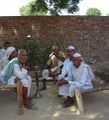
A Jat Chaupal in Uttar Pradesh

Jat Chaupal in Rajasthan
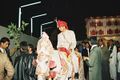
Ghud Chadhi ceremony of Jat marriage

Rajasthani woman's dress, Pomachā and khārā ghāgharā
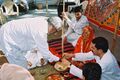
The ceremony of 'Manda Ropana' on the marriage ceremony at bride's house
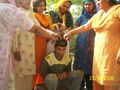
The ceremony of 'Haldi Rasm' on the marriage ceremony at bridegroom's house

The ceremony of 'Jhol Ghalna' on the marriage ceremony at bride's house
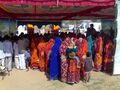
Jat women in tradional dress performing bhāt ceremony
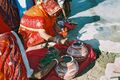
Jat women performing 'Chak Poojana' ceremony, at both bride and bridegroom's houses
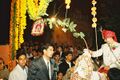
Toran ceremony

Neem jhunwari ceremony

Thapa lagana ceremony after sat fere


References
- ↑ Pandit Jwala Prasad Chaturvedi: Manusmriti - Hindi translation Randhir Prakashan Haridwar 2002, p.68
- ↑ Ram Swarup Joon: History of the Jats, Rohtak, India (1938, 1967)
- ↑ See Flood 1996: 56 and Olivelle 2005.
- ↑ Pandit Jwala Prasad Chaturvedi: Manusmriti - Hindi translation Randhir Prakashan Haridwar 2002, p.68
- ↑ Dr Ompal Singh Tugania: Jat samudāy ke pramukh Ādhār bindu, Jaypal Agencies, Agra 2004 (Page 9)
- ↑ Satyartha Prakasha Ch. IV: The advantages and disadvantages of distant and near marriages
- ↑ Mangal sen Jindal (1992): History of Origin of Some Clans in India (with special Reference to Jats), Sarup & Sons, 4378/4B, Ansari Road, Darya Ganj, New Delhi-110002 ISBN 81-85431-08-6, Page-37, 39
- ↑ Adi Parva, Mahabharata/Mahabharata Book I Chapter 63 यष्टिं च वैणवीं तस्मै ददौ वृत्रनिषूदनः । इष्टप्रदानम उद्दिश्य शिष्टानां परिपालिनीम ।। 17 ।।
- ↑ The Jat traditions - Chak Pooja
- ↑ Ghuddchaddi Aur Chawal Marna
- ↑ Ghuddchaddi Aur Chawal Marna
- ↑ Jats the Ancient Rulers (A clan study)/Relationship with the Aryans, p.85
- ↑ Author: Леонид Борисович Алаев (2000). Book: Л.Б. Алаев--община в его жизни: история нескольких научных идей в документах и материалах. Publisher: Восточная литература РАН. Page: 374. ISBN 5020181609, 9785020181601. Quote: " Джаты разных религий могут, не обижая друг друга, сидеть на одной чарпаи — кровати, служащей днем кушеткой или диваном. "