Abohar

Abohar (अबोहर) is a city and tahsil in Fazilka district in Punjab, India.
Location
It is located on the Ganganagar–Delhi railway route, nearly 50 km from Ganganagar. Its population, as of 2001, was 124,303. This city is also known as the "California of Punjab" for its rich soil, good irrigation sources, and particularly for the production of kinoo, a fruit of the orange family.
Origin
According to H.A. Rose:[1] Bhatti Chief Janra founded the town of Abohar, naming it after his wife Abho.
Villages in Abohar Tahsil
Abohar (M Cl), Abohar (Rural), Alamgarh, Amarpura, Azimgarh, Bahadar Khera, Baluana, Basian, Bazidpura , Bhagu, Bhangala, Bhanger Khera, Bishanpura, Chanan Khera, Dalmir Khera, Danewala Satkosi, Daulatpura, Dhaban Kokarian, Dhagsar, Dharampura, Dharangwala, Dhinganwali, Diwan Khera, Dodewala, Dotarianwali, Gaddan Doab, Gidranwali, Gobindgarh, Gumjal, Haripura, Himatpura, Jandwala Hanwanta, Jhurar Khera, Jodhpura, Kala Tibba, Kaler Khera, Kandhwala Amarkot, Kera Khera, Khairpur, Khatwan, Khubban, Khuian Sarwar, Kikar Khera, Killianwali, Kular, Kundal, Malukpura, Maujgarh, Mehrajpur, Modi Khera, Narainpura, Paniwala Mahla, Panjawa, Panjkosi, Patti Amra Urf Patti Sadiq, Patti Billa, Patti Taja, Raipura, Rajanwali, Rajpura, Ramgarh, Rampura, Ramsara, Roherianwali, Rukanpura Urf Khui Khera, Saiyadwala, Sappanwali], Sardarpura, Sherewala, Shergarh, Sito Gunno, Sukchain, Surj Moharwala, Tutwala, Usman Khera, Wahabwala, Waryam Khera,
History
Abohar is a historical city which is located on the inter-state boundary of the country. It may be called trinity of the culture, ethnicity, and civilization of Punjab, Haryana and Rajasthan. Its boundaries touch Rajasthan's mounds on one side and planes of Haryana on the other. And Village Panjkosi is Famous Village.
According to H.A. Rose:[2] The Hissar tradition says that the Battis are of the Jatu family, and that like the Tunwars they trace their origin to remote antiquity. At some distant period, two persons named Bhatti and Sumija are said to have come to this country from Mathura. The latter had no male issue, and his descendants (called Joiyas) live in Sirsa. After some generations the of the family of the former, niinnd Rusalu, became Raja— he had two sens, Dusul and Jaisul. The latter became Raja of Jaisalmer, where his descendants still reign. The former remained in Bhattiana— he had ony one son, named Janra, who had several wives by whom he had 21 sons, whose [p.103]descendants established different tribes, such as the Lakhiwal, Sidhu, and Barar Jats. Janra founded the town of Abohur, naming it after his wife Abho— by this wife he had three sons- Rajpal, Chun and Dhum :— the Wattus are descendants of the first- the Mai Rajputs of the second— and the Nawab of Rania and his family, of the third. Inasmuch as the Bhattis were more numerous than the rest, the country was called Bhattiana. The habits, manners and customs of Bhattis are similar to those of the Tunwars. (Hissar Settlement Report, p. 8, §§ 25, 26.)
Under British rule, in 1893, the town was more of a mound of sand with a total population of only 5,954. Its name was Kaiser-Ganj. However, its present population has grown to 200,000 approximately, in a period of about 120 years. Its, main business mandi is called darwaza.
River Satluj streaming by its side, Aabu Nagar, some 550 years ago, was a fabulous city of India. As one enters Abohar, one sees the remains of the ancient city Abunagri, a big mound of sand and stones which is known Theh among local people. This mound is not only a dune of sand; there historical city is also a big palace, built by a Suryavanshi king Aabu-Chandni, buried under it.
Another legendary dune named Panjpeer is just 500 feet away from Theh. There are tombs of five pirs on this mound. The beautiful Aabu city was destroyed by the curse of these pirs. A big fair is held on this mound every Thursday. The story of the Aabu Nagar is very attention-grabbing and spine-tingling. After king Aabu-Chandni, king Harichand ruled Aabu Nagar. King Harichand had only one daughter. She was very impressive, a good shooter, and fond of riding also. Once the king fell victim to leprosy. Someone told the king that he could recover only with the blood of the horses of five pirs of Multan. The brave daughter of the king snatched the 81 horses of five pirs along with their goods, but king Harichand succumbed to the disease. Five pirs sent many request to get their horses back, but the princess refused to give their horses back.
At last, the five pirs came to Abu city from Multan to get back their horses and camped on a hillock of sand near present Abohar. Many days passed but the princess did not give back their horses. The wives of five pirs came to Aabu city in search of their husbands. The pirs became angry on seeing them and cursed them due to which they were buried under the earth.
There is another mound at a distance of about 200 feet from Panjpeer, where their tombs are erected. The five pirs got angry, for not being returned their horses, and destroyed the Aabu Nagar with their divine powers, according to popular legends.
At the time of Indian independence in 1947, the city witnessed blood shed due to Hindu Muslim riots as this was the last main town along Delhi-Bahawalpur Section. Much as, as of today, the local community lives in the town with the feeling of harmony and common brotherhood. All sections, castes, religious sects visit PANJ PEER, BALA JI DHAM, CHURCH, and GURUDWARAS with much devotion without any maligned motives or intentions towards each other.
Many other achievements in academic, agriculture, industry, innovations, infrastructure and a big grain market are particularly noteworthy.
In the outer skirts of city Central Institute of Postharvest Engineering and Technology (CIPHET) campus Abohar, an ICAR institute is located here research is carried out and training are given on post harvest aspects of fruits and vegetables.
अबोहर
विजयेन्द्र कुमार माथुर[3] ने लेख किया है ...अबोहर (AS, p.28) पंजाब के फ़िरोजपुर ज़िले में स्थित है। भट्टी राजा ज़ोर का बसाया हुआ नगर है। कहा जाता है कि नगर का नाम उबोहर अर्थात् उबो रानी का ताल है। अलाउद्दीन ख़िलजी के समय यह नगर राजामल भट्टी के अधिकार में था। 1328 ई. में मुहम्मद बिन तुग़लक़ और किशलूखाँ की सेनाओं में उबोहर निर्णायक युद्ध हुआ था। तारीख़ फीरोजशाही का लेखक शमसूसिराज अफीफ अबोहर निवासी ही था। अबोहर का उल्लेख इब्नबतूता ने अपने यात्रा-विवरण में किया है।
इतिहास
ठाकुर देशराज[4] ने लिखा है ....सूबेदार शिवजीराम ने आज से 10 साल पहले अबोहर के दीपक में अबोहर पर ही एक लेख लिखा था जिसमें उन्होंने एक नई जानकारी इतिहासकार को यह दी थी कि अबोहर अभयसिंह भाटी का स्थापित किया हुआ है। और यह नाम अभयगढ़ का अपभ्रंश है।
Demographics
As of 2001 India census, Abohar had a population of 124,303. Males constitute 53% of the population and females 47%. Abohar has an average literacy rate of 65%, higher than the national average of 59.5%; with 58% of the males and 42% of females literate. 13% of the population is under 6 years of age.
Educational Institutes
Abohar is the educational hub in the south west Punjab. It has got a post Graduate college, ITI, Homeopathic College, Nursing College and various other institutes. It has produced many politicians like Dr. Balram Jakhar, who remained the speaker of Lok Sabha (Lower house of Parliament) GOVERNOR OF MADHYA PRADESH, Minister and Governor of State. & Mr. Virendera Kataria etc. Also many students from the DAV college went abroad and well settled there like Ritesh Jhamb who served Government of India and started his well reputed Company in Canada.
Jat Gotras in Abohar
Notable persons
- चौ. हजारी लाल रिणवां अबोहर,
- चौ0 बलवन्त सिंह गोदारा पुत्र चौ0 हरजीराम गोदारा मेजर सुरेन्द्र मार्ग अबोहर जिला फिरोजपुर (पंजाब)[5]
- Master Bega Ram - Freedom fighter, took part in Raisinghnagar movement of farmers. [6]
- मास्टर तेजरामजी अबोहर वालों ने इधर के अपने परिचित जनों से पुस्तक Jat Itihas (Utpatti Aur Gaurav Khand) के छफाई के लिए सहायता दिलाई।

- Surinder Prasad (Major) (05.11.1939 - 23.09.1965) became martyr on 23.09.1965 during Indo-Pak War 1965. He was from Abohar city in Fazilka district of Punjab, India. Unit: 19 Maratha Light Infantry.
Gallery
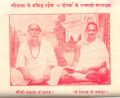
Malu Ram Saran and Tegram Abohar

External links
References
- ↑ A glossary of the Tribes and Castes of the Punjab and North-West Frontier Province By H.A. Rose Vol II/B , p.103-04 fn
- ↑ A glossary of the Tribes and Castes of the Punjab and North-West Frontier Province By H.A. Rose Vol II/B , p.103-04 fn
- ↑ Aitihasik Sthanavali by Vijayendra Kumar Mathur, p.28
- ↑ Thakur Deshraj:Jat Jan Sewak, 1949, p.140-141
- ↑ http://www.swamikeshwanand.com/Donors%20List.aspx sn 132
- ↑ Ganesh Berwal: 'Jan Jagaran Ke Jan Nayak Kamred Mohar Singh', 2016, ISBN 978.81.926510.7.1, p.57-59
Back to Jat Villages/Places/Punjab