Scythian Jats
| Author:Laxman Burdak, IFS (R) & Hardeep Moar |


Scythians were Eurasian nomads, probably mostly using Eastern Iranian languages, who were mentioned by the literate peoples surrounding them as inhabiting large areas in the central Eurasian steppes from about the 9th century BC up until the 4th century AD.[1][2][3][4] Eurasian nomads who were mentioned by the literate peoples surrounding them as inhabiting large areas in the central Eurasian steppes from about the 9th century BC until about the 1st century BC.[5]
Variants of name
- Scythia and Scythians (Anabasis by Arrian, p. 15, 155, 161, 164, 165, 180, 192, 196, 202, 205-214, 227, 233, 234, 237, 238, 272, 273, 284, 308, 309, 370, 899, 401.)
- Scythians (Greek Σκύθης, Σκύθοι)
- Scyth
- Scythes
- Shaka/Śaka (Sanskrit:शक)
- Saka (Old Persian: Sakā)
- New Persian/Pashto: ساکا
- Sakae (Greek: Σάκαι)
- Sacae (Latin)
- Sai (Chinese: 塞; Old Chinese: *sˤək)
- Iskuzai
- Askuzai/Aškuz (Assyrian)
- Skolotoi (Σκώλοτοι, Herodotus 4.6)
- Scythian people
- Sacassani
- Sacæ (Pliny.vi.19)
Jat Gotras Namesake
- Scythian Jats = Tibareni (Pliny.vi.4 )
- Scythian Jats = Scythian Gulf (Pliny.vi.15)
- Scythian Jats = Scythian Ocean (Northern Ocean/Arctic Ocean) (Pliny.vi.15)
- Sacæ (Pliny.vi.19)
- Scythian Jats = Scythian Nations (Pliny.vi.19)
- Scythian Jats = Nation of Scythians (Pliny.vi.20)
- Scythian Jats = Mountains of Scythia (Pliny.vi.22)
- Scythian Jats = Mountains of Scythia (Pliny.vi.29)
- Scythian Jats = Scythian parallel (Pliny.vi.39)
Habitations and Locations
The "classical Scythians" known to ancient Greek historians, agreed to be mainly Iranian in origin, were located in the northern Black Sea and fore-Caucasus region. Other Scythian groups documented by Assyrian, Achaemenid and Chinese sources show that they also existed in Central Asia, where they were referred to as the Iskuzai/Askuzai, Saka (Old Persian: Sakā; New Persian/Pashto: ساکا; Sanskrit: शक Śaka; Greek: Σάκαι; Latin: Sacae), and Sai (Chinese: 塞; Old Chinese: *sˤək), respectively.
Herodotus reveals that the Scythians as far back as the 5th century BC had political control over Central Asia and the northern subcontinent up to the river Ganges. Later Indo-Scythic clans and dynasties (e.g. Mauryas) extended their control to other tracts of the northern subcontinent. The largest Saka imperial dynasties of Sakasthan include the Satraps (204 BC to 78 AD), Kushanas (50 AD - 380), Virkas (420 AD - 640) while others like the Mauryas (324 - 232 BC) and Dharan-Guptas (320 AD - 515) expanded their empires towards the east.[6]
Many DNA Scientists have expressed the view that the Jat people were originally Indo-Scythians. However, without proper study conducted by taking DNA tests they have not succeeded in conclusively proving this point so far. DNA Scientists have done a DNA study and tests and have proved Jats are Indo-Scythian in origin and lineage.
According to Ethnographers and historians like Cunningham, Todd, Ibbetson, Elliot, Ephilstone, Dahiya, B. S. Dhillon, Banerjea, etc., the agrarian and artisan communities (e.g. Jats, Gujars, Ahirs, Rajputs, Lohars, Tarkhans etc.) of the entire west are derived from the war-like Scythians;[6] who settled north-western and western South Asia in successive waves between 500 BC to 500 AD.
Trevaskis put the date of Scythian migrations into India approximately from 600 BC to 600 AD. Trevaskis wrote, "Their (Scythians') successive onslaughts proved the ruin of Assyria, and soon after the fall of Nineveh, B.C. 606, a vast horde of them burst into Punjab."[7]
The 1911 Encyclopedia Brittanica says that a Scythian horde was seated at Pattala on the Indus, in 625 BC; this may have been the Sibi.
It is worth noticing that as early as Pāṇini's (पाणिनि) era, the places in-and-around Sialkot are known to have Sakian etymology i.e. ending in "kantha" — — Chihankantha, Madarakantha, etc. Even the Archaeological Survey Report of India unearths the fact that the ancient name for Sialkot was Sakala.[8][9] Also, Sakala is thought to be "Saka" town by Przyluski and Tarn.[10][11]
List of Scythian tribes
The Scythians – the Greeks' name for this nomadic people – inhabited Scythia from at least the 11th century BC to the 2nd century AD.[12]
Many different groupings of Scythian tribes include the following:
- Abian Scythians
- Abii
- Achaei
- Agaragantes
- Agathyrsi
- Agathyrsi
- Agrippaeans
- Alans
- Amardi (Pliny.vi.19)
- Amazons
- Amyrgians
- Amyrgians
- Androphagi
- Antacati (Pliny.vi.19)
- Anthusiani (Pliny.vi.19)
- Aorsi
- Ariacæ (Pliny.vi.19)
- Arimaspi (Pliny.vi.19)
- Asampatae
- Athernei
- Auchetae
- Budini
- Cadusii
- Came (Pliny.vi.19)
- Camacæ (Pliny.vi.19)
- Caspians
- Cercetae
- Œtei (Pliny.vi.19)
- Chalybes
- Chroasai (Pliny.vi.19)
- Cimmerians
- Cissianti
- Colchi
- Cotieri (Pliny.vi.19)
- Daans (Arrian) [13]
- Dahae [14][15]
- Edones (Pliny.vi.19)
- Essedones (Pliny.vi.19)
- Euchatæ (Pliny.vi.19)
- Gargarii
- Gelae
- Geloni
- Hamaxobii
- Haraiva
- Histi (Pliny.vi.19)
- Iazyges
- Indo-Scythians
- Legae
- Limigantes
- Massagetae (Pliny.vi.19)
- Mathura
- Melanchlaeni
- Napæi (Pliny.vi.19)
- Neuri
- Pæsici (Pliny.vi.19)
- Palæi (Pliny.vi.19)
- Parni
- Pazyryk
- Phoristae
- Psacæ (Pliny.vi.19)
- Rhymmici (Pliny.vi.19)
- Rimphaces
- Roxolani
- Sacæ (Pliny.vi.19)
- Sacassani
- Sakā Haumavargā[16]
- Saka Tigrakhauda
- Saka
- Sarmatians
- Scythians
- Serboi
- Sindi
- Siraces
- Spali
- Spondolici
- Suren
- Tagar
- Tauri
- Thyssagetae
- Tibareni
- Udini (Pliny.vi.15)
- Yancai
- Zygii
Abian Scythians
Arrian[17] writes....Ch.1: Rebellion of the Sogdianians (p.205-206): A few days after this, envoys reached Alexander from the people called Abian Scythians, whom Homer commended in his poem, calling them the justest of men.[1] This nation dwells in Asia and is independent, chiefly by reason of its poverty and love of justice. Envoys also came from the Scythians of Europe, who are the largest nation dwelling in that coutinent.[2] Alexander sent some of the Companions with them, under the pretext indeed that they were to conclude a friendly alliance by the embassy; but the real object of the mission was rather to spy into the natural features of the Scythian land, the number of the inhabitants and their customs, as well as the armaments which they possessed for making military expeditions.[3] He formed a plan of founding a city near the river Tanais, which was to be named after himself; for the site seemed to him suitable and likely to cause the city to grow to large dimensions. He also thought it would be built in a place which would serve as a favourable basis of operations for an invasion of Scythia, if such an event should ever occur; and not only so, but it would also be a bulwark to secure the land against the incursions of the barbarians dwelling on the further side of the river. Moreover he thought that the city would become great, both by reason of the multitude of those who would join in colonizing it, and on account of the celebrity of the name conferred upon it.[4] Meantime the barbarians dwelling near the river seized upon the Macedonian soldiers who were garrisoning their cities and killed them; after which they began to strengthen the cities for their greater security. Most of the Sogdianians joined them in this revolt, being urged on to it by the men who had arrested, Bessus. These men were so energetic that they even induced some of the Bactrians to join in the rebellion, either because they were afraid of Alexander, or because their seducers assigned as a reason for their revolt, that he had sent instructions to the rulers of that land to assemble for a conference at Zariaspa, the chief city; which conference, they said, would be for no good purpose.[5]
1. See Homer's Iliad, xiii. 6. Cf. Curtius, vii. 26; Ammianus, xxiii. 6.
2. Cf. Thucydides, ii. 97.
3. Curtius (vii 26) says, he sent one of his friends named Berdes on this mission. 205
4. This was called Alexandria Ultima, on the Jaxartes, probably the modern Khojend.
5. Of. Gwrtius (vii. 26). Zariaspa was another name for Bactra. See Pliny (vi. 18) and Straho (xi. 11).
Sacassani
Sacassani: Some splinter Scythian groups nevertheless remained in West Asia and settled in Transcaucasia and the area corresponding to modern-day Azerbaijan.[18] One such splinter group joined the Medes and participated in the Median conquest of Urartu,[19] while other Transcaucasian Scythian splinter groups retreated northwards to join the West Asian Scythians who had already moved into the Kuban Steppe previously.[20] One group formed a kingdom in what is now Azerbaijan under Median overlordship, but eventually hostilities broke out between them and Cyaxares, due to which they left Transcaucasia and fled to Lydia as refugees,[21] although a section of these Scythians still remained in the southeast Caucasus, and were later mentioned by Titus Livius under the name of Sacassani, while the country was called the “Land of the Skythēnoi” by Xenophon and Sakasēnē by Ptolemy.[22]
Mention by Pliny
Pliny[23] mentions Lake Mieotis and the adjoining nations....The Scythians call the river Tanais by the name of Silis, and the Mæotis the Temarunda, meaning the "mother of the sea." There is11 a city also at the mouth of the Tanais. The neighbouring country was inhabited first by the Carians, then by the Clazomenii and Mæones, and after them by the Panticapenses.12
11 The former editions mostly have "there was," implying that in the time of Pliny it no longer existed. The name of this place was Tanais; its ruins are still to be seen in the vicinity of Kassatchei. It was founded by a colony from Miletus, and became a flourishing seat of trade. The modern town of Azof is supposed to occupy nearly its site.
12 The people of Panticapæum, on the opposite side of the Palus Mæotis, occupying the site of the present Kertch. It was founded by the Milesians B.C. 541, and took its name from the neighbouring river Panticapes.
Mention by Pliny
Pliny[24] mentions Lake Mieotis and the adjoining nations....Some writers say that the Auchetæ, the Athernei, and the Asampatæ, Scythian tribes, have made inroads upon this territory, and have destroyed the Tanaitæ and the Inapæi to a man.
Mention by Pliny
Pliny[25] mentions.... Beyond these8 (Paryadres) are the deserts of Colchios, on the side of which that looks towards the Ceraunian Mountains dwell the Armenochalybes9; and there is the country of the Moschi, extending to the river Iberus, which flows into the Cyrus; below them are the Sacassani, and after them the Macrones, upon the river Absarus.
8 To the west.
9 "The Armenian workers in iron," or "Chalybes of Armenia." See p. 9.
Mention by Pliny
Pliny[26] mentions Nations situated around the Hyrcanian Sea... Beyond it are the Sogdiani,24 the town of Panda, and, at the very extremity of their territory, Alexandria,25 founded by Alexander the Great. At this spot are the altars which were raised by Hercules and Father Liber, as also by Cyrus, Semiramis, and Alexander; for the expeditions of all these conquerors stopped short at this region, bounded as it is by the river Jaxartes, by the Scythians known as the Silis, and by Alexander and his officers supposed to have been the Tanais. This river was crossed by Demodamas, a general of kings Seleucus and Antiochus, and whose account more particularly we have here followed. He also consecrated certain altars here to Apollo Didymæus.26
24 D'Anville says that there is still the valley of Al Sogd, in Tartary, beyond the Oxus. The district called Sogdiana was probably composed of parts of modern Turkistan and Bokhara. The site of Panda does not appear to be known.
25 It was built on the Jaxartes, to mark the furthest point reached by Alexander in his Scythian expedition. It has been suggested that the modern Kokend may possibly occupy its site.
26 The "twin," of the same birth with Diana.
Mention by Pliny
Pliny[27] mentions The nations of Scythia and the countries on the Eastern Ocean..... Beyond this river (Jaxartes) are the peoples of Scythia. The Persians have called them by the general name of Sacæ,1 which properly belongs to only the nearest nation of them. The more ancient writers give them the name of Aramii. The Scythians themselves give the name of "Chorsari" to the Persians, and they call Mount Caucasus Graucasis, which means "white with snow."
The multitude of these Scythian nations is quite innumerable: in their life and habits they much resemble the people of Parthia.
The tribes among them that are better known are the Sacæ, the Massagetæ,2 the Dahæ,3 the Essedones,4 the Ariacæ,5 the Rhymmici, the Pæsici, the Amardi,6 the Histi, the Edones, the Came, the Camacæ, the Euchatæ,7 the Cotieri, the Anthusiani, the Psacæ, the Arimaspi,8 the Antacati, the Chroasai, and the Œtei; among them the Napæi9 are said to have been destroyed by the Palæi.
1 The Sacæ probably formed one of the most numerous and most powerful of the Scythian Nomad tribes, and dwelt to the east and north-east of the Massagetæ, as far as Servia, in the steppes of Central Asia, which are now peopled by the Kirghiz Cossacks, in whose name that of their ancestors, the Sacæ, is traced by some geographers. 2 Meaning the "Great Getæ." They dwelt beyond the Jaxartes and the Sea of Aral, and their country corresponds to that of the Khirghiz Tartars in the north of Independent Tartary.
3 The Dahæ were a numerous and warlike Nomad tribe, who wandered over the vast steppes lying to the east of the Caspian Sea. Strabo has grouped them with the Sacæ and Massagetæ, as the great Scythian tribes of Inner Asia, to the north of Bactriana.
4 See also B. iv. c. 20, and B. vi. c. 7. The position of the Essedones, or perhaps more correctly, the Issedones, may probably be assigned to the east of Ichim, in the steppes of the central border of the Kirghiz, in the immediate vicinity of the Arimaspi, who dwelt on the northern declivity of the Altaï chain. A communication is supposed to have been carried on between these two peoples for the exchange of the gold that was the produce of those mountain districts.
5 They dwelt, according to Ptolemy, along the southern banks of the Jaxartes.
6 Or the Mardi, a warlike Asiatic tribe. Stephanus Byzantinus, following Strabo, places the Amardi near the Hyrcani, and adds, "There are also Persian Mardi, without the a;" and, speaking of the Mardi, he mentions them as an Hyrcanian tribe, of predatory habits, and skilled in archery.
7 D'Anville supposes that the Euchatæ may have dwelt at the modern Koten, in Little Bukharia. It is suggested, however, by Parisot, that they may have possibly occupied a valley of the Himalaya, in the midst of a country known as "Cathai," or the "desert."
8 The first extant notice of them is in Herodotus; but before him there was the poem of Aristeas of Proconnesus, of which the title was 'Arimaspea;' and it is mainly upon the statements in it that the stories told relative to this people rest—such as their being one-eyed, and as to their stealing the gold from the Gryphes, or Griffins, under whose custody it was placed. Their locality is by some supposed to have been on the left bank of the Middle Volga, in the governments of Kasan, Simbirsk, and Saratov: a locality which is sufficiently near the gold districts of the Uralian chain to account for the legends connecting them with the Gryphes, or guardians of the gold.
9 The former reading was, "The Napæi are said to have perished as well as the Apellæi." Sillig has, however, in all probability, restored the correct one. "Finding," he says, "in the work of Diodorus Siculus, that two peoples of Scythia were called, from their two kings, who were brothers, the Napi and the Pali, we have followed close upon the footsteps of certain MSS. of Pliny, and have come to the conclusion that some disputes aro
Mention by Pliny
Pliny[28] mentions The Parthian Empire....The kingdoms1 of Parthia are eighteen in all: such being the divisions of its provinces, which lie, as we have already stated, along the Red Sea to the south, and the Hyrcanian to the north. Of this number the eleven, called the Higher provinces, begin at the frontiers of Armenia and the shores of the Caspian, and extend to the Scythians, whose mode of life is similar in every respect.
1 The provinces of Parthia have been already mentioned in detail in the preceding Chapters, except Susiana and Elymais, which are mentioned in c. 31.
Mention by Pliny
Pliny[29] mentions Division of the earth into parallels and shadows of equal length....The last of all is the Scythian parallel, which runs from the Riphæan range to Thule, in which, as we have already stated,1 the year is divided into days and nights alternately, of six months' duration. The same authors have also placed before the first parallel, which we have here given,2 two other parallels or circles; the first running through the island of Meroë and the city of Ptolemais which was built on the Red Sea for the chase of the elephant; where the longest day is twelve hours and a half in length; and the second passing through Syene in Egypt, in which the longest day is thirteen hours in length. The same authors have also added half an hour to each of the parallels, till they come to the last.
1 B. iv. c. 26.
2 In p. 111.
DNA study on Y-STR Haplogroup Diversity in the Jat Population
David G. Mahal and Ianis G. Matsoukas[30] conducted a scientific study on Y-STR Haplogroup Diversity in the Jat Population of which brief Conclusion is as under:
The Jats represent a large ethnic community that has inhabited the northwest region of India and Pakistan for several thousand years. It is estimated the community has a population of over 123 million people. Many historians and academics have asserted that the Jats are descendants of Aryans, Scythians, or other ancient people that arrived and lived in northern India at one time. Essentially, the specific origin of these people has remained a matter of contention for a long time. This study demonstrated that the origins of Jats can be clarified by identifying their Y-chromosome haplogroups and tracing their genetic markers on the Y-DNA haplogroup tree. A sample of 302 Y-chromosome haplotypes of Jats in India and Pakistan was analyzed. The results showed that the sample population had several different lines of ancestry and emerged from at least nine different geographical regions of the world. It also became evident that the Jats did not have a unique set of genes, but shared an underlying genetic unity with several other ethnic communities in the Indian subcontinent. A startling new assessment of the genetic ancient origins of these people was revealed with DNA science.
The human Y-chromosome provides a powerful molecular tool for analyzing Y-STR haplotypes and determining their haplogroups which lead to the ancient geographic origins of individuals. For this study, the Jats and 38 other ethnic groups in the Indian subcontinent were analyzed, and their haplogroups were compared. Using genetic markers and available descriptions of haplogroups from the Y-DNA phylogenetic tree, the geographic origins and migratory paths of their ancestors were traced.
The study demonstrated that based on their genetic makeup, the Jats belonged to at least nine specific haplogroups, with nine different lines of ancestry and geographic origins. About 90% of the Jats in our sample belonged to only four different lines of ancestry and geographic origins:
1. Haplogroup L (36.8%)- The origins of this haplogroup can be traced to the rugged and mountainous Pamir Knot region in Tajikistan.
2. Haplogroup R (28.5%): From somewhere in Central Asia, some descendants of the man carrying the M207 mutation on the Y chromosome headed south to arrive in India about 10,000 years ago (Wells, 2007). This is one of the largest haplogroups in India and Pakistan. Of its key subclades, R2 is observed especially in India and central Asia.
3. Haplogroup Q (15.6%): With its origins in central Asia, descendants of this group are linked to the Huns, Mongols, and Turkic people. In Europe it is found in southern Sweden, among Ashkenazi Jews, and in central and Eastern Europe such as, the Rhône-Alpes region of France, southern Sicily, southern Croatia, northern Serbia, parts of Poland and Ukraine.
4. Haplogroup J (9.6%): The ancestor of this haplogroup was born in the Middle East area known as the Fertile Crescent, comprising Israel, the West Bank, Jordon, Lebanon, Syria, and Iraq. Middle Eastern traders brought this genetic marker to the Indian subcontinent (Kerchner, 2013).
5.-9. Haplogroups E, G, H, I, T (9.5%): The ancestors of the remaining five haplogroups E, G, H, I, and T can be traced to different parts of Africa, Middle East, South Central Asia, and Europe (ISOGG, 2016).
Therefore, attributing the origins of this entire ethnic group to loosely defined ancient populations such as, Indo-Aryans or Indo-Scythians represents very broad generalities and cannot be supported. The study also revealed that even with their different languages, religions, nationalities, customs, cuisines, and physical differences, the Jats shared their haplogroups with several other ethnic groups of the Indian subcontinent, and had the same common ancestors and geographic origins in the distant past. Based on recent developments in DNA science, this study provided new insights into the ancient geographic origins of this major ethnic group in the Indian subcontinent. A larger dataset, particularly with more representation of Muslim Jats, is likely to reveal some additional haplogroups and geographical origins for this ethnic group.
Names and terminology
In the strict sense 'Scythian' refers to the nomads north of the Black Sea and is distinguished from the very similar Sarmatians who lived north of the Caspian Sea and later replaced the Scythians proper. The Persian term Saka is used for the Scythians in Central Asia. The Chinese used the term Sai , for Sakas who once inhabited the valleys of the Ili River and Chu River and moved into the Tarim Basin. Herodotus said the Scythians called themselves Skolotoi.[31]
Iskuzai or Askuzai is an Assyrian term for raiders south of the Caucasus who were probably Scythian. A group of Scythians/Sakas went south and gave their name to Sakastan. They, or a related group, invaded northern India and became the Indo-Scythians. Near the end of this article is a list of peoples that have been called Scythians.
Oswald Szemerényi studied the various words for Scythian and gave the following.[32] Most descend from the Indo-European root *skeud-, meaning "propel, shoot" (cognate with English shoot). *skud- is the ablaut form of the same root.
The restored Scythian name is *skuda (roughly "archer"). This yields the ancient Greek Skuthēs (plural Skuthai Σκύθαι) and Assyrian Aškuz; Old Armenian: սկիւթ skiwtʰ is from Greek. A late Scythian sound change from /d/ to /l/ gives the Greek word Skolotoi (Σκώλοτοι, Herodotus 4.6), from Scythian *skula which, according to Herodotus, was the self-designation of the Royal Scythians. Other sound changes gave Sogdia. The form reflected in Old Persian: Sakā, Ancient Greek: Σάκαι; Latin: Sacae, Sanskrit: शक Śaka comes from an Iranian verbal root sak-, "go, roam" and thus means "nomad".[33]
In the broadest sense and in archaeology Scythian and Scythic can be used for all of the steppe nomads at the beginning of recorded history.[34] The grasslands of Mongolia and north China are often excluded, but the Ordos culture and Tagar culture seem to have had significant 'Scythian' features. More commonly 'Scythian' is restricted to the nomads of the western and central steppe who spoke Scythian languages of the Iranian family. If other languages were used in the region we have no definite evidence.
Scythian ku meaning water
Alexander Cunningham[35] writes that The name of Kophes (Kabul) is as old as the time of the Vedas, in which the Kubha river is mentioned as an affluent of the Indus. The Kunar River, the Kurram River, and the Gomal rivers to the west, and the Kunihar River to the east of the Indus, all of which are derived from the Scythian ku, " water." It is the guttural form of the Assyrian hu in Euphrates and Eulaeus, and of the Turki su and the Tibetan chu, all of which mean water or river.
Expansion of Scythian culture

The expansion of Scythian culture stretching from the Hungarian plains and the Carpathians to the Chinese Kansu Corridor and linking Iran, and the Middle East with Northern India and the Punjab, undoubtedly played an important role in the development of the Silk Road. Scythians accompanied the Assyrian Esarhaddon on his invasion of Egypt, and their distinctive triangular arrowheads have been found as far south as Aswan. These nomadic peoples were dependent upon neighbouring settled population for a number of important technologies, and in addition to raiding vulnerable settlements for these commodities, also, encouraged long distance merchants as a source of income through the enforced payment of tariffs. Soghdian Scythian merchants played a vital role in later periods in the development of the Silk Road.
Jat People Genetics

A recent study of the people of Indian Punjab, where about 40% or more of the population are Jat people, strongly shows that the Jat people are Indo-Scythians.[36] The study involved a genealogical DNA test which examined single nucleotide polymorphisms (mutations in a single DNA "letter") on the Y chromosome (which occurs only in males). Jats share many common haplotypes with Ukrainian people, Germanic people, Slavic people, Baltic peoples, Iranian people, and Central Asian groups.[37] This strongly indicates they originate from near or in Ukraine.[38] It found Jat people share only two haplotypes, one of which is also shared with the population of present-day Turkish people, and have few matches with neighbouring Pakistani populations.[39] This haplotype shared between the two Jat groups may be part of an Indo-Aryan (or Indo-European people) genetic contribution to these populations, where as the haplotypes shared with other Eurasian populations is due to the strong DNA contributions of Indo-European Scythians (Saka, Massagetae) and White Huns.[40] The mitochondrial DNA (mtDNA) female DNA, Jats contain haplogroups typical of Northern India, Pakistan, and West Asia. This indicates that for the female mtDNA, there is very little connection with Central Asian and northwest European populations, even though Jats share many Y-SNP markers with these populations. Therefore, this DNA Study proves that there has been male DNA into the Jat people from Ukrainian Scythians (Saka, Massagetae) and White Huns.[41]
MAIN POINT IMPORTANT: Jat People Genetics
The highlighted DNA Study proves that there has been male DNA into the Jat people from Ukrainian Scythians (Saka, Massagetae) and White Huns.[42]
IMPORTANT POINT: The Jat people's FATHERS were Scythians (Saka, Massagetae) and White Huns.
"NE Euro" fractions in DNA samples of Jats
.png)
In August 2013, the geneticist Razib Khan wrote in an article for the Discover Magazine:
- "Finally let's move to North India, and the zone stretching between Punjab in the Northwest and Bihar in the East. Though in much of this region Brahmins have higher "NE Euro" fractions, this relationship seems to breakdown as you go northwest. The Jatt community in particular seems to have the highest in the subcontinent. There are inchoate theories for the origins of the Jatts in Central Asia. I had dismissed them, but am thinking now they need a second look. The reasoning is simple. The Jatts of the eastern Punjab have a higher fraction of "NE Euro" than populations to their northwest (Pathans, Kalash, etc.), and Brahmin groups (e.g., Pandits) in their area who are theoretically higher in caste status. This violation of these two trends implies something not easily explained by straightforward social and geographic processes. The connection between ancestry and caste status also seems to break down somewhat in the Northwest, as there is a wide variation in ancestral components."[43]
Jat origin of the Indo-Scythians

.gif)


James Tod[44] writes that the tribes here alluded to are the Haihaya or Aswa, the Takshak, and the Jat or Getae; the similitude of whose theogony, names in their early genealogies, and many other points, with the Chinese, Tatar, Mogul, Hindu, and Scythic races, would appear to warrant the assertion of one common origin.
Professor B. S. Dhillon states that the Jats are mainly of Indo-Scythian lineage with composite mixing of Sarmatians, Goths & Jutes in History and study of the Jats.[45] Historian James Tod agreed in considering the Jats to be of Indo-Scythian Stock.[46] Moreover, Sir Alexander Cunningham, Former Director-General of the Archaeological Survey of India, considered the Jats to be the Xanthii (a Scythian tribe) of Scythian stock who he considered very likely called the Zaths (Jats) of early Arab writers.[47] He stated "their name is found in Northern India from the beginning of the Christian era." These people were considered by early Arab writers to have descended from Meds and Zaths.[48][49] Sir Cunningham believed that they "were in full possession of the valley of the Indus towards the end of the seventh century.[50]
Stephen Fuchs suggests that the Jats probably migrated from Central Asia to India as a "predatory nomadic tribe".[51] Natalya Romanovna Guseva considered the Jats to be the descendants of the Sakas.[52]
It has also been suggested that "the Rajputs proper were of mixed origin – pre-Muslim invaders such as Scythians, Bactrians, Parthians, Hunas and Gurjaras who came in before, say, the end of the 7th century."[53]
- Sir Alexander Cunningham, (Former Director-General of the Archaeological Survey of India) wrote: The Xanthii (a Scythian tribe) are very probably the Zaths (Jats) of the early Arab writers. As the Zaths were in Sindh to the west of the Indus, this location agrees very well with what we know of the settlement of the Sakas (Scythians) on the Indian frontier.[54]
- Sir John Marshall, (Former Director-General of the Archaeological Survey of India) wrote: "These Scythian invaders came principally from the three great tribes of Massagetae (great Jats), Sacaraucae, and Dahae (still exists as a Jat clan of Punjab)[55], whose home at the beginning of the second century B.C. was in the country between the Caspian sea (sea) and the Jaxartes river (Central Asia).[56]
- Arthur Edward Barstow wrote: "Greeks of Bactria (partly modern Afghanistan), expelled by the hordes of Scythians, entered India in the second and first centuries BC and are said to have penetrated as far as Orissa (an Indian province in south-east). Meanwhile the Medii, Xanthii, Jatii, Getae and other Scythian races, were gradually working their way from the banks of the Oxus (River valley in Central Asia) into Southern Afghanistan and the pastoral highland about Quetta (a Pakistani city), whence they forced their way by the Bolan Pass, through the Sulaiman Mountains into India, settling in the Punjab about the beginning of the first century AD. It is from these Scythian immigrants that most of the Jat tribes are at any rate partly descended."[57]
- A. H. Bingley wrote: "It is from these Scythian Immigrants that most of the Jat tribes are at any rate partly descended."[58]
- Professor Joyce Pettigrew wrote: "Another view holds that the Jats came from Asia Minor and Armenia in the successive invasions during the period 600 B.C. to A.D. 600."[59]
- Professor Henry Smith Williams wrote: "The extent of the Scythian invasion has been variously estimated. Some scholars believe that they virtually supplanted the previous population of India (means Punjab), and there seems little doubt that by far the most numerous section of the Punjab population is of Scythian origin."[60]
- Professor Pritam Singh Gill wrote: "There is a general concensus of opinion that Jats, and with them Rajputs and Gujjars were foreigners who came from their original home, near the Oxus, Central Asia."[61]
- Professor Tadeusz Sulimirski wrote: "The evidence of both the ancient authors and the archaeological remains point to a massive migration of Sacian (Sakas)/Massagetan ("great" Jat) tribes from the Syr Daria Delta (Central Asia) by the middle of the second century B.C. Some of the Syr Darian tribes; they also invaded North India."[62]
- Horace Arthur Rose wrote: "Many of the Jat tribes of the Punjab have customs which apparently point to non-Aryan origin. Suffice it to say that both Sir Alexander Cunningham and Colonel Tod agreed in considering the Jats to be of Indo-Scythian Stock. The former identified them with the Zanthi of Strabo (Greek Geographer of the ancient times) and the Jatii of Pliny (Roman writer) and Ptolemy (Another Greek Geographer of the ancient times); and held that they probably entered the Punjab from their home on the Oxus (in Central Asia) very shortly after the Meds or Mands (still exist as one of the Jat clans of the Punjab), who also were Indo-Scythians, and who moved into the Punjab about a century before Christ."[63]
- Sir Henry Miers Elliot wrote: "These ignorant tribes (Jats) pointing to the remote Ghazni (Afghanistan) as their original seat, the very spot we know to have been occupied by the Yuechi, or, as Klaproth says, more correctly, Yuti, in the first centuries of our era, after the Sakas (a Scythian tribe) were repelled back from the frontiers of India, and left the country between India and Persia open for their occupation. The Jat tribes not doubt emigrated, no at all once, but at different times, and it is probable that those in the North-West are among the latest importations."[64]
- I. Sara wrote: "Recent excavations in the Ukraine and Crimea. The finds points to the visible links of the Jat and Scythians."[65]
- Sir Mountstuart Elphinstone Grant Duff wrote: "My conclusion, therefore, is, that the Jats may be of Scythian descent."[66]
- Ujagir Singh Mahil wrote: "Jat were called Scythians; because they were the inhabitants of the ancient country of Scythia. The Jats who invaded the Punjab and conquered India up to Benares were called Indo-Scythians."[67]
- James Francis Katherinus Hewitt wrote: "Further evidence both of the early history and origin of the race of Jats, or Getae, is given by the customs and geographical position of another tribe of the same stock, called the Massagetae, or great (massa) Getae."[68]
- Sir George Fletcher MacMunn (Sir and Lt. General) wrote: "Alexander came to India in his capacity as the holder of the Persian throne. From his camp near Kabul (Afghanistan), the Macedonian (Alexander) summoned those chiefs whom Skylax (Persian general) had conquered in the old time afore, to come and renew their homage to their ancient Persian overlord in the person of himself. Several obeyed his summons, others did not, and it has been surmised that those who did were later arrivals, of Jat or Scythian origin, outside the normal Aryan fold as later comers to India."[69]
- Syed Muhammad Latif wrote: "A considerable portion of the routed army of the Scythians settled in the Punjab, and a race of them, called Nomardy, inhabited the country on the west bank of the Indus (river). They are described as a nomadic tribe, living in wooden houses, after the old Scythian fashion, and settling where they found sufficient pasturage. A portion of these settlers, the descendants of Massagetae, were called Getes, from whom sprung the modern Jats."[70]
- Dr. Gopal Singh wrote: "The Jats of the Panjab, are Scythians in origin and came from Central Asia, whose one branch migrated as far south in Europe as Bulgaria. "[71]
- N. Singh wrote: "The Scythians appear to originate from Central Asia. They reached Punjab between 50 B.C. and A.D. 50. It seems probable that the Scythian ancestors of the Jats entered the Sindh Valley (presently in Pakistan Kashmir) between 100 B.C. and A.D. 100."[72]
- Satya Shrava wrote: "The Jats are none other than the Massagetae (Great Getae) mentioned in Diodorus as an off-spring of the ancient Saka tribe.... a fact now well-known."[73]
- Bakhshish Singh Nijjar wrote: "The Jats are the descendants of Scythians, whose kingdom's capital was Scythia, in the present Ukraine (Ukrainian), Soviet Social Republic, is the constituent Republic of the European USSR (Population 49,757,000) in 1947. Now Ukraine's capital is Kiev, the third leading city in Russia. Before the invasion of the golden herd, 13th century B.C. Scythian, ancient kingdom of indeterminate boundaries, centered in the area north of the Black Sea."[74]
- Rima Hooja suggests that the Jats are "probably descendants of the Scythians who entered India in early historical times".[75]
(ख) सीथिया देश -
इस देश का कुछ भाग यूरोप में तथा कुछ भाग एशिया में स्थित था। देन्यूब नदी (Danube) से लेकर ठीक दक्षिणी रूस के पार तक, कैस्पियन सागर के पूर्व में अमू दरिया व सिर दरिया की घाटी तक, पामीर पहाड़ियों की शृंखला तक तथा पूर्वी तुर्किस्तान की तारिम नदी की घाटी तक यह सीथिया देश फैला हुआ था।[76]
Identification of the Jats as Getae and Massagetae
- Steven M. Collins advocates the identification of Massagetaeans as "Great Jits or Jats" of Asia.[77][78]
- Weer Rajendra Rishi advocates that the Jats are none other than the Massagetaeans (Maha/Great Getae).[79]
- Rahul Sankrityayan had identified the Jats as Massagetaeans.[80]
- Arnold Joseph Toynbee wrote: "It may not be fantastic to conjecture that the Tuetonic-speaking Goths and Gauts of Scandinavia may have been descended from a fragment of the same Indo-European-speaking tribe as the homonymous Getae and Thyssagetae and Massagetae of the Eurasian Steppe who are represented today by the Jats of the Panjab."[81]
- Arnold Joseph Toynbee, also wrote: "It had been carried from the Oxus-Jaxartes Basin into the Indus Basin by the Massagetae themselves, together with their tribal name (the Jats), in their Volkerwander- ung in the second century BC"[82]
- George Rawlinson has identified the Massagetaeans as "Great Jits or Jats" of Asia.[83][84][85][86][87][88]
- Sir Richard Francis Burton wrote: "The Massagetae (greater Jats or Goths) are opposed to the Thyssa (or lesser) Getae, and both used the sagaris."[89]
Origin and Etymology of Indo Scythians
Origin
The ancestors of the Indo-Scythians are thought to be Sakas (Scythian) tribes, originally settled in southern Siberia, in the Ili river area.
N. S. Gill writes:
- "A rightly skeptical Herodotus says the Scythians claimed the first man to exist in the region -- at a time when it was desert and about a millennium before Darius of Persia -- was named Targitaos. He was the son of Zeus and the daughter of the river Borysthenes. Targitaos had three sons from whom the tribes of the Scythians sprang. Another legend Herodotus reports connects the Scythians with Hercules and Echidna."[90]
Etymology
N. S. Gill writes:
- "The Greek epic poet Hesiod called the northern tribes hippemolgi 'mare milkers'. The Greek historian Herodotus refers to the European Scythians as Scythians and the eastern ones as Sacae. The name Scythians and Sacae applied to themselves was Skudat 'archer'. Later, the Scythians were sometimes called Getae. The Persians also called the Scythians, Sakai. Scythians, who attacked the kingdom of Urartu in Armenia, were called Ashguzai or Ishguzai by the Assyrians. The Scythians may have been the Biblical Ashkenaz."[91]
"The first to describe the life style of these tribes was a Greek researcher, Herodotus, who lived in the fifth century BCE. Although he concentrates on the tribes living in modern Ukraine, which he calls Scythians, we may extrapolate his description to people in Kazakhstan, Turkmenistan, Uzbekistan, Tajikistan, Kyrgyzstan and possibly Mongolia, even though Herodotus usually calls these eastern nomads 'Sacae'. In fact, just as the Scythians and the Sacae shared the same life style, they had the same name: in their own language, which belonged to the Indo-Iranian family, they called themselves Skudat ('archers'?). The Persians rendered this name as Sakâ and the Greeks as Skythai. The Chinese called them, at a later stage in history, Sai."[92][93]
Jat History
Prof. B.S. Dhillon[94] writes....Jats are the one component of a group of people known as the Scythians in the Western countries and Sakas in India. Diodorus (first century B.C.) [95] wrote, "But now, in turn, we shall discuss the Scythians who inhabit the country bordering India. But some time later the descendants (Scythians) of these kings, because of their unusual valour and skill as generals, subdued much of the territory beyond the Tanais river (far eastern Europe) as far as Thrace (modern north of Greece), and advancing with their power as far as the Nile in Egypt. This people increased to great strength and had notable kings, one of whom gave his name to the Sacae (Sakas), another to the Massagetae ("great" Jats), another to the Arimaspi, and several other tribes". The recent edition of the Encyclopaedia Britannica [96] states "The Scythians were a people who during the 8th-7th centuries B.C. moved from Central Asia to Southern Russia, where they founded an empire that survived until they were gradually overcome and supplanted by the Sarmatians (another Scythian people) during the 4th century B.C. 2nd century A.D.".
Prof. B.S. Dhillon[97] writes .....6.5 Scythians: Herodotus [98]in the fifth century B.C., was the first historian to give detail accounts of Scythians occupying the area north of the Black Sea, modern Ukraine. As per Herodotus [99] and other authors[100][101] [102] [103], the Scythians of Asia were defeated by their powerful cousins Massagetae, as a result, they (Scythians) moved westward and attacked and subdued Cimmerians residing in the area north of the Black Sea. The Scythians' supremacy lasted in this area over 600 years until their brethren, the Samartians, uprooted them. During their rule Scythians occupied much of Persia and forced the Egyptian ruler to purchase peace on their terms. Scythians were tall people [104] and spoke one of the Iranian group of languages [105]. As per the findings in their graves, Scythian males were warriors and mounted archers. They carried short iron swords (daggers), and six-foot lances with large iron points[106].
Scythians were mare-milkers and milk-drinkers [107] as well as like their other brethren Alans, Sarmatians, Massagetae, and Sakas, they were also accomplished horse riders. Furthermore, the Scythian soldiers were not paid but were entitled to a share of the day's loot.
History and study of the Jats: End of p.95
This loot was divided by their chief according to their performance in the battle. Scythians were heavy drinkers of wine, kept beards and long hair, carried small combs as per the discovery of objects [108] similar to the one carried by the modern baptized Sikh. Also, as per the uncovered "Oxus treasure" [109], earrings (one for men and two for women) are found on most of the bodies. In addition, they were fond of wearing finger-rings, sometimes on each finger of both hands. Furthermore, they used their horses only for riding and employed oxen for domestic purposes and heavy work [35]. This was also the case at least among the Jat Sikhs even in the early part of this century. More Information on Scythians may be found in Refs.[110]
Hukum Singh Panwar (Pauria)[111] writes that The Russian archaeologists discovered innumerable graves of the Saka Kings and chieftains in the Kuban, north of the Caucasus (7th-6th century B.C.), in the Crimea, in south Russia, in the Taman peninsula, in the Dnieper Valley as far up as Kiev, as well as in the Don, Donetz and Volga basins as far westwards as the Urals, in the Dunube basin as far west as Hungary and in what used to be East Prussia and is now Western Poland (6th-5th century B.C.)107. Excavations of the Royal Scythian tombs by M.P. Gryazhnov, S.I. Rudenko and others at Pazyryk and other sites in the Western Altai and nearer to lake Baikal (6th-4th century B.C. contemporary of Herodotus's Royal Scythians of South Russia) were most interesting and informative[112].
Ram Sarup Joon[113] writes....In the eight generation of Krishna was King Ushinar whose son was Shavi, more popularly known as Shiv Ji. He married Sati and Parbati and had two sons Ganesh or Ganpati and Somi Kartik. Ganesh or Ganpati are not names but titles meaning head of a tribe. Jats have a big Gotra called Shavi. Iran was once known as Shavi Desh as mentioned by Huen Tsang and Fa Hein in the account of their travels to India. They have stated that through Tartar, Kashgar and Pamir they reached Shavi Country. Shavi is even today remembered in Iran as Prophet Shish. A shrine on his name is situated on the bank of River Tigris. A province of Iran was called Shavisthan now known as Seistan. These Shavi
History of the Jats, End of Page-29
People came to be known as Shavisthani, Shavisthans or Scythians. A great Scythian writer Abul Ghazi has called himself a Jat of Chandravanshi dynasty. He also writes that the mother of Scythians was the daughter of Ahilya Devi.
Ram Sarup Joon[114] writes that.... Uchis got divided into two groups. One of these settled down On the borders of Tibet. The other settled on the banks of Sihun River and was known as Scythians. They defeated the Saka tribe and passed through Afghanistan. When exactly they did so is not known. They advanced through the Bolan Pass, crossed the River Indus and occupied the area upto the river Ganga. They got integrated with the local population to such an extent that they ceased to be called Scythians. This event has given rise to the historical ambiguity that Jats, Ahirs and Gujars are of Scythian descent. No Jat, however claims this honour bestowed on him by some historians who have looked only that for and no further.
On the other hand, there is sufficient evidence to prove that these Scythians themselves were Jats and so easily amalgamated with their kith and kin. These very Scythians had named their territory in Turkistan as Jug Jats and a province in Iran as Jatali. The Khisans of Khamrian were known as Jat i-Iran. [115]
List of Indo-Scythian rulers (c. 90 BC – 45 AD)
Northwestern India (c. 90 BC – 10 AD)
- Maues (c. 85–60 BC)
- Vonones (c. 75–65 BC)
- Spalahores (c. 75–65 BC)
- Spalarises (c. 60–57 BC)
- Azes I (c. 57–35 BC)
- Azilises (c. 57–35 BC)
- Azes II (c. 35–12 BC)
- Zeionises (c. 10 BC – 10 AD)
- Kharahostes (c. 10 BC – 10 AD)
- Hajatria
- Liaka Kusuluka, satrap of Chuksa
- Kusulaka Patika, satrap of Chuksa and son of Liaka Kusulaka
Mathura area (c. 20 BC – 20 AD)
Apracharaja rulers (12 BC – 45 AD)
- Vijayamitra (12 BC – 15 AD)
- Itravasu (c. 20 AD)
- Aspavarma (15–45 AD)
Minor local rulers
War of Darius against the Scythians (520/519)
Behustun Inscription Line (74) reads - King Darius says: Afterwards with an army I went off to Scythia, after the Scythians who wear the pointed cap. These Scythians went from me. When I arrived at the river, I crossed beyond it then with all my army. Afterwards, I smote the Scythians exceedingly; [one of their leaders] I took captive; he was led bound to me, and I killed him. [Another] chief of them, by name Skunkha, they seized and led to me. Then I made another their chief, as was my desire. Then the province became mine.
Ch. 19: Darius pursued into Media and Parthia
Arrian[116]After bringing these matters to a successful issue, he advanced towards Media; for he ascertained that Darius was there. Now Darius had formed the resolution, if Alexander remained at Susa or Babylon, to stay there among the Medes, in order to see if any change of policy were made by Alexander. But if the latter marched against him, he resolved to proceed into the interior towards Parthia and Hyrcania, as far as Bactria, laying waste all the land and making it impossible for Alexander to advance any further. He therefore sent the women and the rest of the property which he still retained, together with the covered carriages, to what were called the Caspian Gates[1]; but he himself stayed at Ecbatana,[2] with the forces which had been collected from those who were at hand. Hearing this, Alexander advanced towards Media, and invading the land of the Paraetacae,[3] he subdued it, and appointed Oxathres, son of Abulites, the former viceroy of Susa, to rule as viceroy. Being informed on the march that Darius had determined to meet him for battle, and to try the fortune of war again (for the Scythians and Cadusians had come to him as allies), he ordered that the beasts of burden, with their guards and the rest of the baggage, should follow; and taking the rest of his army, he led it in order of battle, and on the twelfth day arrived in Media. There he ascertained that the forces of Darius were not fit for battle, and that his allies, the Cadusians and Scythians, had not arrived; but that he had resolved to flee. He therefore marched on with still greater speed; and when he was only three days' journey from Ecbatana, he was met by Bistanes, son of Ochus, who reigned over the Persians before Darius. This man announced that Darius had fled five days before, taking with him 7,000 talents of money[4] from the Medes, and an army of 3,000 cavalry and 6,000 infantry.
When Alexander reached Ecbatana, he sent the Thessalian cavalry and the other Grecian allies back to the sea, paying them the full hire which had been stipulated, and making them an additional donation from himself of 2,000 talents. He issued an order that if any man of his own accord wished still to continue to serve for hire with him, he should enlist; and those who enlisted in his service were not a few. He then ordered Epocillus, son of Polyeides, to conduct the rest down to the sea, taking other cavalry as a guard for them, since the Thessalians sold their horses there. He also sent word to Menes to take upon himself the duty of seeing that they were conveyed in triremes to Euboea, when they arrived at the sea.[5] He instructed Parmenio to deposit the money which was being conveyed from Persis in the citadel at Ecbatana, and to hand it over to the charge of Harpalus;[6] for he had left this man over the money with a guard of 6,000 Macedonians and a few horsemen and light-armed infantry to take care of it. He told Parmenio himself to take the Grecian mercenaries, the Thracians, and all the other horsemen except the Companion cavalry, and march by the land of the Cadusians into Hyrcania. He also sent word to Clitus, the commander of the royal squadron of cavalry, who had been left behind at Susa ill, that when he arrived at Ecbatana from Susa he should take the Macedonians who had been left there in charge of the money, and go in the direction of Parthia, where also he himself intended soon to arrive.
1. This was the principal pass through the Elburz mountains from Media into Hyrcania and Parthia.
2. This was the capital of Media, called in Chaldee Achmetha (Ezra vi. 2). The present city of Hamadan is on the same site. It is situated at the foot of Mount Orontes, and was used by the Persian and Parthian kings as their summer residence. It was surrounded by seven walls, each overtopping the one before it, from the outer to the inner, crowned with battlements of different colours. Its citadel was used as a royal treasury. Below it stood a splendid palace, with silver tiles, and adorned with wainscotings, capitals, and entablatures of gold and silver. These treasures, to the value of 4,000 talents, were coined into money by Antiochus the Great of Syria. See Herodotus, i. 98; Polybius, x. 27.
3. This tribe lived in the mountains between Media and Persis.
4. £1,700,000.
5. Curtius (v. 23) says that 6,000 Grecian mercenaries under Plato the Athenian met Alexander in Media, having marched up from Cilicia.
6. Diodorus (xvii. 80) says that the amount of treasure deposited at Ecbatana was 180,000 talents or £41,400,000.
See also
- Scythia
- Scythian kingdom in West Asia
- Siberia
- Indo-Scythians
- Goths
- Gutian
- Jutes
- Yuechi
- Jat History in Russian and Ukrainian language books
Gallery
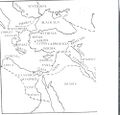
Map of Scythian location


External links
- http://www.csen.org/Pubs_Sales_Reviews/Nomads/Nomad-188579-00-2.pdf
- The Mysterious Scythians Burst Into History
- Ancestral Scythian migration of Jatt people (or Jat people)
- Scythians - Who Were the Scythians
- Scythian Gold From Siberia Said to Predate the Greeks - New York Times | By JOHN VAROLI - Published: January 09, 2002
- Frozen Siberian Mummies Reveal a Lost Civilization | Archaeology | DISCOVER Magazine - by Andrew Curry | From the July 2008 issue; published online June 25, 2008
- The place where Europe began: Spiral cities built on remote Russian plains by swastika-painting Aryans | Mail Online
- Bhim Singh Dahiya: "The Mauryas: Their Identity", Vishveshvaranand Indological Journal, Vol. 17 (1979), p.112-133.
- Origin of the Saka Races - Collapse of the Brahminist Empire (Chapter 3) | by Khshatrapa Gandasa
- http://evans-experientialism.freewebspace.com/sanskrit_exposure.htm
References
- ↑ "Scythian". Encyclopædia Britannica Online
- ↑ Waldman, Carl; Mason, Catherine (2006). Encyclopedia of European Peoples. Infobase Publishing. ISBN 1438129181. Retrieved January 16, 2015. pp. 719–724
- ↑ West, Barbara A. (January 1, 2009). Encyclopedia of the Peoples of Asia and Oceania. Infobase Publishing. ISBN 1438119135, p. 713–717
- ↑ Sinor, Denis (1990). The Cambridge History of Early Inner Asia. Cambridge. ISBN 978-0-521-24304-9. (1990, p. 97)
- ↑ Bonfante, Larissa (2011). "The Scythians: Between Mobility, Tomb Architecture, and Early Urban Structures". The Barbarians of Ancient Europe: Realities and Interactions. Cambridge University Press. ISBN 978-0-521-19404-4. (2011, p. 110)
- ↑ 6.0 6.1 Origin of the Saka Races - Collapse of the Brahminist Empire (Chapter 3) | by Khshatrapa Gandasa
- ↑ Trevaskis (p. 40.)
- ↑ Archaeological Survey Report of India, Vol II, Vanaras, page 193.
- ↑ Kumar, Raj (2008). Encyclopaedia Of Untouchables Ancient, Medieval And Modern. Gyan Publishing House. p. 144. ISBN 8178356643, 9788178356648.
- ↑ Przyluski
- ↑ Tarn
- ↑ Lessman, Thomas. "World History Maps". 2004. Thomas Lessman.
- ↑ Anabasis by Arrian, p. 161, 198, 199, 284.
- ↑ Pliny.vi.19
- ↑ Anabasis by Arrian, p. 161.
- ↑ [1]
- ↑ The Anabasis of Alexander/4a,
- ↑ Olbrycht, Marek Jan (2000). "Remarks on the Presence of Iranian Peoples in Europe and Their Asiatic Relations". In Pstrusińska, Jadwiga [in Polish]; Fear, Andrew (eds.). Collectanea Celto-Asiatica Cracoviensia. Kraków: Księgarnia Akademicka. pp. 101–104. ISBN 978-8-371-88337-8.
- ↑ Sulimirski & Taylor 1991, p. 564-568.
- ↑ Sulimirski & Taylor 1991, p. 560-564.
- ↑ Diakonoff 1985, p. 125-126.
- ↑ Sulimirski & Taylor 1991, p. 560-564.
- ↑ Natural History by Pliny Book VI/Chapter 7
- ↑ Natural History by Pliny Book VI/Chapter 7
- ↑ Natural History by Pliny Book VI/Chapter 11
- ↑ Natural History by Pliny Book VI/Chapter 18
- ↑ Natural History by Pliny Book VI/Chapter 19
- ↑ Natural History by Pliny Book VI/Chapter 29
- ↑ Natural History by Pliny Book VI/Chapter 39
- ↑ Y-STR Haplogroup Diversity in the Jat Population Reveals Several Different Ancient Origins
- ↑ Ivanchik, i
- ↑ Szemerényi, Oswald (1980). Four old Iranian ethnic names: Scythian – Skudra – Sogdian – Saka (PDF). .
- ↑ http://www.livius.org/articles/people/scythians-sacae/ Lendering, Jona (25 January 2017). "Scythians / Sacae". Livius.
- ↑ Di Cosimo, Nicola, "The Northern Frontier in Pre-Imperial China (1,500 – 221 BC)", in: M. Loeuwe, E.L. Shaughnessy, eds, The Cambridge History of Ancient China: From the Origins of Civilization to 221BC, 1999, Cambridge University Press 1999, Template:ISBN
- ↑ Alexander Cunningham: The Ancient Geography of India/Kabul, p. 37
- ↑ YHRD - Y Chromosome Haplotype Reference Database
- ↑ YHRD - Y Chromosome Haplotype Reference Database
- ↑ YHRD - Y Chromosome Haplotype Reference Database
- ↑ YHRD - Y Chromosome Haplotype Reference Database
- ↑ YHRD - Y Chromosome Haplotype Reference Database
- ↑ YHRD - Y Chromosome Haplotype Reference Database
- ↑ YHRD - Y Chromosome Haplotype Reference Database
- ↑ Author: Razib Khan. Article: What the Harappa Ancestry Project has resolved. Magazine: Discover Magazine. Published: 04 August 2013.
- ↑ Annals and Antiquities of Rajasthan, Volume I,, James Todd Annals/Chapter 6 Genealogical history of the Rajput tribes subsequent to Vikramaditya
- ↑ Dhillon, Balbir Singh (1994). History and study of the Jats: with reference to Sikhs, Scythians, Alans, Sarmatians, Goths, and Jutes (illustrated ed.). Canada: Beta Publishers. ISBN 1895603021.
- ↑ Tod, J., (Lt. Col.), Annals and Antiquities of Rajasthan, Vol.1, Routledge & Kegan Paul Ltd., London, 1972 (reprint), first published in 1829, pp. 623.
- ↑ Sir Alexander Cunningham, (Sir, Major-General, and former Director-General of the Archaeological Survey of India), Coins of the Indo-Scythians, Sakas, and Kushans, Indological Book House, Varanasi, India, 1971, first published in 1888, pp. 33.
- ↑ Sir Alexander Cunningham, (Sir, Major-General, and former Director-General of the Archeological Survey of India), Coins of the Indo-Scythians, Sakas, and Kushans, Indological Book House, Varanasi, India, 1971, first published in 1888, pp. 33.
- ↑ Rose, H.A., A Glossary of the Tribes and Castes of the Punjab and North-West Frontier Province, Reprinted by the Languages Dept., Patiala, Punjab, 1970, first published in 1883, pp. 362-363, (Vol. II), 58 (Vol. I).
- ↑ Alexander Cunningham, The Ancient Geography of India: The Buddhist Period, Including the Campaigns of Alexander, and the Travels of Hwen-Thsang (1871), pp. 290-291.
- ↑ Fuchs, Stephen (1973). The Aboriginal Tribes of India (1st ed.). Macmillan Publishers (Holtzbrinck Publishing Group). p. 129. ISBN 0333900227, 9780333900222. Quote: "The overall analysis of the nomadic tribes in northern India suggests that they fall into three main categories: (a) one group belongs to a basically primitive foodgathering and hunting stage of culture; (b) the second group belongs to a more advanced culture of jungle dwellers and primitive cultivators, akin perhaps to the Doms, and the aborigines of north-eastern India in their past; and (c) a third group which probably belonged to originally predatory nomadic tribes, immigrants from central Asia, such as the Jats and Rajputs."
- ↑ Author: Наталья Романовна Гусева (1994). Book: Индия в зеркале веков: религия, быт, культура. Publisher: Российская академия наук, Ин-т этнологии и антропологии им. Н.Н. Миклухо-Маклая. Page: 49. Quote: " Саки были тем этногенетическим пластом, на основе которого сформировались джаты, составляющие и в наше время подавляющую маооу населения Пенджаба. "
- ↑ The Thirty-six Royal Races of Rajput
- ↑ Sir Alexander Cunningham, (Sir, Major-General, and former Director-General of the Archeological Survey of India), Coins of the Indo-Scythians, Sakas, and Kushans, Indological Book House, Varanasi, India, 1971, first published in 1888, pp. 33.
- ↑ Dahiya, B.S., Jats: The Ancient Rulers, Sterling Publishers Pvt. Ltd., New Delhi, India, 1980, pp. 23.
- ↑ Sir John Marshall, (Sir, Hon. Fellow of King's College, Cambridge University, and formerly Director-General of Archaeology in India), A Guide to Taxila, Cambridge University Press, London, 1960, pp. 24.
- ↑ Barstow, A. E., The Sikhs: An Ethnology, Reprinted by B.R. Publishing Corporation, Delhi, India, 1985, first published in 1928, pp. 105-135, 63, 155, 152, 145.
- ↑ Bingley, A. H., Handbooks for the Indian Army: Sikhs, Compiled Under the Orders of the Government of India, Printed at the Government Central Printing Office, Simla, India, 1899, pp. 8-9, 3.
- ↑ Professor J. Pettigrew, Robber Noblemen: A Study of the Political System of the Sikh Jats, Routledge & Kegan Paul Ltd., London, 1975, pp. 25, 238.
- ↑ Professor H. S. Willliams, The Historians' History of the World, 21 Vols., The Outlook Company, New York, 1905, Vol. 2, pp. 481.
- ↑ Professor P. S. Gill, Heritage of Sikh Culture, New Academic Publishing Co., Jullundur, Punjab, 1975, pp. 12-13.
- ↑ Professor T. Sulimirski, The Sarmatians, Praeger Publishers, New York, 1970, pp. 113-114.
- ↑ Rose, H. A., A Glossary of the Tribes and Castes of the Punjab and North-West Frontier Province, Reprinted by the Languages Dept., Patiala, Punjab, 1970, first published in 1883, pp. 362-363, (Vol. II), 58 (Vol. I).
- ↑ Sir H. M. Elliot, Encyclopaedia of Caste, Customs, Rites and Superstitions of the Races of Northern India, Vol. 1, Reprinted by Sumit Publications, Delhi, 1985, first published in 1870, pp. 133-134.
- ↑ Sara, I., The Scythian Origins of the Sikh-Jat, The Sikh Review, March 1978, pp. 26-35.
- ↑ Elphinstone, M. (Hon.), The History of India, Reprinted by Kitab Mahal Private Ltd., Allahabad, India, 1966, first published in 1874, pp. 226-229, 16-17, 12.
- ↑ Mahil, U. S., Antiquity of Jat Race, Atma Ram & Sons, Delhi, India, 1955, pp. 2, 9,14.
- ↑ Hewitt, J. F., The Ruling Races of Prehistoric Times in India, South-Western Asia and Southern Europe, Archibald Constable & Co., London, 1894, pp. 481-487.
- ↑ MacMunn, G. (Sir and Lt. General), The Martial Races of India, Reprinted by Mittal Publications, Delhi, India, 1979, first published in 1932, pp. 21-22.
- ↑ Latif, S. M., History of the Panjab, Reprinted by Progressive Books, Lahore, Pakistan, 1984, first published in 1891, pp. 56.
- ↑ Dr. Singh, G., A History of the Sikh People (1469-1978), World Sikh University Press, Delhi, India, 1979, pp. 11-12.
- ↑ Singh, N., Canadian Sikhs, Canadian Sikhs' Studies Institute, 21 Jay Avenue, Nepean, Ontario, Canada, 1994, pp. 164.
- ↑ Shrava, Satya (1981). The Sakas in India. New Delhi: Pranava Prakashan, 1981.
- ↑ Nijjar, B. S. (2008). Origins And History Of Jats And Other Allied Nomadic Tribes Of India. Atlantic Publishers & Dist. ISBN 8126909080, 9788126909087.
- ↑ Hooja, Rima (2006). A History of Rajasthan. Rupa Publications, India. p. 431. ISBN 8129108909, 9788129108906. Quote: "Jambho-ji provided help to the people and their animals, and became known for this as much as for his piety. Probably he had already started putting his eco-friendly tenets into practice. In the early winter of 1485 November, he formally initiated his uncle, Poolo, as first his disciple. His following grew rapidly thereafter, taking on the shape of a distinct sect. Followers came from different castes and sub-castes, and included the Jats (probably descendants of the Scythians who entered India in early historical times), Rajputs, merchants, as well as lesser castes."
- ↑ Jat History Dalip Singh Ahlawat/Chapter IV (Page 317)
- ↑ Collins, Steven M. (2005). Israel's Tribes Today (illustrated ed.). Book 4 of Lost tribes of Israel, Steven M. Collins.Bible Blessings. ISBN 0972584935, 9780972584937.
- ↑ Israel's Tribes Today - The Two Houses of Israel Information Center
- ↑ Rishi, Weer Rajendra (1982). India & Russia: linguistic & cultural affinity. Roma Publications. p. 95.
- ↑ Rishi, Weer Rajendra (1982). India & Russia: linguistic & cultural affinity. Roma Publications. p. 95. "Some of the Indian writers including Rahul Sankrityayan and Ujagar Singh Mahil in his book "Antiquity of Jat Race" say that Jats inhabiting the northern India are the descendants of Massagetae, or Malta (great) Getae or Jat."
- ↑ Toynbee, Arnold Joseph (1939). A Study of History. Volume 2. London: Oxford University Press. p. 435.
- ↑ Royal Institute of International Affairs; Toynbee, Arnold Joseph (1962). A Study of History (2 ed.). Volume 10. Oxford University Press. p. 54.
- ↑ Rawlinson, George (1873). The sixth great Oriental monarchy: or, The geography, history, & antiquities of Parthia. Longmans, Green, and co. p. 118
- ↑ Rawlinson, George (1893). The story of Parthia. G. P. Putnam's sons. p. 110.
- ↑ Rawlinson, George (2004). The Seven Great Monarchies of the Ancient Eastern World (2, illustrated ed.). Volume 3 of The Seven Great Monarchies of the Ancient Eastern World, Or: The History, Geography and Antiquities of Chaldaea, Assyria, Babylon, Media, Persia, Parthia, and Sassanian, Or the New Persian Empire, George Rawlinson. Gorgias Press LLC. p. 66. ISBN 1593331711, 9781593331719.
- ↑ Rawlinson, George (2007). Parthia. Cosimo, Inc. p. 110. ISBN 160206136X.
- ↑ Rawlinson, George (2010). The Seven Great Monarchies of the Ancient Eastern World: Or, The History, Geography and Antiquities of Chaldæa, Assyria, Babylon, Media, Persia, Parthia, and Sassanian Or New Persian Empire. Volume 3. Nottingham Society. p. 66.
- ↑ Rawlinson, George (2012). The Seven Great Monarchies Of The Ancient Eastern World, Vol 6. (of 7): Parthia The History, Geography, And Antiquities Of Chaldaea, Assyria, Babylon, Media, Persia, Parthia, And Sassanian or New Persian Empire, With Maps and Illustrations. Tredition. ISBN 3847205145, 9783847205142.
- ↑ Burton, Richard Francis (Sir) (2008). The Book of the Sword. Cosimo, Inc. p. 90. ISBN 1605204366, 9781605204369.
- ↑ Scythians - Who Were the Scythians
- ↑ Scythians - Who Were the Scythians
- ↑ Scythians - Livius
- ↑ Scythian (Skythian) : Etymology
- ↑ History and study of the Jats/Chapter 2, p.31
- ↑ Diodorus of Sicily (published around 49 B.C.), translated by C.H. Oldfather, Harvard University Press, Cambridge, Massachusetts, 1936, pp. 27-28 (Vol. II), pp. 377, 382-383 (Vol. VIII).
- ↑ Scythians, The Encyclopaedia Britannica, The New Encyclopaedia Britannica, Inc., Chicago, 1984, pp. 438-442.
- ↑ Prof. B.S. Dhillon: History and study of the Jats/Chapter 6]], pp.
- ↑ Herodotus. The Histories, Penguin Books, Inc., London, 1988. pp. 272-273, 122-128.
- ↑ Herodotus. The Histories, Penguin Books, Inc., London, 1988. pp. 272-273, 122-128.
- ↑ Scythians. in the New Encyclopaedia Britannica. Inc.. Chicago, 1984. pp. 438 442.
- ↑ Talbot-Rice, T., The Scythians, F.A. Praeger, New York, 1961, pp. 43-44,145, 70.
- ↑ Williams. H.S., Chapter II: Scythians and Cimmerians, in the Historians' History of the World, The Outlook Company, New York, 1905, pp. 400-410.
- ↑ Minns, E.H., The Scythians and Northern Nomads, in the Cambridge Ancient History, edited by Bury, J.B., Cook, S.A., Adcock, F.E., Vol. III, The Cambridge University Press, Cambridge, 1954, pp. 179-203.
- ↑ Rolle, R., The World of the Scythians, University of California Press, Berkeley, 1989, pp. 55-57.
- ↑ Mongait, A.L., Archaeology in the USSR, Penguin Books, London, 1961, pp. 165, 157, 160.
- ↑ Mongait, A.L., Archaeology in the USSR, Penguin Books, London, 1961, pp. 165, 157, 160.
- ↑ Williams. H.S., Chapter II: Scythians and Cimmerians, in the Historians' History of the World, The Outlook Company, New York, 1905, pp. 400-410.
- ↑ Trippett, F., The First Horsemen, Time Life Books, New York, 1974.
- ↑ Talbot-Rice, T., The Scythians, F.A. Praeger, New York, 1961, pp. 43-44,145, 70.
- ↑ Rolle, R., The World of the Scythians, University of California Press, Berkeley, 1989, pp. 55-57. ; Mongait, A.L., Archaeology in the USSR, Penguin Books, London, 1961, pp. 165, 157, 160.; ]. Herodotus. The Histories, Penguin Books, Inc., London, 1988. pp. 272-273, 122-128. ; Talbot-Rice, T., The Scythians, F.A. Praeger, New York, 1961, pp. 43-44,145, 70; Williams. H.S., Chapter II: Scythians and Cimmerians, in the Historians' History of the World, The Outlook Company, New York, 1905, pp. 400-410; Minns, E.H., The Scythians and Northern Nomads, in the Cambridge Ancient History, edited by Bury, J.B., Cook, S.A., Adcock, F.E., Vol. III, The Cambridge University Press, Cambridge, 1954, pp. 179-203; Trippett, F., The First Horsemen, Time Life Books, New York, 1974; Minns, E.H., Scythlans and Greeks, Biblo and Tannen, New York, 1965. (Two Vols.) ; Scythians. in the Encyclopaedia Britannica. The New Encyclopaedia Britannica. The New Encyclopaedia Britannica. Inc.. Chicago. 1984. pp. 438-442; Rostovtzeff. M. Iranians (Scythians) And Greeks in South Russia. Russell and Russell. A Division of Atheneum Publishers. Inc., New York, 1922, reprinted in 1969.
- ↑ The Jats:Their Origin, Antiquity and Migrations/The identification of the Jats,p.318
- ↑ Artamonov, M.I.; 'Frozen Tombs of the Scythians', in the Scientific American, May, 1965, Vol. 212, No.5, pp. 100-109.
- ↑ History of the Jats/Chapter II,p. 29-30
- ↑ History of the Jats/Chapter III,p.37
- ↑ Todd's Rajasthan - Urdu edition
- ↑ Arrian: The Anabasis of Alexander/3b, Ch.19