Indo-Scythians
- For specific research-work on the Scythian origin of the Jats, please visit : Indo-Scythian origin of the Jats.

The Indo-Scythians are a branch of the Indo-Iranian Sakas (Scythians) were rulers in Central Asia. [1] They migrated from southern Siberia into Bactria, Sogdiana, Arachosia, Gandhara, Kashmir, Punjab, and into parts of Western and Central India, Gujarat and Rajasthan, from the middle of the 2nd century BCE to the 4th century CE. The first Saka King in India was Maues or Moga who established Saka power in Gandhara and gradually extended supremacy over north-western India. Indo-Scythian rule in India ended with the last Western Satrap Rudrasimha III in 395 CE.
Herodotus reveals that the Scythians as far back as the 5th century B.C. had political control over Central Asia and the northern subcontinent up to the river Ganges. Later Indo-Scythic clans and dynasties (e.g. Mauryas, Rajputs) extended their control to other tracts of the northern subcontinent. The largest Saka imperial dynasties of Sakasthan include the Satraps (204 BC to 78 AD), Kushanas (50 AD - 380), Virkas (420 AD - 640) while others like the Mauryas (324 - 232 BC) and Dharan-Guptas (320 AD - 515) expanded their empires towards the east.[2]
According to Ethnographers and historians like Cunningham, Todd, Ibbetson, Elliot, Ephilstone, Dahiya, Dhillon, Banerjea, etc., the agrarian and artisan communities (e.g. Jats, Gujars, Ahirs, Rajputs, Lohars, Tarkhans etc.) of the entire west are derived from the war-like Scythians;[2] who settled north-western and western South Asia in successive waves between 500 BC to 500 AD.
Trevaskis put the date of Scythian migrations into India approximately from 600 BC to 600 AD. Trevaskis wrote, "Their (Scythians') successive onslaughts proved the ruin of Assyria, and soon after the fall of Nineveh, BC 606, a vast horde of them burst into Punjab."[3]
The 1911 Encyclopedia Britannica says that a Scythian horde was seated at Pattala on the Indus, in 625 BC; this may have been the Sibi.
It is worth noticing that as early as Pāṇini's (पाणिनि) era, the places in-and-around Sialkot are known to have Sakian etymology i.e. ending in "kantha" — Chihankantha, Madarakantha, etc. Even the Archaeological Survey Report of India unearths the fact that the ancient name for Sialkot was Sakala.[4][5] Also, Sakala is thought to be "Saka" town by Przyluski and Tarn.[6][7]
Saka clan is found in Afghanistan. Saka, usually associated with the Ladi, represents the Sakai (Sacae) of the Persians and Greeks, after whom Sistan was named Sakastan[8]
H. W. Bellew writes that Ishak, the Musalman disguise of Saka or Sak, represents the Persian Saka and Greek Sakai, the Skythian conquerors who gave their name to Sistan, the Sagistan of Arab writers, and Sakasthan of Indians. Another branch of Saka Skythians is found in the Sagpae and Sagpue Hazara clans, before noticed. [9]
The invasion of India by Scythian tribes from Central Asia, often referred to as the Indo-Scythian invasion, played a significant part in the history of India as well as nearby countries. In fact, the Indo-Scythian war is just one chapter in the events triggered by the nomadic flight of Central Asians from conflict with Chinese tribes which had lasting effects on Bactria, Kabol, Parthia and India as well as far off as Rome in the west.
The Scythian groups that invaded India and set up various kingdoms, may have included besides the Sakas other allied tribes, such as the Parama Kambojas, Bahlikas, Rishikas and Paradas.
Origins
The ancestors of the Indo-Scythians are thought to be Sakas (Scythian) tribes, originally settled in southern Siberia, in the Ili river area.
- Legendary Origins of the Scythians
N. S. Gill writes:
- "A rightly skeptical Herodotus says the Scythians claimed the first man to exist in the region -- at a time when it was desert and about a millennium before Darius of Persia -- was named Targitaos. He was the son of Zeus and the daughter of the river Borysthenes. Targitaos had three sons from whom the tribes of the Scythians sprang. Another legend Herodotus reports connects the Scythians with Hercules and Echidna."[10]
Etymology
N. S. Gill writes:
- "The Greek epic poet Hesiod called the northern tribes hippemolgi 'mare milkers'. The Greek historian Herodotus refers to the European Scythians as Scythians and the eastern ones as Sacae. The name Scythians and Sacae applied to themselves was Skudat 'archer'. Later, the Scythians were sometimes called Getae. The Persians also called the Scythians, Sakai. Scythians, who attacked the kingdom of Urartu in Armenia, were called Ashguzai or Ishguzai by the Assyrians. The Scythians may have been the Biblical Ashkenaz."[11]
"The first to describe the life style of these tribes was a Greek researcher, Herodotus, who lived in the fifth century BCE. Although he concentrates on the tribes living in modern Ukraine, which he calls Scythians, we may extrapolate his description to people in Kazakhstan, Turkmenistan, Uzbekistan, Tajikistan, Kyrgyzstan and possibly Mongolia, even though Herodotus usually calls these eastern nomads 'Sacae'. In fact, just as the Scythians and the Sacae shared the same life style, they had the same name: in their own language, which belonged to the Indo-Iranian family, they called themselves Skudat ('archers'?). The Persians rendered this name as Sakâ and the Greeks as Skythai. The Chinese called them, at a later stage in history, Sai."[12][13]
Yuezhi expansion
In the second century BCE, a fresh nomadic movement started among the Central Asian tribes, producing lasting effects on the history of Rome in Europe and Bactria, Kabol, Parthia and India in the east. Recorded in the annals of the Han dynasty and other Chinese records, this great tribal movement began after the Yuezhi Chinese tribe fled westwards after their defeat by the neighbouring Hiung-nu, creating a domino effect as the Yuezhi displaced other central Asian tribes in their path.
According to these ancient sources Mao-tun of the Hsiung-nu tribe of Mongolia attacked the Yue-chi and evicted them from their homeland Kansu (Nan-shan).[14] Leaving behind a remnant of their number, most of the population moved westwards, and following the route north of Takla Makan, entered the lands of the Haumavarka Sakas of Issyk-kul Lake through the passes of Tien-shan. Unable to withstand the assault, the Haumavarka Sakas allowed the Yue-chi to settle in their lands. In the years to come, the Haumavarka Sakas (Sakas of Wu-sun?) sought the help of the Hsiung-nu people and evicted the Yue-chi.
Even so, the initial clash with the invading Yue-chi caused a large group of the Haumavarka Shakas to leave their ancestral home. These Sakas journeyed through Tashkent and Ferghana (Sogdiana) (inhabited by the Sugud or Shulik tribe of the Iranians) and occupied the Doab of Oxus and Jaxartes, also overrunning the Greek kingdom of Bactria, occupying most of its western parts.[15] Others suggest Tukhara (India and Central Asia, 1955, p 125, Dr P. C. Bagch). Dr D. C. Sircar reconciles the difference by suggesting that Ta-hia referred to Tukhara and the eastern parts of Bactria.[16]
After being defeated and evicted by the joint forces of the Wu-sun and Hsiung-nu people, the Ta Yue-chis also moved southwards, overrunning in their path the Rishikas, Parama-Kambojas, Lohas and other allied Scythian clans living in the Transoxian regions as far Fargana. Many fled in a southwesterly direction and joined the Haumavarka Sakas in Bactria. The Yue-chi followed behind. Once again under extreme pressure, the Sakas and other allied Scythian groups including the Kambojas were forced to leave Bactria.
They first tried to enter India via the Kabol valley but were vigorously opposed by the Greek powers there. Rebuffed, the clans turned westwards to Herat and then took a southerly direction, reaching Helmund valley (Sigal) in south-west Afghanistan, the region later called Sakasthan or Seistan. Scholars believe that this Scythian migration through Herat to Drangiana was accompanied by groups of Kambojas (Parama-Kambojas), Rishikas and other allied tribes from Transoxiana that were also displaced by the Yue-chi.[17][18]
Around 175 BCE, the Yuezhi tribes (probable related to the Tocharians) who lived in eastern Tarim Basin area, were defeated by the Hiung-nu (Huns) tribes, and had to migrate towards the West into the Ili river area. There, they displaced the Sakas, who had to migrate south into Ferghana and Sogdiana. According to the Chinese historical chronicles (who call the Sakas, "Sai" 塞):
"The Yuezhi attacked the king of the Sai who moved a considerable distance to the south and the Yuezhi then occupied his lands" (Han Shu 61 4B).
Sometime after 155 BCE, the Yuezhi were again defeated by an alliance of the Wusun and the Hiung-nu, and were forced to move south, again displacing the Scythians, who migrated south towards Bactria, and south-west towards Parthia and Afghanistan.
The Sakas seem to have entered the territory of the Greco-Bactrian Kingdom around 145 BCE, where they burnt to the ground the Greek city of Alexandria on the Oxus. The Yuezhi remained in Sogdiana on the northern bank of the Oxus, but they became suzerains of the Sakas in Bactrian territory, as described by the Chinese ambassador Zhang Qian who visited the region around 126 BCE.
In Parthia, between 138 BCE-124 BCE, the Sakas tribes of the Massagetae and Sacaraucae came into conflict with the Parthian Empire, winning several battles, and killing successively king Phraates II and king Artabanus I of Parthia.
The Parthian king Mithridates II of Parthiafinally retook control of Central Asia, first by defeating the Yuezhi in Sogdiana in 115 BCE, and then defeating the Scythians in Parthia and Seistan around 100 BCE.
After their defeat, the Yuezhi tribes migrated into Bactria, which they were to control for several centuries, and from which they later conquered northern India to found the Kushan Empire. The area of Bactria they settled came to be known as Tokharistan, since the Yuezhi were called Tocharians by the Greeks.
DNA study on Y-STR Haplogroup Diversity in the Jat Population
David G. Mahal and Ianis G. Matsoukas[19] conducted a scientific study on Y-STR Haplogroup Diversity in the Jat Population of which brief Conclusion is as under:
The Jats represent a large ethnic community that has inhabited the northwest region of India and Pakistan for several thousand years. It is estimated the community has a population of over 123 million people. Many historians and academics have asserted that the Jats are descendants of Aryans, Scythians, or other ancient people that arrived and lived in northern India at one time. Essentially, the specific origin of these people has remained a matter of contention for a long time. This study demonstrated that the origins of Jats can be clarified by identifying their Y-chromosome haplogroups and tracing their genetic markers on the Y-DNA haplogroup tree. A sample of 302 Y-chromosome haplotypes of Jats in India and Pakistan was analyzed. The results showed that the sample population had several different lines of ancestry and emerged from at least nine different geographical regions of the world. It also became evident that the Jats did not have a unique set of genes, but shared an underlying genetic unity with several other ethnic communities in the Indian subcontinent. A startling new assessment of the genetic ancient origins of these people was revealed with DNA science.
The human Y-chromosome provides a powerful molecular tool for analyzing Y-STR haplotypes and determining their haplogroups which lead to the ancient geographic origins of individuals. For this study, the Jats and 38 other ethnic groups in the Indian subcontinent were analyzed, and their haplogroups were compared. Using genetic markers and available descriptions of haplogroups from the Y-DNA phylogenetic tree, the geographic origins and migratory paths of their ancestors were traced.
The study demonstrated that based on their genetic makeup, the Jats belonged to at least nine specific haplogroups, with nine different lines of ancestry and geographic origins. About 90% of the Jats in our sample belonged to only four different lines of ancestry and geographic origins:
1. Haplogroup L (36.8%)- The origins of this haplogroup can be traced to the rugged and mountainous Pamir Knot region in Tajikistan.
2. Haplogroup R (28.5%): From somewhere in Central Asia, some descendants of the man carrying the M207 mutation on the Y chromosome headed south to arrive in India about 10,000 years ago (Wells, 2007). This is one of the largest haplogroups in India and Pakistan. Of its key subclades, R2 is observed especially in India and central Asia.
3. Haplogroup Q (15.6%): With its origins in central Asia, descendants of this group are linked to the Huns, Mongols, and Turkic people. In Europe it is found in southern Sweden, among Ashkenazi Jews, and in central and Eastern Europe such as, the Rhône-Alpes region of France, southern Sicily, southern Croatia, northern Serbia, parts of Poland and Ukraine.
4. Haplogroup J (9.6%): The ancestor of this haplogroup was born in the Middle East area known as the Fertile Crescent, comprising Israel, the West Bank, Jordon, Lebanon, Syria, and Iraq. Middle Eastern traders brought this genetic marker to the Indian subcontinent (Kerchner, 2013).
5.-9. Haplogroups E, G, H, I, T (9.5%): The ancestors of the remaining five haplogroups E, G, H, I, and T can be traced to different parts of Africa, Middle East, South Central Asia, and Europe (ISOGG, 2016).
Therefore, attributing the origins of this entire ethnic group to loosely defined ancient populations such as, Indo-Aryans or Indo-Scythians represents very broad generalities and cannot be supported. The study also revealed that even with their different languages, religions, nationalities, customs, cuisines, and physical differences, the Jats shared their haplogroups with several other ethnic groups of the Indian subcontinent, and had the same common ancestors and geographic origins in the distant past. Based on recent developments in DNA science, this study provided new insights into the ancient geographic origins of this major ethnic group in the Indian subcontinent. A larger dataset, particularly with more representation of Muslim Jats, is likely to reveal some additional haplogroups and geographical origins for this ethnic group.
Jat clans from Sakas
Hukum Singh Panwar [20] writes:
The next source at our disposal is "The Political and social Movements in Ancient Panjab" written by Dr. Buddha Prakash who has meticulously sorted out the Saka tribes which were assimilated in our society. However, with a few exceptions, he does not declare them Jats whereas our experience and a perusal of the names or Gotras of the Jat tribes unerringly attest that they also are included in the Jats. According to him, the Saka Tigarkhauda are the Massagetae (Maha Jats) and the Soma or Haumavarka Sakas or the Amyrgians of the Greek writers (V.S. Aggarwal, 1963: 443,467) or the Sakaraucae of Wessendonk or the Sakarucae of Marquart are the Baltis or Ladakhis Somas of Afghanistan and the Virkas of the Panjab, the last two of whom are undoubtedly Jats.
The Srnjayas or the Parthians of the Mahabharata and of Shafer (1954: 138.) or the Sarangai of Herodotus or the Zranke of the Achaemenian Inscriptions or the Sir-re-anke of the Elamite records or the Saragoi of Arrian or the Dragiane of Strabo (in Seistan) or the descendents of Narishyanta, the progenitor of the Sakas, (are the Jats), known in the Mahabharata and the Rigveds as Srnjayas, the sons of the Sickle (Hewitt, 1972: 481) (survived by the Siringi or Singar or Singhar or Singhal or Sangar or Sanghar tribes in the Jats).
The Neuris (Nur or Nuri Jats), Salva (Salu Jats), Arjunayan or the Kathoi and Kathoi and Kathroi (Kshatriyas or Khatri Jats) are the Jun and Rajayan tribes in the Jats. The Karaskaras (Upadhyaya, 1973: 84-Guptas or Karaskara Jats) are modern Khokhars. The Thakurs or Thakaras or Thakran or Thagora or Taugara or Tokhi are from the Tukharas (Yueh-Chih) and the Soi and Sikkas, Kajal or Kuzul or Khosla, Kanka, now Kangs; Sulikas or Solgi or Solkah or Solanki or Sulki; Lampaka or Lambaka or Lamba; Kirata (or Kira or Kirah) are mostly from the Sakas of Sogdiana. The Mehra and Moga or Mogha are from the Megas (the Saka Brahmans). Chaul (or Chol or Cholak), Jaula, Tomar, Khatri, Khan or Khanua and Sahi, Wusun or Wasan or
The Jats:Their Origin, Antiquity and Migrations:End of page 325
Wassan are from the White Ephthalites or Huns. Hun or Hoon is also a tribe of the Jats and Khatris. The Her Jats are the descendents of the Heraios Kushanas from the Sakas.
According to Vishwa Mitra Mohan (1976: 84f), the Gakhar Jats are a fierce Scythian tribe spread over Sindh, eastern and western Panjab upto Khyber pass in the Frontier Province. The Khar or Kher or Kharata or Khareta and possibly the Kharb Jats are the descendents of the Saka Ksharatas mentioned in the Indian Epigraphs or the Karatai Scythians. In the end, it may be said that B.S.Dahiya has done a good job and his book is a compendium of the Jat tribes living in India and abroad. But lack of space does not allow us to repeat what he has laboured to bring before us from the misty lap of time and space.
Settlement in Sakastan

The Sakas settled in areas of southern Afghanistan, still called after them Sakastan. From there, they progressively expanded into the Indian subcontinent, where they established various kingdoms, and where they are known as "Indo-Scythians".
The Arsacid emperor Mithridates II (c 123-88/87 BCE) had scored many successes against the Scythians and added many provinces to the Parthian empire,[21] and apparently the Bactrian Scythian hordes were also conquered by him. A section of these people moved from Bactria to Lake Helmond in the wake of Yue-chi pressure and settled about Drangiana (Sigal), a region which later came to be called "Sakistana of the Skythian (Scythian) Sakai",[22] towards the end of first century BCE.[23] The region is still known as Seistan.
Sakistan or Seistan of Drangiana may not only have been the habitat of the Saka alone but may also have contained population of the Pahlavas and the Kambojas.[24] The Rock Edicts of king Ashoka only refer to the Yavanas, Kambojas and the Gandharas in the northwest, but no mention is made of the Sakas, who imigrated in the region more than a century later. It is thus likely that the immigrant Saka populations who settled in Afghanistan did so among or near the Kambojas and nearby Greek cities.[25] Numerous scholars believe that during centuries immediately preceding Christian era, there had occurred extensive social and cultural admixture among the Kambojas and Yavanas; the Sakas and Pahlavas; and the Kambojas, Sakas, and Pahlavas etc.... such that their cultures and social customs had become almost identical.
The presence of the Sakas in Sakastan in the 1st century BCE is mentioned by Isidore of Charax in his "Parthian stations". He explained that they were bordered at that time by Greek cities to the east (Alexandria of the Caucasus and Alexandria of the Arachosians), and the Parthian-controlled territory of Arachosia to the south:
- "Beyond is Sacastana of the Scythian Sacae, which is also Paraetacena, 63 schoeni. There are the city of Barda and the city of Min and the city of Palacenti and the city of Sigal; in that place is the royal residence of the Sacae; and nearby is the city of Alexandria (and nearby is the city of Alexandropolis), and six villages." Parthian stations, 18.[26]
Kantha Ending names
V. S. Agrawala[27] writes that Panini mentions village name in category ending Kanthā (IV.2.142) - Panini gives the interesting information that Kantha ending was in use in Ushinara (II.4.20)
[p.68]: and Varnu (Bannu (IV.2.103). He names the following places:
Chihaṇakantha, Maḍarakantha, Vaitulakantha, Paṭatkakantha, Vaiḍalikarṇakantha, Kukkuṭakantha, Chitakaṇakakantha.
Kanthā was a Saka word for a town as in the expression kadahvara= kanthāvara occurring in a Khroshthi inscription. "Here belongs Sogdian expression kanda- "city" and Saka kantha "city" earlier attested in Markantha". H W Bellew also points out that Persian word Kand, Khotanese Kanthā, Sogdian, Buddhist Sanskrit kndh Pasto Kandai, Asica (the dielect of Rishikas or Yuchi) kandā are all akin to Sanskrit Kanthā.
It may be noted that in the time of Panini and as stated by Darius I, in his Inscriptions, the Shakas were living beyond Oxus. That region naturally still abounds in Kanthā-ending place names, such as Samarkand, Khokand, Chimkand, Tashkent, Panjkand, Yarkand, all indicating Saka influence.
The Mahabharata speaks of the Sakas as living in this region, named by it as Sakadvipa, and particularly mentions places like Chakshu (=Oxus), Kumud (=Komedai of Herodotus, a mountain in the Shaka country), Himavat (=Hemodan mountain), Sita (=Yarkand River, Kaumara (=Komarai of Herodotus), Mashaka (=Masagetai of Strabo, Rishika (=Asioi, Tushara (=Tokarai).
Panini must also have known Shakas, not in Seistan but in their original home in Central Asia.
[p.69]: How a string of kanthā-ending place names was found in Ushinara country in the heart of Punjab, is an unexplained problem. It points to an event associated with Shaka history even before Panini, possibly an intrusion which left its relics in place names before the Saka contact with India in the second century BC. Katyayana mentions Shakandhu and Karkandhu, two kinds of wells of the Shakas and Karkas (Karkians), which may be identified as the stepped well (vāpī) and the Persian wheel (arghaṭṭa) well respectively.
Lastly we owe to the Kasika the following names ending in kanthā: Saushamikantha and Āhvarakantha both in Ushinara country in Vahika (II.4.20).
Mention by Pliny
Pliny[28] mentions The nations of Scythia and the countries on the eastern ocean.....The multitude of these Scythian nations is quite innumerable: in their life and habits they much resemble the people of Parthia.
The tribes among them that are better known are the Sacæ, the Massagetæ,2 the Dahæ,3 the Essedones,4 the Ariacæ,5 the Rhymmici, the Pæsici, the Amardi,6 the Histi, the Edones, the Came, the Camacæ, the Euchatæ,7 the Cotieri, the Anthusiani, the Psacæ, the Arimaspi,8 the Antacati, the Chroasai, and the Œtei; among them the Napæi9 are said to have been destroyed by the Palæi.
2 Meaning the "Great Getæ." They dwelt beyond the Jaxartes and the Sea of Aral, and their country corresponds to that of the Khirghiz Tartars in the north of Independent Tartary.
3 The Dahæ were a numerous and warlike Nomad tribe, who wandered over the vast steppes lying to the east of the Caspian Sea. Strabo has grouped them with the Sacæ and Massagetæ, as the great Scythian tribes of Inner Asia, to the north of Bactriana.
4 See also B. iv. c. 20, and B. vi. c. 7. The position of the Essedones, or perhaps more correctly, the Issedones, may probably be assigned to the east of Ichim, in the steppes of the central border of the Kirghiz, in the immediate vicinity of the Arimaspi, who dwelt on the northern declivity of the Altaï chain. A communication is supposed to have been carried on between these two peoples for the exchange of the gold that was the produce of those mountain districts.
5 They dwelt, according to Ptolemy, along the southern banks of the Jaxartes.
6 Or the Mardi, a warlike Asiatic tribe. Stephanus Byzantinus, following Strabo, places the Amardi near the Hyrcani, and adds, "There are also Persian Mardi, without the a;" and, speaking of the Mardi, he mentions them as an Hyrcanian tribe, of predatory habits, and skilled in archery.
7 D'Anville supposes that the Euchatæ may have dwelt at the modern Koten, in Little Bukharia. It is suggested, however, by Parisot, that they may have possibly occupied a valley of the Himalaya, in the midst of a country known as "Cathai," or the "desert."
8 The first extant notice of them is in Herodotus; but before him there was the poem of Aristeas of Proconnesus, of which the title was 'Arimaspea;' and it is mainly upon the statements in it that the stories told relative to this people rest—such as their being one-eyed, and as to their stealing the gold from the Gryphes, or Griffins, under whose custody it was placed. Their locality is by some supposed to have been on the left bank of the Middle Volga, in the governments of Kasan, Simbirsk, and Saratov: a locality which is sufficiently near the gold districts of the Uralian chain to account for the legends connecting them with the Gryphes, or guardians of the gold.
9 The former reading was, "The Napæi are said to have perished as well as the Apellæi." Sillig has, however, in all probability, restored the correct one. "Finding," he says, "in the work of Diodorus Siculus, that two peoples of Scythia were called, from their two kings, who were brothers, the Napi and the Pali, we have followed close upon the footsteps of certain MSS. of Pliny, and have come to the conclusion that some disputes arose between these peoples, which ultimately led to the destruction of one of them."
Indo-Scythian kingdoms
Abiria to Surastrene
The first Indo-Scythian kingdom in the Indian subcontinent occupied the southern part of Pakistan (which they accessed from southern Afghanistan), in the areas from Abiria (Sindh) to Surastrene (Gujarat), from around 110 to 80 BCE. They progressively further moved north into Indo-Greek territory until the conquests of Maues, circa 80 BCE.
The 1st century CE Periplus of the Erythraean Sea describes the Scythian territories there:
- "Beyond this region (Gedrosia), the continent making a wide curve from the east across the depths of the bays, there follows the coast district of Scythia, which lies above toward the north; the whole marshy; from which flows down the river Sinthus, the greatest of all the rivers that flow into the Erythraean Sea, bringing down an enormous volume of water (...) This river has seven mouths, very shallow and marshy, so that they are not navigable, except the one in the middle; at which by the shore, is the market-town, Barbaricum. Before it there lies a small island, and inland behind it is the metropolis of Scythia, Minnagara."[29]
The Indo-Scythians ultimately established a kingdom in the northwest, based in Taxila, with two Great Satraps, one in Mathura in the east, and one in [Surastrene (Gujarat) in the southwest.
In the southeast, the Indo-Scythians invaded the area of Ujjain, but were subsequently repelled in 57 BCE by the Malwa king Vikramaditya. To commemorate the event Vikramaditya established the Vikrama era, a specific Indian calendar starting in 57 BCE. More than a century later, in 78 CE the Sakas would again invade Ujjain and establish the Saka era, marking the beginning of the long-lived Saka Western Satraps kingdom.[30]
Gandhara and Punjab
The presence of the Scythians in north-western India during the 1st century BCE was contemporary with that of the Indo-Greek Kingdoms there, and it seems they initially recognized the power of the local Greek rulers.
Maues first conquered Gandhara and Taxila around 80 BCE, but his kingdom disintegrated after his death. In the east, the Indian king Vikrama retook Ujjain from the Indo-Scythians, celebrating his victory by the creation of the Vikrama Era (starting 58 BCE). Indo-Greek kings again ruled after Maues, and prospered, as indicated by the profusion of coins from kings Apollodotus II and Hippostratos. Not until Azes I, in 55 BCE, did the Indo-Scythians take final control of northwestern India, with his victory over Hippostratos.
Mathura area ("Northern Satraps")
In central India, the Indo-Scythians conquered the area of Mathura over Indian kings around 60 BCE. Some of their satraps were Hagamasha and Hagana, who were in turn followed by the Saca Great Satrap Rajuvula.
The Mathura lion capital, an Indo-Scythian sandstone capital in crude style, from Mathura in Central India, and dated to the 1st century CE, describes in kharoshthi the gift of a stupa with a relic of the Buddha, by Queen Nadasi Kasa, the wife of the Indo-Scythian ruler of Mathura, Rajuvula. The capital also mentions the genealogy of several Indo-Scythian satraps of Mathura.
Rajuvula apparently eliminated the last of the Indo-Greek kings Strato II around 10 CE, and took his capital city, Sagala.
The coinage of the period, such as that of Rajuvula, tends to become very crude and barbarized in style. It is also very much debased, the silver content becoming lower and lower, in exchange for a higher proportion of bronze, an alloying technique (billon) suggesting less than wealthy finances.
The Mathura Lion Capital inscriptions attest that Mathura fell under the control of the Sakas. The inscriptions contain references to Kharaosta Kamuio and Aiyasi Kamuia. Yuvaraja Kharostes (Kshatrapa) was the son of Arta as is attested by his own coins.[31] Arta is stated to be brother of king Moga or Maues.[32] Princess Aiyasi Kambojaka, also called Kambojika, was the chief queen of Shaka Mahakshatrapa Rajuvula. Kamboja presence in Mathura is also verified from some verses of epic Mahabharata which are believed to have been composed around this period.[33] This may suggest that Sakas and Kambojas may have jointly ruled over Mathura/Uttara Pradesh. It is revealing that Mahabharata verses only attest the Kambojas and Yavanas as the inhabitants of Mathura, but do not make any reference to the Sakas.[34] Probably, the epic has reckoned the Sakas of Mathura among the Kambojas (Dr J. L. Kamboj) or else have addressed them as Yavanas, unless the Mahabharata verses refer to the previous period of invasion occupation by the Yavanas around 150 BCE.
The Indo-Scythian satraps of Mathura are sometimes called the "Northern Satraps", in opposition to the "Western Satraps" ruling in Gujarat and Malwa. After Rajuvula, several successors are known to have ruled as vassals to the Kushans, such as the "Great Satrap" Kharapallana and the "Satrap" Vanaspara, who are known from an inscription discovered in Sarnath, and dated to the 3rd year of Kanishka (circa 130 CE), in which they were paying allegiance to the Kushans.[35]
Pataliputra
The text of the Yuga Purana describes an invasion of Pataliputra by the Scythians sometimes during the 1st century BCE, after seven greats kings had ruled in succession in Saketa following the retreat of the Yavanas. The Yuga Purana explains that the king of the Sakas killed one fourth of the population, before he was himself slain by the Kalinga king Shata and a group of Sabalas (Sabaras).[36]
Kushan and Indo-Parthian conquests
After the death of Azes II, the rule of the Indo-Scythians in northwestern India finally crumbled with the conquest of the Kushans, one of the five tribes of the Yuezhi who had lived in Bactria for more than a century, and were now expanding into India to create a Kushan Empire. Soon after, the Parthians invaded from the west. Their leader Gondophares temporarily displaced the Kushans and founded the Indo-Parthian Kingdom that was to last towards the middle of the 1st century CE.
The Kushans ultimately regained northwestern India from around 75 CE, and the area of Mathura from around 100 CE, where they were to prosper for several centuries.
Western Kshatrapas legacy
The Indo-Scythians continued to hold the area of Seistan until the reign of Bahram II (276-293 CE), and held several areas of India well into the 1st millennium: Kathiawar and Gujarat were under their rule until the 5th century under the designation of Western Kshatrapas, until they were eventually conquered by the Gupta emperor Chandragupta II (also called Vikramaditya).
The Brihat-Katha-Manjari of the Kshmendra (10/1/285-86) informs us that around 400 CE the Gupta king Vikramaditya (Chandragupta II) had unburdened the sacred earth of the Barbarians like the Shakas, Mlecchas, Kambojas, Yavanas, Tusharas, Parasikas, Hunas, etc. by annihilating these sinners completely.
The 10th century CE Kavyamimamsa of Raj Shekhar (Ch 17) still lists the Shakas, Tusharas, Vokanas, Hunas, Kambojas, Bahlikas, Pahlavas, Tangana, Turukshas, etc. together and states them as the tribes located in the Uttarapatha division.
Indo-Scythian coinage

Indo-Scythian coinage is generally of a high artistic quality, although it clearly deteriorates towards the desintegration of Indo-Scythian rule around 20 CE (coins of Rajuvula). A fairly qualitative but rather stereotypes coinage would continue with the Western Satraps until the 4th century CE.
Indo-Scythian coinage is generally quite realistic, artistically somewhere between Indo-Greek and Kushan coinage. It is often suggested Indo-Scythian coinage benefited from the help of Greek celators (Boppearachchi).
Indo-Scythian coins essentially continue the Indo-Greek tradition, bu using the Greek language on the obverse and the Kharoshthi language on the reverse. The portrait of the king is never shown however, and is replaced by depictions of the king on horse (and sometimes on camel), or sometimes sitting cross-legged on a cushion. The reverse of their coins typically show Greek divinities.
Buddhist symbolism is present throughout Indo-Scythian coinage. In particular, they adopted the Indo-Greek practice since Menander I of showing divinities forming the vitarka mudra with their right hand (as for the mudra-forming Zeus on the coins of Maues or Azes II), or the presence of the Buddhist lion on the coins of the same two kings, or the triratana symbol on the coins of Zeionises.
Depiction of Indo-Scythians

Besides coinage, few works of art are known to indisputably represent Indo-Scythians. Indo-Scythians rulers are usually depicted on horseback in armour, but the coins of Azilises show the king in a simple, undecorated, tunic.
Several Gandharan sculptures also show foreigner in soft tunics, sometimes wearing the typical Scythian cap. They stand in contrast to representations of Kushan men, who seem to wear thicks, rigid, tunics, and who are generally represented in a much more simplistic manner[37]
Buner reliefs
Indo-Scythian soldiers in military attire are sometimes represented in Buddhist friezes in the art of Gandhara (particularly in Buner reliefs). They are depicted in ample tunics with trousers, and have heavy straight sword as a weapon. They wear a pointed hood (the Scythian cap or bashlyk), which distinguishes them from the Indo-Parthians who only wore a simple fillet over their bushy hair,[38] and which is also systematically worn by Indo-Scythian rulers on their coins. With the right hand, some of them are forming the Karana mudra against evil spirits. In Gandhara, such friezes were used as decorations on the pedestals of Buddhist stupas. They are contemporary with other friezes representing people in purely Greek attire, hinting at an intermixing of Indo-Scythians (holding military power) and Indo-Greeks (confined, under Indo-Scythian rule, to civilian life).
Another relief is known where the same type of soldiers are playing musical instruments and dancing, activities which are widely represented elsewhere in Gandharan art: Indo-Scythians are typically shown as reveling devotees.
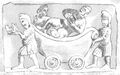
Indo-Scythians pushing along the Greek god Dyonisos with Ariadne.[39]
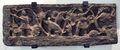
Hunting scene.
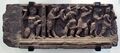
Hunting scene.
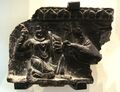
Hunting scene.


Stone palettes
Main article: Stone palette
Numerous stone palettes found in Gandhara are considered as good representatives of Indo-Scythian art. These palettes combine Greek and Iranian influences, and are often realized in a simple, archaic style. Stone palettes have only been found in archaeological layers corresponding to Indo-Greek, Indo-Scythian and Indo-Parthian rule, and are essentially unknown the preceding Mauryan layers or the succeeding Kushan layers.[40]
Very often these palettes represent people in Greek dress in mythological scenes, a few in Parthian dress (head-bands over bushy hair, crossed-over jacket on a bare chest, jewelry, belt, baggy trousers), and even fewer in Indo-Scythian dress (Phrygian hat, tunic and comparatively straight trousers). A palette found in Sirkap and now in the New Delhi Museum shows a winged Indo-Scythian horseman riding winged deer, and being attacked by a lion.
The Indo-Scythians and Buddhism

The Indo-Scythians seem to have been followers of Buddhism, and many of their practices apparently continued those of the Indo-Greeks. They are known for their numerous Buddhist dedications, recorded through such epigraphic material as the Taxila copper plate inscription or the Mathura lion capital inscription.
Butkara Stupa


Excavation at the Butkara Stupa in Swat by an Italian archaeological team have yielded various Buddhist sculptures thought to belong to the Indo-Scythian period. In particular, an Indo-Corinthian capital representing a Buddhist devotee within foliage has been found which had a reliquary and a coins of Azes II buried at its base, securely dating the sculpture to around 20 BCE.[43] A contemporary pilaster with the image of a Buddhist devotee in Greek dress has also been found at the same spot, again suggesting a mingling of the two populations.[44] Various reliefs at the same location show Indo-Scythians with their characteristics tunics and pointed hoods within a Buddhist context, and side-by-side with reliefs of standing Buddhas.[45]
Gandharan sculptures
Other reliefs have been found, which show Indo-Scythian men with their characteristic pointed cap pushing a cart on which is reclining the Greek god Dyonisos with his consort Ariadne.
Mathura lion capital
The Mathura lion capital, which associates many of the Indo-Scythian rulers from Maues to Rajuvula, mentions a dedication of a relic of the Buddha in a stupa. It also bears centrally the Buddhist symbol of the triratana, and is also filled with mentions of the bhagavat Buddha Sakyamuni, and characteristically Buddhist phrases such as:
- "sarvabudhana puya dhamasa puya saghasa puya"
- "Revere all the Buddhas, revere the dharma, revere the sangha"
- (Mathura lion capital, inscription O1/O2)
- PilarImage4.jpg
Indo-Corinthian capital from Butkara Stupa, dated to 20 BCE, during the reign of Azes II. Turin City Museum of Ancient Art.
- DancingIndoScythians.jpg
Dancing Indo-Scythians (top) and hunting scene (bottom). Buddhist relief from Swat, Gandhara.
- ButkaraDoorJamb.jpg
Butkara door jamb, with Indo-Scythians dancing and reveling. On the back side is a relief of a standing Buddha[46]
- IndoScythiansAndBuddha.jpg
Devotees of the Buddha in Indo-Scythian clothes (top), and erotical scene (bottom), Butkara stupa.
Indo-Scythians in Western sources
The presence of Scythian territory in northwestern India, and especially around the mouth of the Indus is mentioned extensively in Western maps and travel descriptions of the period. The Ptolemy world map, as well as the Periplus of the Erythraean Sea mention prominently Scythia in the Indus area, as well as Roman Tabula Peutingeriana. The Periplus states that Minnagara was the capital of Scythia, and that Parthian king were fighting for it during the 1st century CE. It also distinguishes Scythia with Ariaca further east (centered in Gujarat and Malwa), over which ruled the Western Satrap king Nahapana.
Indo-Scythians in Indian literature
- Main article: Sakas
The Indo-Scythians were named "Shaka" in India, an extension on the name Saka used by the Persians to designate Scythians. From the time of the Mahabharata wars (1500-500 BCE) Shakas receive numerous mentions in texts like the Puranas, the Manusmriti, the Ramayana, the Mahabharata, the Mahabhasiya of Patanjali, the Brhat Samhita of Vraha Mihira, the Kavyamimamsa, the Brihat-Katha-Manjari, the Katha-Saritsagara and several other old texts. They are described as part of an amalgam of other war-like tribes from the northwest.
"Degraded Kshatriyas" from the northwest
The Manusmriti, written about CE, groups the Shakas with the Yavanas, Kambojas, Paradas, Pahlavas, Kiratas and the Daradas etc..., and addresses them all as degraded warriors, or Kshatriyas (X/43-44). Anushasanaparava of the Mahabharata also views the Shakas, Kambojas, Yavanas etc. in the same light. Patanjali in his Mahabhasya regards the Shakas and Yavanas as pure Shudras (II.4.10).
The Vartika of the Katyayana informs us that the kings of the Shakas and the Yavanas, like those of the Kambojas, may also be addressed by their respective tribal names.
The Mahabharata also associates the Shakas with the Yavanas, Gandharas, Kambojas, Pahlavas, Tusharas, Sabaras, Barbaras etc and addresses them all as the Barbaric tribes of Uttarapatha. In another verse, the epic groups the Shakas Kambojas and Khashas and addresses them as the tribes from Udichya i.e. north division (5/169/20). Also, the Kishkindha Kanda of the Ramayana locates the Shakas, Kambojas, Yavanas and Paradas in the extreme north-west beyond the Himavat (i.e. Hindukush) (43/12).
The Udyogaparava of the Mahabharata (5/19/21-23) tells us that the composite army of the Kambojas, Yavanas and Shakas had participated in the Mahabharata war under the supreme command of Sudakshina Kamboja. The epic repeatedly applauds this composite army as being very fierce and wrathful.
Invasion of India (180 BCE onward)
The Vanaparava of the Mahabharata contains verses in the form of prophecy that the kings of the Shakas, Yavanas, Kambojas, Bahlikas and Abhiras, etc. shall rule unrighteously in Kaliyuga (MBH 3/188/34-36).
This reference apparently alludes to the precarious political scenario following the collapse of Mauryan and Sunga dynasties in northern India and its occupation by foreign hordes of the Shakas, Yavanas, Kambojas and Pahlavas.
Mahabharata references
Udyoga Parva of Mahabharata groups the Shakas, Pahlavas, Paradas with the ‘’Kamboja-rishikas’’ and attests them as living on sea-shore in western India.[48] Again Udyoga Parava of Mahabharata lists the Shakas, Kambojas and the Khashas together and calls them as tribes of Udichya or Uttarapatha.[49] The Shanti Parva of Mahabharata also associates the Shakas with the Kambojas, Yavanas, Gandharas, Pahlavas, Tusharas, Sabaras, Barbaras, etc. and addresses them all as the Barbaric tribes of Uttarapatha.[50] More importantly, the Shaka army had joined the Kamboja army and together they had participated in the Kurukshetra war under single and supreme command of Sudakshina Kamboja.[51]
Ramayana references
Kishkindha Kanda Sarga 43 of Valmiki Ramayana collocates the Kambojas with the Shakas, Yavanas, Paradas and the Uttarakurus in the extreme northwest. The Yavanas are in (Bactria) and Kambojas in Tajikstan, the Paradas are on river Sailoda in Xinjiang province of China. The Uttarakurus lie beyond the Pamirs. The Shakas of the Ramayana obviously refer to the Shakas of Issyk-kul Lake lying beyond Suguda.[52] Adi-Kanda of the Ramayana,[53] tells us that the Kambojas, Shakas, Pahlavas and some other allied tribes from northwest were 'created' at the request of sage Vasishta by the Divine cow Shavala to defend Vasishta sage from the forces of king Vishwamitra (Dr B. C. Law). All these Ramayanic references seem to closely connect the Kambojas and the Shakas together.
Puranic references
Harivamsa Purana[54] and other Puranic literature[55] attest that Iksvaku king Bahu of Ayodhya was driven out of his dominions by Haihayas and Talajanghas with the assistance of Shakas, Kambojas, Yavanas, Pahlavas and Paradas Ayudhajivin Kshatriyas from Uttarapatha, popularly known as "five hordes" (ganah pāñca).[56]
Kalika Purana, one of the Upa-Puranas of the Hindus, refers to a war between Brahmanical king Kalika (supposed to be Pusyamitra Sunga) and Buddhist king Kali (supposed to be Maurya king Brihadratha (187-180 BCE)) and states the Shakas, Kambojas, Khasas, etc together as a powerful military allies of king Kali. The Purana further states that these Barbarians take the orders from their women.[57]
The Bhuvanakosha section of Puranic texts also lists the Kambojas with the Shakas, Paradas, Yavanas, Bahlikas, Sindhus, Soviras, Madrakas, Kekayas etc and place then all in the Udychya or northwest division.
Manusmiriti reference
Manusmriti places the Shakas with the Kambojas, Yavanas, Pahlavas, Paradas and labels them all as degraded Kshatriyas defying the Brahmanical codes and rituals.[58]
Mahabharata, too similarly groups the Shakas with the Kambojas and Yavanas and states that they were originally noble Kshatriyas but got degraded to vrishala status on account of their non-observance of the sacred Brahmanical codes.[59]
Mudrarakshas reference
The Buddhist drama Mudrarakshas by Visakhadutta and the Jaina works Parisishtaparvan refer to Chandragupta's alliance with Himalayan king Parvatka. This Himalayan alliance gave Chandragupta a powerful composite army made up of the north western tribes including the Shakas, Kambojas, Yavanas, Parasikas, Bahlikas etc.[60]
Other references
In the Brihat Katha of Pt. Kshmendra, Vedic king Vikramaditya had fought with the joint mlechcha forces of the Shakas, Kambojas, Hunas, Sabaras, Tusharas, Parasikas and had destroyed them completely.[61]
The Vartika of the Katyayana on Panini's Ashtadhyayi informs us that the kings of the Shakas and the Yavanas, like those of the Kambojas may similarly be addressed by their respective tribal names.[62]
There are numerous more similar references in ancient Sanskrit literature where the Kambojas and Shakas are listed together. All these references amply prove that the Shakas were closely allied to the Kambojas and both were living as close neighbors in the extreme of northwest division of ancient India.
Sai-Wang Scythian hordes of Chipin or Kipin
A section of the Central Asian Scythians (under Sai-Wang) is said to have taken southerly direction and after passing through the Pamirs it entered the Chipin or Kipin after crossing the Hasuna-tu (Hanging Pass) located above the valley of Kanda in Swat country.[63] Chipin has been identified by Dr Pelliot, Dr Bagchi, Dr Raychaudhury and some others with Kashmir[64] while other scholars identify it with Kapisha (Kafirstan).[65][66] The Sai-Wang had established his kingdom in Kipin. Dr S. Konow interprets the Sai-Wang as Saka Murunda of Indian literature, Murunda being equal to Wang i.e. king, master or lord,[67] but prof Bagchi who takes the word Wang in the sense of the king of the Scythians but he distinguishes the Sai Sakas from the Murunda Sakas.[68] There are reasons to believe that Sai Scythians were Kamboja Scythians and therefore Sai-Wang belonged to the Scythianised Kambojas (i.e. Parama-Kambojas) of the Transoxiana region and came back to settle among his own stock after being evicted from his ancestral land located in Scythia or Shakadvipa. King Moga or Maues could have belonged to this group of Scythians who had migrated from the Sai country (Central Asia) to Chipin.[69] The Mathura Lion Capital inscriptions attest that the members of the family of king Moga (q.v.) had last name Kamuia or Kamuio (q.v) which Khroshthi term has been identified by scholars with Sanskrit Kamboja or Kambojaka.[70] Thus, Sai-Wang and his migrant hordes which came to settle in Kabol valley in Kapisha may indeed have been from the transoxian Parama Kambojas living in Shakadvipa or Scythian land.[71]
Establishment of Mlechcha Kingdoms in Northern India
The mixed Scythian hordes that migrated to Drangiana and surrounding regions, later spread further into north and south-west India via the lower Indus valley. Their migration spread into Sovira, Gujarat, Rajasthan and northern India, including kingdoms in the Indian mainland.
There are important references to the warring Mleccha hordes of the Shakas, Yavanas, Kambojas and Pahlavas in the Bala Kanda of the Valmiki Ramayana also[72].
Leading Indologists like Dr H. C. Raychadhury glimpses in these verses the struggles between the Hindus and the invading hordes of Mlechcha barbarians from the northwest. The time frame for these struggles is the second century BCE onwards. Dr Raychadhury fixes the date of the present version of the Valmiki Ramayana around or after the second century CE.[73]
This picture presented by the Ramayana probably refers to the political scenario that emerged when the mixed hordes descended from Sakasthan and advanced into the lower Indus valley via Bolan Pass and beyond into the Indian mainland. It refers to the hordes' struggle to seize political control of Sovira, Gujarat, Rajasthan, Punjab, Malwa, Maharashtra and further areas of eastern, central and southern India.
Mahabharata too furnishes a veiled hint about the invasion of the mixed hordes from the northwest. Vanaparava by Mahabharata contains verses in the form of prophecy deploring that "......the Mlechha (barbaric) kings of the Shakas, Yavanas, Kambojas, Bahlikas, etc shall rule the earth (i.e India) un-rightously in Kaliyuga..".[74]
According to Dr H. C. Ray Chaudhury, this is too clear a statement to be ignored or explained away.
Mahabharata's epic reference apparently alludes to the chaotic politics which followed the collapse of the Mauryan and Sunga dynasties in northern India and the area's subsequent occupation by foreign hordes of the Saka, Yavana, Kamboja, Pahlavas, Bahlika, Shudra and Rishika tribes from the northwest.
See also: Migration of Kambojas
Evidence about joint invasions
The clans of the Shakas, Yavanas, Kambojas, Pahlavas, Paradas, etc had been invading India from Central Asia many years before the Christian era. These peoples were all absorbed into the community of Kshatriyas of mainstream Indian society.[76]
The Shakas were formerly a people of trans-Hemodos region---the Shakadvipa of the Puranas or the Scythia of the classical writings. Isidor of Charax (beginning of first c AD) attests them in Sakastana (modern Seistan). First century CE Periplus of the Erythraean Sea (c AD 70-80) also attests a Scythian district in lower Indus with Minnagra as its capital. Ptolemy (c AD 140) also attests Indo-Scythia in south-western India which comprised Patalene, Abhira and the Surastrene (Saurashtra) territories.
The second century BCE Scythian invasion of India, was in all probability carried out jointly by the Sakas, Pahlavas, Kambojas, Paradas, Rishikas and other allied tribes from the northwest.[77] As a result, groups of these people who had originally lived in the northwest before the Christian era, were also found to have lived in southwest India in post-Christian times. All these groups of north-western peoples apparently entered Indian mainland following the Scythian invasion of India.
Main Indo-Scythian rulers
Northwestern India:
- Maues, c. 90-60 BCE
- Vonones, c. 75-65 BCE
- Spalahores, c. 75-65 BCE, satrap and brother of king Vonones, and probably the later king Spalirises.
- Spalirises, c. 60-57 BCE, king and brother of king Vonones.
- Spalagadames c.50 BCE, satrap, and son of Spalahores.
- Azes I, c. 57-35 BCE
- Azilises, c. 57-35 BCE
- Azes II, c. 35-12 BCE
- Zeionises, c.10 BCE-10 CE
- Kharahostes, c.10 BCE- 10 CE
- Indravarman
- Hajatria
Kshaharatas:
Main article: Kshaharatas
- Liaka Kusuluka, satrap of Chuksa
- Kusulaka Patika, satrap of Chuksa and son of Liaka Kusulaka
- Abhiraka
- Bhumaka
- Nahapana (founder of the Western Satraps)
Apracarajas (Bajaur area):
Main article: Apracarajas
- Vijayamitra (12 BCE - 15 CE)
- Itravasu (c.20 CE)
- Aspavarma (15 - 45 CE)
Paratarajas:
Main article: Paratarajas
- Kuvhusuvhume
- Spajhana
- Spajhayam
- Bhimajhuna
- Yolamira, son of Bagavera (2nd century)
- Arjuna, son of Yolamira (2nd century)
- Karyyanapa
- Hvaramira, another son of Yolamira(2nd century)
- Mirahvara, son of Hvaramira (2nd century)
- Miratakhma, another son of Hvaramira (2nd century)
"Northern Satraps" (Mathura area):
- Hagamasha (satrap, 1st century BCE)
- Hagana (satrap, 1st century BCE)
- Rajuvula, c.10 CE (Great Satrap)
- Sodasa, son of Rajuvula
- "Great Satrap" Kharapallana (circa 130 CE)
- "Satrap" Vanaspara (circa 130 CE)
Minor local rulers:
Western Satraps
Main article: Western Satraps
- Nahapana (119-124) 50px
- Chastana (c 120), son of Ghsamotika 50px
- Jayadaman, son of Chastana
- Rudradaman I (c 130-150), son of Jayadaman 50px
- Damajadasri I (170-175)
- Jivadaman (175 d 199)
- Rudrasimha I (175-188 d 197)
- Isvaradatta (188-191)
- Rudrasimha I (restored) (191-197)
- Jivadaman (restored) (197-199)
- Rudrasena I (200-222)

- Samghadaman (222-223)
- Damasena (223-232)
- Damajadasri II (232-239) with
- Viradaman (234-238)
- Yasodaman I (239)
- Vijayasena (239-250)
- Damajadasri III (251-255)
- Rudrasena II (255-277)
- Visvasimha (277-282)
- Bhratadarman (282-295)50px with
- Visvasena (293-304)
- Rudrasimha II, son of Lord (Svami) Jivadaman (304-348) with
- Yasodaman II (317-332)
- Rudradaman II (332-348)
- Rudrasena III (348-380)
- Simhasena (380- ?)
- Rudrasena IV (382-388)
- Rudrasimha III (388-395)50px


Ch.8 Description of Darius-III's Army at Arbela against Alexander

They come to the aid of Darius-III (the last king of the Achaemenid Empire of Persia) and were part of alliance in the battle of Gaugamela (331 BC) formed by Darius-III in war against Alexander the Great at Arbela, now known as Arbil, which is the capital of Kurdistan Region in northern Iraq.
Arrian[78] writes....Alexander therefore took the royal squadron of cavalry, and one squadron of the Companions, together with the Paeonian scouts, and marched with all speed; having ordered the rest of his army to follow at leisure. The Persian cavalry, seeing Alexander, advancing quickly, began to flee with all their might. Though he pressed close upon them in pursuit, most of them escaped; but a few, whose horses were fatigued by the flight, were slain, others were taken prisoners, horses and all. From these they ascertained that Darius with a large force was not far off. For the Indians who were conterminous with the Bactrians, as also the Bactrians themselves and the Sogdianians had come to the aid of Darius, all being under the command of Bessus, the viceroy of the land of Bactria. They were accompanied by the Sacians, a Scythian tribe belonging to the Scythians who dwell in Asia.[1] These were not subject to Bessus, but were in alliance with Darius. They were commanded by Mavaces, and were horse-bowmen. Barsaentes, the viceroy of Arachotia, led the Arachotians[2] and the men who were called mountaineer Indians. Satibarzanes, the viceroy of Areia, led the Areians,[3] as did Phrataphernes the Parthians, Hyrcanians, and Tapurians,[4] all of whom were horsemen. Atropates commanded the Medes, with whom were arrayed the Cadusians, Albanians, and Sacesinians.[5] The men who dwelt near the Red Sea[6] were marshalled by Ocondobates, Ariobarzanes, and Otanes. The Uxians and Susianians[7] acknowledged Oxathres son of Aboulites as their leader, and the Babylonians were commanded by Boupares. The Carians who had been deported into central Asia, and the Sitacenians[8] had been placed in the same ranks as the Babylonians. The Armenians were commanded by Orontes and Mithraustes, and the Cappadocians by Ariaoes. The Syrians from the vale between Lebanon and Anti-Lebanon (i.e. Coele-Syria) and the men of Syria which lies between the rivers[9] were led by Mazaeus. The whole army of Darius was said to contain 40,000 cavalry, 1,000,000 infantry, and 200 scythe-bearing chariots.[10] There were only a few elephants, about fifteen in number, belonging to the Indians who live this side of the Indus.[11] With these forces Darius had encamped at Gaugamela, near the river Bumodus, about 600 stades distant from the city of Arbela, in a district everywhere level;[12] for whatever ground thereabouts was unlevel and unfit for the evolutions of cavalry, had long before been levelled by the Persians, and made fit for the easy rolling of chariots and for the galloping of horses. For there were some who persuaded Darius that he had forsooth got the worst of it in the battle fought at Issus, from the narrowness of the battle-field; and this he was easily induced to believe.
1. Cf. Aelian (Varia Historia, xii. 38).
2. Arachosia comprised what is now the south-east part of Afghanistan and the north-east part of Beloochistan.
3. Aria comprised the west and north-west part of Afghanistan and the east part of Khorasan.
4. Parthia is the modern Khorasan. Hyrcania was the country south and south-east of the Caspian Sea. The Tapurians dwelt in the north of Media, on the borders of Parthia between the Caspian passes. Cf. Ammianus, xxiii. 6.
5. The Cadusians lived south-west of the Caspian, the Albanians on the west of the same sea, in the south-east part of Georgia, and the Sacesinians in the north-east of Armenia, on the river Kur.
6. "The Red Sea was the name originally given to the whole expanse of sea to the west of India as far as Africa. The name was subsequently given to the Arabian Gulf exclusively. In Hebrew it is called Yam-Suph (Sea of Sedge, or a seaweed resembling wool). The Egyptians called it the Sea of Weeds.
7. The Uxians occupied the north-west of Persis, and Susiana was the country to the north and west of Persis.
8. The Sitacenians lived in the south of Assyria. ἐτετάχατο. is the Ionic form for τεταγμἑνοι ἦσαν.
9. The Greeks called this country Mesopotamia because it lies between the rivers Euphrates and Tigris. In the Bible it is called Paddan-Aram (the plain of Aram, which is the Hebrew name of Syria). In Gen. xlviii. 7 it is called merely Paddan, the plain. In Hos. xii. 12, it is called the field of Aram, or, as our Bible has it, the country of Syria. Elsewhere in the Bible it is called Aram-naharaim, Aram of the two rivers, which the Greeks translated Mesopotamia. It is called "the Island," by Arabian geographers.
10. Curtius (iv. 35 and 45) states that Darius had 200,000 infantry, 45,000 cavalry, and 200 scythed chariots; Diodorus (xvii. 53) says, 800,000 infantry, 200,000 cavalry, and 200 scythed chariots; Justin (xi. 12) gives 400,000 foot and 100,000 horse; and Plutarch (Alex., 31) speaks of a million of men. For the chariots cf. Xenophon (Anab., i 8, 10); Livy, xxxvii. 41.
11. This is the first instance on record of the employment of elephants in battle.
12. This river is now called Ghasir, a tributary of the Great Zab. The village Gaugamela was in the district of Assyria called Aturia, about 69 miles from the city of Arbela, now called Erbil.
In Puranas
Vishnu Purana[79] gives list of Kings who ruled Magadha. ...After these, various races will reign, as seven Ábhíras, ten Garddhabas, sixteen Śakas, eight Yavanas, fourteen Tusháras, thirteen Mundas, eleven Maunas, altogether seventy-nine princes , who will be sovereigns of the earth for one thousand three hundred and ninety years.
- Ábhíras, 7, M.; 10, V;
- Avabhriti, 7, Bhág.
- Garddabhins, 10, M. V. Bhág.
- Śakas, 18, M. V.;
- Kankas, 16, Bhág.
- Yavanas, 8, M. V. Bhág.
- Tusháras, 14, M. V.;
- Tushkaras, 14, Bhág.
- Marúńdas, 13, V.;
- Purúńd́as, 13, M.;
- Surúńdas, 10, Bhág.
- Maunas, 18, V.;
- Húńas, 19, M.;
- Maulas, 11, Bhág.
Total--85 kings, Váyu; 89, Matsya; 76, and 1399 years, Bhág.
Footnotes
- ↑ Jat History Dalip Singh Ahlawat/Chapter IV, p.341
- ↑ 2.0 2.1 Origin of the Saka Races - Collapse of the Brahminist Empire (Chapter 3) | by Khshatrapa Gandasa
- ↑ Trevaskis (p. 40.)
- ↑ Archaeological Survey Report of India, Vol II, Vanaras, p. 193.
- ↑ Kumar, Raj (2008). Encyclopaedia Of Untouchables Ancient, Medieval And Modern. Gyan Publishing House. p. 144. ISBN 8178356643, 9788178356648
- ↑ Przyluski
- ↑ Tarn
- ↑ An Inquiry Into the Ethnography of Afghanistan By H. W. Bellew, The Oriental University Institute, Woking, 1891, p.185
- ↑ An Inquiry Into the Ethnography of Afghanistan By H. W. Bellew, The Oriental University Institute, Woking, 1891, p.161
- ↑ Scythians - Who Were the Scythians
- ↑ Scythians - Who Were the Scythians
- ↑ Scythians - Livius
- ↑ Scythian (Skythian) : Etymology
- ↑ Ma-Twan-Lin's Chinese Encyclopedia of the 13th century AD states: "In ancient times, the Hiung-nu having defeated the Yue-chi, the latter went to the west and dwelt among the Ta-hia and the king of Sai went to southwards to live in Kipin. The tribes of Sai divided and dispersed so as to form here and there different kingdoms." Shin-chi, Chapter 123; Political History of Ancient India, 1996, p 691; History and Culture of Indian People, The Age of Imperial Unity, p 122.
- ↑ Ch'ien Han-Shu's History of the first Han Dynasty says: “Formerly when the Hiung-nu conquered the Ta Yue-chi (Great Yue-chi), the latter migrated to the west and subjugated the Ta-hia whereupon the Sai-Wang went to South and ruled over Kipin” (Ch'ien Han-shu, Chapter 96A). The territory of the Wu-sun was originally the country of the Sai (Ch'ien Han-shu, Chapter 96B). The name of the Sai-Wang ruler is not given. Some scholars identify the Ta-hia in these records as Bactria (Cambridge History of India, Vol I, p 511, E. J. Rapson (Ed)).
- ↑ The Age of Imperial Unity, History and Culture of Indian People, p122, (Ed.) Dr R. C. Majumdar, Dr A. D. Pusalkar.
- ↑ Ancient Kamboja, People and the Country, 1981, pp 296-309, Dr J. L. Kamboj.
- ↑ The joint resistance of the Saka, Kamboja Parama-Kamboja), Rishika, Loha, Parada and Bahlikas tribes to the Yue-chi and migration south-west together reflected the strong ties between the neighbouring tribes since remote antiquity. Early Indian literature records military alliances between the Sakas, Kambojas, Pahlavas and Paradas. The ancient Puranic traditions mentions several joint invasions of India by the Scythians. The conflict between the Bahu-Sagara of India and the Haihaya-Kamboja-Saka-Pahlava-Yavana-Parada is well known as the war fought by "five hordes" (pāňca-ganha). The Sakas, Yavanas, Tusharas and Kambojas also fought the Kurukshetra war under the command of Sudakshina Kamboja. The Valmiki Ramayana also attests that the Sakas, Kambojas, Pahlavas and Yavanas fought together against the Vedic, Hindu king Vishwamitra of Kanauj.
- ↑ Y-STR Haplogroup Diversity in the Jat Population Reveals Several Different Ancient Origins
- ↑ The Jats:Their Origin, Antiquity and Migrations/The identification of the Jats,pp. 325-326
- ↑ Justin XL.II.2
- ↑ Isodor of Charax, Sathmoi Parthikoi, 18.
- ↑ Political History of Ancient India, 1996, p 693.
- ↑ The Sakas in India, p 14, Dr S. Chattopadhyaya; The Development of Khroshthi Script, p 77, Dr C. C. Dasgupta; Hellenism in Ancient India, p 120, Dr G. N. Banerjee; Ancient Kamboja, People and the Country, 1981, p 308, Dr J. L. Kamboj; Kambojas Through the Ages, 2005, p 169, S Kirpal Singh etc
- ↑ Journal of Bohar and Orissa Research Society, Vol XVI, Parts III and IV, 1930, p 229; Hindu Polity, 1943, p 144, Dr K. P. Jayswal
- ↑ Parthian stations
- ↑ V. S. Agrawala: India as Known to Panini, 1953, p.68-69
- ↑ Natural History by Pliny Book VI/Chapter 19
- ↑ Periplus of the Erythraean Sea, 38
- ↑ "The dynastic art of the Kushans", John Rosenfield, p.130
- ↑ Kshatrapasa pra Kharaostasa Artasa putrasa. See: Political History of Ancient India, 1996, p 398, Dr H. C. Raychaudhury, Dr B. N. Mukerjee; Ancient Kamboja, People and the Country, 1981, p 307, Dr J. L. Kamboj; Ancient India, 1956, p 220-221, Dr R. K. Mukerjee; Kambojas Through the Ages, 2005, p 168, S Kirpal Singh.
- ↑ Ancient India, pp 220-221, Dr R. k. Mukerjee; Kambojas Through the Ages, 2005, pp 168-169, S Kirpal Singh; Ancient Kamboja, People and the Country, 1981, p p 306-09, Dr J. L. Kamboj; Corpus Inscriptionum Indicarum, Vol II, Part 1, p 36, D S Konow
- ↑ Dr Jayaswal writes:“Mathura was under outlandish people like the Yavanas and Kambojas... who had a special mode of fighting" (Manu and Yajnavalkya, Dr K. P. Jayswal); See also: Indian Historical Quarterly, XXVI-2, p 124. Prof Shashi Asthana comments: "Epic Mahabharata refers to the siege of Mathura by the Yavanas and Kambojas (see: History and Archaeology of India's Contacts with Other Countries, from Earliest Times to 300 B.C., 1976, p 153, Shashi Asthana). Dr Buddha Prakash observes: "Along with the Sakas, the Kambojas had also entered Indian mainland and spread into whole of North India, especially in Panjab and Uttar Pradesh. Mahabharata contains references to Yavanas and Kambojas having conquered Mathura (12/105/5)....There is also a reference to the Kambojas in the Mathura Lion Capital inscriptions of Saka Satrap (Kshatrapa) Rajuvula found in Mathura " (India and the World, p 154, Dr Buddha Parkash); cf: Ancient India, 1956, p 220, Dr R. K. Mukerjee
- ↑ Mahabharata 12.101.5.
- ↑ Source: "A Catalogue of the Indian Coins in the British Museum. Andhras etc..." Rapson, p ciii
- ↑ A gap in Puranic history
- ↑ Francine Tissot "Gandhara", p74
- ↑ Wilcox and McBride (1986), p. 12.
- ↑ Photographic reference here.
- ↑ "Let us remind that in Sirkap, stone palettes were found at all excavated levels. On the contrary, neither Bhir-Mound, the Maurya city preceding Sirkap on the Taxila site, nor Sirsukh, the Kushan city succeeding her, did deliver any stone palettes during their excavations", in "Les palettes du Gandhara", p89. "The terminal point after which such palettes are not manufactured anymore is probably located during the Kushan period. In effect, neither Mathura nor Taxila (although the Sirsukh had only been little excavated), nor Begram, nor Surkh Kotal, neither the great Kushan archaeological sites of Soviet Central Asia or Afghanistan have yielded such objects. Only four palettes have been found in Kushan-period archaeological sites. They come from secondary sites, such as Garav Kala and Ajvadz in Soviet Tajikistan and Jhukar, in the Indus Valley, and Dalverzin Tepe. They are rather roughly made." In "Les Palettes du Gandhara", Henri-Paul Francfort, p91. (in French in the original)
- ↑ Source:"Butkara I", Faccena
- ↑ "Gandhara" Francine Tissot
- ↑ The Turin City Museum of Ancient Art Text and photographic reference: Terre Lontane > O2
- ↑ For the pilaster showing a man in Greek dress Image:ButkaraPilaster.jpg.
- ↑ Facenna, "Sculptures from the sacred area of Butkara I", plate CCCLXXI. The relief is this one, showing Indo-Scythians dancing and reveling, with on the back side a relief of a standing Buddha (not shown).
- ↑ Faccenna, "Sculptures from the sacred area of Butkara I", plate CCCLXXII
- ↑ Coin reference, also, also, also.
- ↑ .
- Shakanam pahlavana.n cha daradanam cha ye nripah
- Kambojarishika ye cha pashchimanupakash cha ye
- (MBH 5/5/15.)
- ↑ Udichya Kamboja Shakaih Khashaish cha (MBH 5/159/20) .
- ↑ Mahabharata 12.65.13-14
- ↑
- vibhuuamana vatena bahurupa ivambudah/
- Sudakshinashcha Kambojo yavanaishcha shakaistatha|| 21
- upajagama kauravyamakshauhinya visham pate |
- tasya sena samavayah shalabhanamivababhau ||22
- ↑
- Kaamboja Yavanaan caiva Shakaan pattanaani ca |
- Anvikshya Varadaan caiva Himavantam vicinvatha || 12 ||
- (Ramayana 4.43.12).
- ↑ Ramayana 1/55/2-3
- ↑ 14.01-19
- ↑ e.g Vayu Purana 88.127-43; Brahma Purana (8.35-51); Brahamanda Purana (3.63.123-141); Shiva Purana (7.61.23); Vishnu Purana (5.3.15-21), Padama Purana (6.21.16-33) etc etc.
- ↑ Ete hyapi 'ganah pancha' haihayarthe parakraman... (Brahama Purana 8.36).
- ↑ Ref: Kalika Purana, III(6), 22-40).
- ↑ Manusmiriti X.43-44
- ↑ Mahabharata 13/33/20-2.
- ↑ Mudrarakshas, II.
- ↑ Brhatkatha 10.1.285-86
- ↑ Kambojadhybya iti vachyam Vartika (Katyayana); See: Some Kshatriya Tribes of Ancient India, 1924, p 234, Dr B. C. Law
- ↑ Serindia, Vol I, 1980 Edition, p 8, M. A. Stein
- ↑ Op cit p 693, Dr H. C. Raychaudhury, Dr B. N. Mukerjee; Early History of North India, p 3, Dr S. Chattopadhyava; India and Central Asia, p 126, Dr P. C. Bagchi
- ↑ Epigraphia Indiaca XIV, p 291 Dr S Konow; Greeks in Bactria and India, p 473, fn, Dr W. W. Taran; Yuan Chwang I, p 259-60, Watters; Comprehensive History of India, Vol I, p 189, Dr N. K. Sastri; History and Culture of Indian People, The Age of Imperial Unity, 122; History and Culture of Indian People, Classical Age, p 617, Dr R. C. Majumdar, Dr A. D. Pusalkar.
- ↑ Scholars like Dr E. J. Rapson, Dr L. Petech etc also connect Kipin with Kapisha. Dr Levi holds that prior to 600 AD, Kipin denoted Kashmir, but after this it implied Kapisha See Discussion in The Classical Age, p 671.
- ↑ Corpus Inscriptionum Indicarum, II. 1. XX f; cf: Early History of North India, pp 54, Dr S Chattopadhyaya.
- ↑ India and Central Asia, 1955, p 124, Dr P. C. Bagch; Geographical Data in Early Puranas, 1972, p 47, Dr M. R. Singh.
- ↑ See: Political History of Ancient India, 1996, p fn 13, Dr B. N. Mukerjee; Chilas, Islamabad, 1983, no 72, 78, 85, pp 98, 102, A. H. Dani
- ↑ Corpus Inscriptionum Indicarum, Vol II, Part 1, p xxxvi, see also p 36; Bihar and Orisaa Research Society, Vol XVI, 1930, part III and IV, p 229 etc
- ↑ Dr Buddha Prakash has identified some of the modern castes of the Punjab with ancient tribes which came from Central Asia and settled in India. Dr Prakash has correctly related the modern Kamboj/Kamboh to the Iranian Kambojas who belonged to the domain of Kumuda-dvipa of the Puranas or the Komdei of Ptolemy’s Geography (Political and Social Movements in Ancient Punjab, Dr. Buddha Prakash; See: Studies in Indian History and Civilization, Agra, p 351; India and the World, 1964, p 71, Dr Buddha Prakash; The Kambojas Through the Ages, 2005, p 92, 59/159, S. Kirpal Singh). This was the habitat of the Parama Kambojas referred to in Mahabharata (MBH 2.27.25) and were located in Transoxiana territory in Shakadvipa (Ibid, S Kirpal Singh). Dr Buddha Prakash further states that the people of Soi clan of Punjab are descended from the Sai-Wang (Saka). It is not mere coincidence that modern Kamboj of Punjab have prominent clan names like Soi, Asoi and Sahi/Shahi: See link for Kamboj clan names: [[[kamboj#List of Kamboj Gotras .28clans.29|http://en.wikipedia.org/wiki/Kamboj#List of Kamboj Gotras .28clans.29]]]. Clan name Soi can be linked to Sai-Wang as Dr Buddh Prakash has shown. Similarly, Asoi clan of Kamboj can also be very well related to or connected with Asii or Asio of Strabo (See: Strabo XI.8,2.) which clan name undoubtedly represents people connected with horse-culture, which the ancient Kambojas pre-eminently were. The above evidence thus again points to a connection of the Sai/Sai-wang mentioned in Chinese chronicles and the Asii/Asio clan mentioned in Strabo’s accounts with the Scythian Kambojas i.e. Parama Kambojas.
- ↑
- taih asit samvrita bhuumih Shakaih-Yavana mishritaih || 1.54-21 ||
- taih taih Yavana-Kamboja barbarah ca akulii kritaah || 1-54-23 ||
- tasya humkaarato jatah Kamboja ravi sannibhah |
- udhasah tu atha sanjatah Pahlavah shastra panayah || 1-55-2 ||
- yoni deshaat ca Yavanah Shakri deshat Shakah tathaa |
- roma kupesu Mlecchah ca Haritah sa Kiratakah || 1-55-3 ||.
- ↑ Political History of Ancient India, 1996, p 3-4.
- ↑
- viparite tada loke purvarupa.n kshayasya tat || 34 ||
- bahavo mechchha rajanah prithivyam manujadhipa |
- mithyanushasinah papa mrishavadaparayanah || 35 ||
- Andhrah Shakah Pulindashcha Yavanashcha naradhipah |
- Kamboja Bahlikah Shudrastathabhira narottama || 36 ||
- — (MBH 3.188.34-36).
- ↑ Coin source
- ↑ History and Culture of Indian People, The Vedic Age, pp 286-87, 313-14.
- ↑ cf: Interaction Between India and Western World, pp 75-93, H. G. Rawlinson; Ancient Kamboja, People and the Country, 1981, p 306; cf: India and the World, p 154, Dr Buddha Parkash; cf: Kambojas Through the Ages, 2005, p 159-60, 168-69, S Kirpal Singh.
- ↑ The Anabasis of Alexander/3a, Ch.8
- ↑ Vishnu Purana/Book IV:Chapter XXIV pp.474-476


References
- Bailey, H. W. 1958. "Languages of the Saka." Handbuch der Orientalistik, I. Abt., 4. Bd., I. Absch., Leiden-Köln. 1958.
- Faccenna D., "Sculptures from the sacred area of Butkara I", Istituto Poligrafico Dello Stato, Libreria Dello Stato, Rome, 1964.
- Foucher, M. A. 1901. "Notes sur la geographie ancienne du Gandhâra (commentaire à un chaptaire de Hiuen-Tsang)." BEFEO No. 4, Oct. 1901, pp. 322–369.
- Harmatta, János, ed., 1994. History of civilizations of Central Asia, Volume II. The development of sedentary and nomadic civilizations: 700 B.C. to A.D. 250. Paris, UNESCO Publishing.
- Hill, John E. 2004. The Western Regions according to the Hou Hanshu. Draft annotated English translation.[3]
- Hill, John E. 2004. The Peoples of the West from the Weilue 魏略 by Yu Huan 魚豢: A Third Century Chinese Account Composed between 239 and 265 CE. Draft annotated English translation. [4]
- Hulsewé, A. F. P. and Loewe, M. A. N. 1979. China in Central Asia: The Early Stage 125 BC – AD 23: an annotated translation of chapters 61 and 96 of the History of the Former Han Dynasty. E. J. Brill, Leiden.
- Konow, Sten. Editor. 1929. Kharoshthī Inscriptions with Exception of those of Asoka. Corpus Inscriptionum Indicarum, Vol. II, Part I. Reprint: Indological Book House, Varanasi, 1969.
- Litvinsky, B. A., ed., 1996. History of civilizations of Central Asia, Volume III. The crossroads of civilizations: A.D. 250 to 750. Paris, UNESCO Publishing.
- Liu, Xinru 2001 “Migration and Settlement of the Yuezhi-Kushan: Interaction and Interdependence of Nomadic and Sedentary Societies.” Journal of World History, Volume 12, No. 2, Fall 2001. University of Hawaii Press, pp. 261–292. [5].
- Bulletin of the Asia Institute: The Archaeology and Art of Central Asia. Studies From the Former Soviet Union. New Series. Edited by B. A. Litvinskii and Carol Altman Bromberg. Translation directed by Mary Fleming Zirin. Vol. 8, (1994), pp. 37-46.
- Pulleyblank, Edwin G. 1970. "The Wu-sun and Sakas and the Yüeh-chih Migration." Bulletin of the School of Oriental and African Studies 33 (1970), pp. 154-160.
- Puri, B. N. 1994. "The Sakas and Indo-Parthians." In: History of civilizations of Central Asia, Volume II. The development of sedentary and nomadic civilizations: 700 B.C. to A.D. 250. Harmatta, János, ed., 1994. Paris: UNESCO Publishing, pp. 191-207.
- Thomas, F. W. 1906. "Sakastana." Journal of the Royal Asiatic Society (1906), pp. 181-216.
- Watson, Burton. Trans. 1961. Records of the Grand Historian of China: Translated from the Shih chi of Ssu-ma Ch'ien. Chapter 123: The Account of Ta-yüan, p. 265. Columbia University Press. ISBN 0-231-08167-7
- Yu, Taishan. 1998. A Study of Saka History. Sino-Platonic Papers No. 80. July, 1998. Dept. of Asian and Middle Eastern Studies, University of Pennsylvania.
- Yu, Taishan. 2000. A Hypothesis about the Source of the Sai Tribes. Sino-Platonic Papers No. 106. September, 2000. Dept. of Asian and Middle Eastern Studies, University of Pennsylvania.
- Political History of ancient India, 1996, Dr H. C. raychaudhury
- Hindu Polity, A Constitutional history of India in Hindu Times, 1978, Dr K. P. Jayswal
- Geographical Data in Early Puranas, 1972, Dr M. R. Singh
- Ancient Kamboja, People and the Country, 1981, Dr J. L. Kamboj
- Kambojas Through the Ages, 2005, S Kipal Singh
- India and Central Asia, 1955, Dr P. C. Bagchi
- Geography of Puranas, 1973, Dr S. M. Ali
- Greeks in Bactria and India, Dr W. W. Tarn
- Early History of North India, Dr S. Chattopadhyava
- Sakas in Ancient India, Dr S. Chattopadhyava
- Development of Kharoshthi script, C. C. Dasgupta
- Ancient India, 1956, Dr R. K. Mukerjee
- India and the World, p 154, Dr Buddha Parkash
- These Kamboj People, 1979, K. S. Dardi
- Ancient India, Vol III, Dr T. L. Shah
- Hellenism in Ancient India, Dr G. N. Banerjee
- Journal of Asiatic Society of Bengal, Vol XLIII, Part I, 1884
- Journal of Bihar and Orissa Research Society, Vol XVI, Part III, & IV, 1930
- Manu and Yajnavalkya, Dr K. P. Jayswal
- Anabaseeos Alexanddrou, Arrian
- Geography, by Ptolemy
- Mathura Lion Capital Inscriptions
- Corpus Inscriptionium Indicarum, Vol II, Part I, Dr S Konow
See also
- Russia
- Siberia
- Ukraine
- Scythians
- Getae
- Massagetaeans
- Thyssagetae
- Goths
- Gutium
- Jutes
- Yuezhi
- Tillia tepe
- Greco-Bactrian Kingdom
- Indo-Greek Kingdom
- Indo-Parthian Kingdom
- Kushan Empire
- Kambojas
- Tarkhan (Punjab)
External links
- Y-STR Haplogroup Diversity in the Jat Population Reveals Several Different Ancient Origins David G. Mahal and Ianis G. Matsoukas
- Ancestral Scythian migration of Jatt people (or Jat people)
- "Indo-Scythian dynasties", RC Senior
- Coins of the Indo-Scythians
- Burner relief
- Scythians - Who Were the Scythians
- Scythian Gold From Siberia Said to Predate the Greeks - New York Times | By JOHN VAROLI - Published: January 09, 2002
- Frozen Siberian Mummies Reveal a Lost Civilization | Archaeology | DISCOVER Magazine - by Andrew Curry | From the July 2008 issue; published online June 25, 2008
- The place where Europe began: Spiral cities built on remote Russian plains by swastika-painting Aryans | Mail Online
- Bhim Singh Dahiya: "The Mauryas: Their Identity", Vishveshvaranand Indological Journal, Vol. 17 (1979), p.112-133.
- Origin of the Saka Races - Collapse of the Brahminist Empire (Chapter 3) | by Khshatrapa Gandasa
Back to The Ancient Jats