Kang
Kang (कंग)[1]/(कांग)[2] [3]Kangri (कंगरी)[4][5]Kangori (कंगोरी)[6] King (किंग)[7][8] Kankas (कंकस)/Kang(काँग)[9] [10]Kank (कंक/कन्क)/Kang (कंग)[11] [12] is Suryavanshi gotra (clan) of Jats found in Punjab, Himachal Pradesh, Uttar Pradesh and Rajasthan in India and in Pakistan. Dilip Singh Ahlawat has mentioned it as one of the ruling Jat clans in Central Asia. [13] They were inhabitants of Kanyaka forest country, who dwell now in Punjab.[14] Kang clan is found in Afghanistan.[15]
Origin
It is surmised that they have originated from The Mahabharata Tribes Kanka (कङ्क). [16]. Kanger/Kanker (in Bastar, Chhattisgarh) probably get name after Mahabharata tribe named Kanka (कंक). In the list of The Mahabharata Tribes we find mention of Kanka (कङ्क), in the tribute list Mahabharata (II.47.26)[17] , as wearing horns, a practice among some Iranian tribes of Central Asia. Sandhya Jain[18] has identified it with A Jat tribe living between Beas and Sutlej in Punjab as Kang; who claim descent from solar race of Ayodhya. The tradition of wearing horns, a practice among some Iranian tribes of Central Asia, has probably come down to Bison Horn Madia tribe of Bastar.
Jat Gotras Namesake
- Gangra is a historical city presently called Çankırı, the capital city of Çankırı Province, in Turkey. Pliny has mentioned it as Gangre. [19]. Its Variants are: Cankiri, Çankırı, Changra, Gagra for the Jews, Gangra (Greek: Γάγγρα), Gangre (Pliny.vi.2), Germanicopolis (Greek: Γερμανικόπολις), Hangara for the Arabs, Kandari, Kanghari, Kângıri or Çankıri for the Turks, Kankiri, Tzungra for the Turks, Kiengareh, Kangreh, Changeri.
Jat Gotras Namesake
- Kang = Kanger/Kanger River. Kanger River is among very few perennial rivers of Bastar, and herein lies the importance of the river and the park. Kanger River is a lifeline and hills are its recharging reservoir; the whole national park is the catchment of Godavari River.
Villages after Kank
- Kankjol was one of the Buddhist places visited by Xuan Zang in 639 AD. Alexander Cunningham[20] has identified Kankjol with Rajmahal city in Sahibganj district in Jharkhand.
- कंका (जाट गोत्र - कंक) : कंका नाम का गाँव झारखंड के पश्चिमी सिंहभूम जिले की मझगांव विकास-खंड में है।
- Kangan (कंगन) is a tahsil town in Ganderbal District of Jammu & Kashmir State, India.
History
Bhim Singh Dahiya[21] writes.... The Kangs: The Kang Jats are also a clan of remote antiquity. They are mentioned as early as seventh century B.C. The Chinese mention them as, Kiang-nu. R. Sankrityayana says that the Kangs were branch of Massagetae. 214 He traces the word Massagetae from Massaga which in turn is taken from Mahasaka. In the Ramayana
214. MAKI, p. 75; also see Bergermann, Les Scythes.
[p.76]: the Mahi-Sakas are mentioned with Rishikas.215 Kasika on Panini says: ऋषिकेषु जात आर्षिक:, महिषिकेषु जात: महिषिक (Arshikas are born of Rishikas and Mahi-Sakas are born of Mahishikas). This also establishes the connection of the Massagetae, viz., the great Jats with the Sakas. About the Kangs, R. Sankritayayana says that the founders of the canal system in Central Asia were the ancestors of the Kangs, viz., Massagetae.216 These canals of the Jats in Central Asia are now being excavated by the Russians. The ancient canals are practically intact, only filled with sand of the nearby deserts. Numerous cities of the Kangs are being uncovered. Coins, images, and even inscriptions of the Kang language have been found in Toprak Kala.217
These findings refute the theories of the barbaric nature and nomadic living habits of the Jats in Central Asia. Cities, languages, coins, images and canals, presuppose a well settled population in seventh century B.C. Of course, as is well known, the Jats had only two professions, viz., war or fighting and agriculture-cum-cattle breeding. That is why they had dug up a huge canal system for irrigation and that is why they had developed the stepped well and the Persian wheel well are mentioned by Agarwala.218 Of course, for grazing the cattle, the people used to cover extensive areas. This habit is still there and we find huge herds of cows, etc., coming to U.P., Haryana and Punjab areas from Jodhpur, Jaisalmer side almost every year during the dry seasons. Therefore, although a large portion of the population was definitely settled in villages and cities, a fairly large section were constantly on the move with their cows and horses and of course, their arms.
According to MAKI, the canals laboriously constructed by the Messagetae were covered by sand in 5th century A.D. or later. These were constructed prior to Akhamenian Empire or Persia and the Kangs refused to be defeated by Cyrus the Great. These canals are now lying in the womb of the desert of Kizilkun. 219 The same author says that Yue-che were linguistically Sakas. Further, Wusun, Saiwang, Kang and Parthian (Pahlva) are dialects
215. Kishkindha Kanda, 41.10. अब्रवंतीम् अवंतीम् च सर्वम् एव अनुपश्यत । विदर्भान् ऋष्टिकान् चैव रम्यान् माहिषकान् अपि ॥४-४१-१०॥
216. op. cit.
217. ibid., p. 162, and Archaeology in USSR.
218. op. cit.
219. MAKI, p. 160.
[p.77]:of Saka language.220 That is why the Chinese traveller, Changkian writes that from Fargana to Parthia, the same language was spoken.221 Parthian was in fact a minor Saka tribe and helped by the Kangs and other clans, the Parthians established their empire up to Caspian sea.222 It was during this Parthian Empire that many Sakas from the Yue-che lands were established in Eastern Iran and the area of their settlement was named after them as Sakasthan, modern Siestan. That is why the Sakas and , the Parthians, though bitterly fighting among themselves outside and inside India also, were treating each other as brothers during peace time. After the start of the Christian era, they gave many royal houses to India such as the Sahravat, the Kasvans, the Dharan (Guptas), etc. And it is not only to India that they gave such royal dynasties. At least three dynasties of China were established by these people. As is well known, a number of Chinese ladies were married by these people and for centuries this process was continued. It was due to the mixing of Chinese blood in this manner that these people acquired in the later periods of history some Mongoloid features.
220. ibid., p. 186.
221. JAOS, 1917, p. 89.
222. op. cit., p. 189.
Ram Swarup Joon[22] writes that According to "Mahabharata Sabha Parva" page 31 to 33 the 'King' ruler attended the coronation of Yudhishtra. They were Buddhists and paid no respect to the Brahmin priests. According to the "Bisnu ( Vishnu) purana" and the "Brahma purana" the clan of King would one day under go all kinds of sufferings. This gotra is found among the Jats, the Rajputs and the Sikhs. They revolted against the Guptas in or about 350 AD
Sandhya Jain[23] mentions Kanka (कङ्क) in the list of The Mahabharata Tribes in the tribute list of Mahabharata (II.47.26) as wearing horns, a practice among some Iranian tribes of Central Asia. A Jat tribe living between Beas and Sutlej in Punjab is as Kang; claims descent from solar race of Ayodhya.
B S Dahiya[24] writes: Kang, In Sanskrit works, are mentioned as Kankas. Their Central Asian origin has already been discussed. Vishnu Purana and Brahmanda Purana mention the Kang as ruling over South Maharashtra and Bhoj areas. According to Fleet, they were ruling near Hyderabad and the Musa river in the south (Deccan).[25] They are mentioned in the Aban Yasht, where the brave Hunas (Huns? Sunu? Son ?) of Vaesaka invoke the goddess Ardvisura (Ardoksho of the Kusanas?) at the gate of the lofty fort of Khsathrosaoka of the high and holy Kanga.[26] Firdausi places the fort of Kang (Kangdez) at about a month's distance from China.[27] Modi also mentions a Khyaona Arejataspa, (perhaps reminding of Ari-Zatoi of the Manda empire).[28] The Chinese name of Sogdiana-Kang- is so named as the Kang-nu were the rulers there.
Mahabharata says that when Yudhishthira performed his rajasuya yajna, these people (Kanka) along with the Sakas and the Tukharas brought to Indraprashtha, their horses as gifts to the Pandava king. [29]Their origin is Central Asia. R. Sankritayana says that the founders of the canal system in Central Asia were the ancestors of Kangs. [30]Visnu Purana and Brahmāṇḍa Purana mention the Kang as ruling over south Maharashtra and Bhoj areas. According to Fleet, they were ruling near Hyderabad and Musa river in south (Deccan).[31] They are mentioned in the Aban Yasht, where the brave Hunas (Huns?, Sunu?, Son?) of Vaesaka invoke the goddess Ardvisura (Ardoksho of Kusanas ?) at the gate of the lofty fort of Kshathrosaoka of the high and holy Kanga. [32] Firdausi places the fort of Kang (Kangdez) at about a month's distance from China. [33] Modi also mentions a Khyaona Arejataspa, (perhaps reminding of Ari-Zatoi of the Manda Empire).[34] The Chinese name of Sogdian -Kang-is so named as the Kang-nu were the rulers there. [35]
According to "Mahabharata Sabha Parva" page' 31 to 33 the 'King' ruler attended the coronation of Yudhishtra. They were Buddhists and paid no respect to the Brahmin priests. According to the "Vishnu) Purana" and the "Brahma Purana" the clan of King would one day under go all kinds of sufferings. This gotra is found among the Jats, the Rajputs and the Sikhs. They revolted against the Guptas in or about 350 AD. [36]
H.A. Rose[37] writes that Kang (कंग). — A tribe of Jats, found chiefly in the angle between the Beas and Sutlej, though they have crossed the latter river into Ambala and Ferozepur, and are apparently found in small numbers all along its banks and even on the Lower Indus. Their tradition is that they came from Garh Ghazni, but in Amritsar they say they were first settled in
[Page-473]: Khirpur, near Delhi. They occupied a position of some considerable political importance in their own tract, during the early days of Sikh rule. Mr. Barkley wrote of the Jullundur Kang :— " Most of the Sikh Sardars of the Nakodar tahsil either belong to this tribe, or were connected with it by marriage when they established their authority there. Tara Singh Gheba (sic), who was their loader at the time of the conquest, was himself of this race and a native of Kang on the Sutlej, where it is said that eighteen Sardars at one time resided ; but on the village being swept away by the river they dispersed themselves in their separate jagirs on both sides of the river." The Kang are said to claim descent from the Solar Race of Ajudhia through their ancestor Jogra, father of Kang, and in Amritsar give the following pedigree : —
Ram Chandar. → Lahu. → Ghaj. → Harbam → Talochar. → Mal. → Jogra. → Kang.
(According to the Sialkot tradition Jogra had four sons, Rai, Natt, Kang and Abala origin who founded as many septs.)
Baba Malha, son of Mangu, 6th in descent from Kang, fell in fight with the Kheras on the spot which still marks a village boundary, and he is now worshipped, Mirasis taking the offerings made to him. Kangs and Kheras still refuse to intermarry.
Kang (कंग) Hindu Jat clan is found in Montgomery, and Amritsar. [38]
Faxian (337 – c. 422 CE) was a Chinese Buddhist monk who travelled by foot all the way from China to India, visiting many sacred Buddhist sites in what are now Xinjiang, China, Pakistan, India, Nepal, Bangladesh and Sri Lanka and between 399 and 412 to acquire Buddhist scriptures. Antiquated transliterations of his name include Fa-Hien and Fa-hsien. According to James Legge[39] his surname was Kung, and he was a native of Wu-yang in P’ing-Yang, which is still the name of a large department in Shan-hsi. Now we know that Kang is a Jat clan. There is need to search relation of Kang people with the ancestors of Faxian.
कंक-कंग जाटों का राज्य
दलीप सिंह अहलावत[40] के अनुसार कंक-कंग वंश के जाटों का राज्य महाभारतकाल में था। शक, तुषारों की तरह कंक देश के लोग महाराजा युधिष्ठिर के राजसूय यज्ञ में तीखी लम्बी तलवारें, फरसे तथा सहस्रों रत्न लाये थे। (महाभारत सभापर्व, अध्याय 51, श्लोक 26-29)। बौद्धकाल में इन लोगों ने बौद्ध धर्म अपनाया। ब्राह्मणों ने इस कंक वंश को भी अनार्य घोषित कर दिया था और इनका किरात, हूण, आन्ध्र आदि जातियों की भांति ही बहिष्कार कर दिया गया (भागवत पुराण 2/4/18)। सिकन्दर से अमू दरिया पर जाटों ने युद्ध किया, उनमें दहिया व कंग जाट भी थे।
कुछ समय तक ये लुप्त जैसे रहे किन्तु दक्षिणी प्रांत वर्णन में विष्णु पुराण व ब्रह्माण्ड पुराण के ये पद सामने आए - अर्थात् “कंक वंश स्त्री राष्ट्र भोजक और भूषिक जनपद का भोग करेगा।” इस विषय में “रायल एशियाटिक सोसाईटी के जरनल” सन् 1905, पृष्ठ 293 पर फ्लीट और इसके बाद काशीप्रसाद जायसवाल ने प्रकट किया कि यह वर्णन दक्षिण हैदराबाद से दक्षिण की ओर बहने वाली मूसा नदी के समीपवर्ती प्रदेश का है। एक प्रकार से यह वंश दक्षिणी सम्राट् था। 350 ई० के लगभग इस कंक वंश ने सम्राट् समुद्रगुप्त (धारण गोत्री जाट) की अधीनता मानने से इन्कार कर दिया। नलगोण्डा से मिले शिलालेख से भी प्रान्तीय सामन्तों द्वारा इस वंश के राजा के मुकुट पर चंवर करने का उल्लेख ‘एपिग्राफिका इण्डिका’ 8-35 में किया गया है। किन्तु कंक लोग साम्राज्य स्थापित करने में असफल रहे। इसका कारण गुप्त साम्राज्य की निरन्तर वृद्धि थी।
यह इतिहास जिन दिनों का है वे दिन अभी तक ‘अन्धकार युग’ में माने जाते रहे। किन्तु बैरिस्टर जायसवाल ने ‘अन्धकार युगीन भारत’ नामक ग्रन्थ लिखकर इतिहास के स्वाध्यायी जनों का भारी उपकार किया है। यह वंश प्राचीन काल से है।
पंजाब में इस वंश की बहुत बड़ी स्थिति है। वहां के जाटों में कन्क के साथ कंग शब्द भी प्रचलित है। 1941 ई० की जनसंख्या में ये इस प्रकार पाए गए -
अमृतसर 2258, जालन्धर 1980, स्यालकोट 393, फिरोजपुर 880, लुधियाना 329, अम्बाला 1950, पटियाला 275 । इस वंश की बालूकी या डल्लेवालिया मिसल भी थी जिसकी
जाट वीरों का इतिहास: दलीप सिंह अहलावत, पृष्ठान्त-299
स्थापना कपूरथला राज्य में डल्ला गांव के सरदार तारासिंह ने की थी। इसके जत्थे ने अहमदशाह अब्दाली को लूटा था। धीरू मिर्जई या झब्बू भी लुधियाने के कंक जाटों का प्रमुख केन्द्र था जहां कि 1763 ई० से लेकर देर तक मुगल शासन पर चोट की जाती रही। (जाटों का उत्कर्ष पृ० 316-317, लेखक योगेन्द्रपाल शास्त्री)।
बल्ख के कंग/कांग
कंग/कांग वंश - दलीप सिंह अहलावत[41] ने लिखा है.... 700 ई० पू० में इन जाटों का राज्य बल्ख पर था। चीनी इतिहासकारों ने इनको किअंगनू लिखा है। राहुल सांकृत्यायन ने लिखा है कि “कांग लोग मस्सागेटाई की शाखा हैं जिसका अर्थ है महान् जाट। मध्य एशिया में इन कांग लोगों ने 700 ई० पू० में नहरों का निर्माण किया। ये नहरें पांचवीं शताब्दी ईस्वी में रेत से भर गईं थीं। ये नहरें आज रूस के किजीलकुत प्रान्त की मरुभूमि में विद्यमान हैं।”
जाटों की बनवाई हुई ये नहरें अब रूस सरकार द्वारा खुदवाई जा रही हैं। कांग लोगों के अनेक नगर खोदे गए हैं जिनमें इनके राजाओं के सिक्के, मूर्तियां और कांग भाषा के शिलालेख मिले हैं। ये वस्तुएं तोपरक काला में मिली हैं। op. cit. p. 162 and Archaelogy in USSR).
वीर कांग जाटों को सम्राट साईरस अपने अधीन न कर सका। इससे इनकी वीरता का पता लग जाता है। (जाट्स दी ऐनशन्ट रूलर्ज पृ० 75-76, 131, लेखक बी० एस० दहिया)। (अधिक जानकारी के लिए देखो तृतीय अध्याय, कांग-कंग प्रकरण)।
Kankusi village
- कंकुसी (जाट गोत्र - कंक) : कंकुसी नाम का गाँव झारखंड के पश्चिमी सिंहभूम जिले की चाईबासा विकास-खंड में है।
Distribution in Punjab and Himachal Pradesh
Most of the people of this tribe(Kang) live in north India, mostly in Punjab and Himachal Pradesh. It is believed by many local people of Pubjab and people of Jat (Kang) tribe that their Ancestors (Jathere) were based at village Dholi-Moli near Balachor, Just close to the Chandigarh-Jalandhar highway in Punjab about 70 kms from Chandigarh. They also have a place of worship at this village which is only for Kang people. Twice every year they have a ceremony (one at very next day of diwali and one in year when all other people go to their ancestor place) at this village where they even have public lunch and bull races to praise their ancestors.
They are said to be in parts of Haryana, Western Uttar Pradesh and Rajasthan and variously known as Kang, Kank, Kankas and Kangri. In the census of 1881, in Rohtak district they were 786 in numbers.( source--The 1881 Census.-By Sir Denzil Ibbetson).In the folklore,it is said that their oldest village was Keharpur or Keharpura near Delhi from where the clan went over to various places.[42]
Keharpura (केहरपुरा) - We have information of two villages of this name and both are in Chirawa tahsil in Jhunjhunu district of Rajasthan. These are:
Keharpur (केहरपुर) - It is interesting to find two villages of name Keharpur (केहरपुर) and both in Chhattisgarh:
- 1. In Mungeli tahail in Bilaspur district in Chhattisgarh.
- 2. In Mahasamund tahsil and district in Chhattisgarh.

We have traces of Kang history in Chhattisgarh.
Kanker (कांकेर) is a town and district in Chhattisgarh. It gets name after Mahabharata tribe named Kanka (कंक). In the list of The Mahabharata Tribes we find mention of Kanka (कङ्क), in the tribute list Mahabharata (II.47.26), as wearing horns, a practice among some Iranian tribes of Central Asia. Sandhya Jain has identified it with A Jat tribe living between Beas and Sutlej in Punjab as Kang; who claim descent from solar race of Ayodhya. [43]
- शकास तुखाराः कङ्काश च रॊमशाः शृङ्गिणॊ नराः
- महागमान थूरगमान गणितान अर्बुथं हयान (II.47.26)
Distribution in Up
Villages in Hapur district
Distribution in Haryana
Village in Sirsa district
Distribution in Punjab
Villages in Gurdaspur district
Kang named Village is in Gurdaspur tahsil in Gurdaspur district in Punjab.
Villages in Patiala district
Kang Jats have population 2,850 in Patiala.[44] Kang Jats are 6,159 in number in Amritsar district. This clan holds a cluster of villages in the Tarn-Taran area including Kang, Mal Chak and Kalla. [45] Kang Jats are 897 in number in Ludhiana district.[46]
Villages in Jalandhar district
- Kang Sahbu, Kang Sahibrai, Kangna, are villages in Nakodar tahsil in Jalandhar district in Punjab, India.
- Kang Araian, Kang Jagir, Kangniwal are village in Phillaur tahsil in Jalandhar district in Punjab, India.
- Kang Kalan, Kang Khurd are villages in Shahkot tahsil in Jalandhar district in Punjab, India.
According to B S Dhillon the population of Kang clan in Jalandhar district is 5,400.[47]
Villages in Hoshiarpur district
- Kang is village in Dasua tahsil in Hoshiarpur district in Punjab.
- Kang named village is in Hoshiarpur tahsil in Hoshiarpur district in Punjab, India.
In Hoshiarpur district the Kang population is 1,590. [48]
Villages in Firozpur district
In Firozpur district the Kang population is 2,400. [49]
Villages in Nawanshahr district
- Kang, Kangraur villages in Nawanshahr tahsil in Nawanshahr district in Punjab.
Villages in Fatehgarh Sahib district
Now a small town - Khamanon in Fatehgarh Sahib district in Punjab has a substantial population of Jats with the Kang Gotra. Master Manjit Singh Kang, was a well known school Principal who was also Numberdar and member of the Block Committee.
Distribution in Rajasthan
Jats of this clan live in Chittorgarh district in Rajasthan.
Kang village
Kang village is in the Jullundur District of Punjab and its main occupants are the Kang Jats. Almost all of the village land is owned by them.[50]
Distribution in Pakistan
Kang - The Kang are one of the larger Jat clans. They claim descent from Jogah, who was also an ancestor of the Sohal and Natt Jats. They are found in Lahore, Shaikhupura, Sialkot, Gujrat, Sargodha, Narowal, Faisalabad and Sahiwal districts. Prior to partition, many Muslim Kang were also found in Amritsar, Firozpur, Jalandhar and Ludhiana districts.
According to 1911 census the Kang were principal Muslim Jat clan in districts:
- Sialkot District - Kang (173)
- Amritsar District - Kang (97)
- Gujrat District - Kang (1,032)
- Muzaffargarh District - Kang (629)
- Dera Ghazi Khan District - Kang (10)
Notable persons from this clan
- Kurran Kang Sarabha (Kang) - Revolutionary Freedom Fighter
- G.A.S. Kang - IAS, Ex. Chief Secretary Bihar.
Gallery
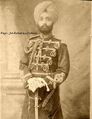
Sirdar Ajmer Singh Kang of Khamano Kalan, Misl:- Dallewalia, Estate- Khamano Kalan, Dynasty:- Kang, Source - Jat Kshatriya Culture


External Links
References
- ↑ Dr Ompal Singh Tugania: Jat Samuday ke Pramukh Adhar Bindu, p.29,sn-186,237.
- ↑ B S Dahiya:Jats the Ancient Rulers (A clan study), p.239, s.n.111
- ↑ Dr Ompal Singh Tugania: Jat Samuday ke Pramukh Adhar Bindu, p.30,sn-237.
- ↑ Jat History Dalip Singh Ahlawat/Parishisht-I, s.n.क-7
- ↑ Dr Ompal Singh Tugania: Jat Samuday ke Pramukh Adhar Bindu, p.29,sn-186.
- ↑ Jat History Dalip Singh Ahlawat/Parishisht-I, s.n. 169
- ↑ Jat History Dalip Singh Ahlawat/Parishisht-I, s.n. क-75
- ↑ Dr Ompal Singh Tugania: Jat Samuday ke Pramukh Adhar Bindu, p.31,sn-317.
- ↑ Jat History Dalip Singh Ahlawat/Parishisht-I, s.n. क-121
- ↑ Dr Ompal Singh Tugania: Jat Samuday ke Pramukh Adhar Bindu, p.30,sn-237.
- ↑ Jat History Dalip Singh Ahlawat/Parishisht-I, s.n. क-145
- ↑ Dr Ompal Singh Tugania: Jat Samuday ke Pramukh Adhar Bindu, p.30,sn-237.
- ↑ Jat History Dalip Singh Ahlawat/Chapter IV, p.341
- ↑ Mahendra Singh Arya et al.: Ādhunik Jat Itihas, Agra 1998, p.228
- ↑ An Inquiry Into the Ethnography of Afghanistan, H. W. Bellew, p.135,185
- ↑ Sandhya Jain:Adideo Arya Devata, A Panoramic view of Tribal-Hindu Cultural Interface, Published in 2004 by Rupa & Co, 7/16, Ansari Road, Daryaganj, New Delhi, p.131
- ↑ शकास तुखाराः कङ्काश च रॊमशाः शृङ्गिणॊ नराः, महागमान थूरगमान गणितान अर्बुथं हयान (II.47.26)
- ↑ Sandhya Jain:Adideo Arya Devata, A Panoramic view of Tribal-Hindu Cultural Interface, Published in 2004 by Rupa & Co, 7/16, Ansari Road, Daryaganj, New Delhi, p.131
- ↑ Pliny.vi.2
- ↑ The Ancient Geography of India: I. The Buddhist Period, Including the Campaigns of Alexander, and the Travels of Hwen-Thsang. By Sir Alexander Cunningham, p.478-479
- ↑ Jats the Ancient Rulers (A clan study)/The Jats,pp.75-77
- ↑ Ram Swarup Joon: History of the Jats/Chapter V,p. 91
- ↑ Sandhya Jain:Adideo Arya Devata, A Panoramic view of Tribal-Hindu Cultural Interface, Published in 2004 by Rupa & Co, 7/16, Ansari Road, Daryaganj, New Delhi, p.131
- ↑ Jats the Ancient Rulers (A clan study)/Jat Clan in India,p. 259
- ↑ JRAS, 1905, p.293.
- ↑ J.J. Modi, ABORI, commemorative Volume, 1977, p.70,
- ↑ ibid., p. 69.
- ↑ ibid., p. 75.
- ↑ Bhim Singh Dahiya, Jats the Ancient Rulers ( A clan study), p. 34 (Sanskrit-शकास्तुखारा कंकाश्च रोमशः श्रंगिणों नराः)
- ↑ Bhim Singh Dahiya, Jats the Ancient Rulers ( A clan study), p. 76
- ↑ Journal of Royal Asitic Society, 1905, p. 293
- ↑ J J Modi, Annals of Bhandarkar Oriental Research Institute, Poona, Commemorative Volume, 1977, p. 70
- ↑ ibid, p. 69
- ↑ ibid., p.75
- ↑ Bhim Singh Dahiya, Jats the Ancient Rulers ( A clan study), p. 259
- ↑ Ram Swarup Joon, History of the Jats
- ↑ A glossary of the Tribes and Castes of the Punjab and North-West Frontier Province By H.A. Rose Vol II/K,p.472-473
- ↑ A glossary of the Tribes and Castes of the Punjab and North-West Frontier Province By H.A. Rose Vol II/K,p.473
- ↑ A Record of Buddhistic Kingdoms/Introduction, 1
- ↑ जाट वीरों का इतिहास: दलीप सिंह अहलावत, पृष्ठ.299-300
- ↑ [[Jat History Dalip Singh Ahlawat/Chapter IV],p.351
- ↑ Email by Manjit Singh Kang: kangmanjitsingh@yahoo.com
- ↑ Sandhya Jain:Adideo Arya Devata, A Panoramic view of Tribal-Hindu Cultural Interface, Published in 2004 by Rupa & Co, 7/16, Ansari Road, Daryaganj, New Delhi, p.131
- ↑ History and study of the Jats. B.S Dhillon. p.126
- ↑ History and study of the Jats. B.S Dhillon.p.124
- ↑ History and study of the Jats. B.S Dhillon. p.123
- ↑ History and study of the Jats. B.S Dhillon.127
- ↑ History and study of the Jats. B.S Dhillon. 127
- ↑ History and study of the Jats. B.S Dhillon.127
- ↑ History and study of the Jats. B.S Dhillon. 106
Back to Jat Gotras/Jat Villages
- Jat Gotras
- Ancient Jat Gotras
- Muslim Jat Gotras
- Jat Gotras in Pakistan
- Jat Gotras in Afghanistan
- Himachal Pradesh
- Punjab
- Rajasthan
- Uttar Pradesh
- Gotras in Chittorgarh
- Gotras in Patiala
- Gotras in Amritsar
- Gotras in Jalandhar
- Jat Villages
- Jat Villages in Punjab
- Villages in Patiala
- Villages in Jalandhar
- Villages in Hoshiarpur
- Villages in Firozpur
- Villages in Gurdaspur
- Villages in Nawanshahr
- Gotras in Nawanshahr
- Gotras in Sialkot
- Suryavanshi
- Gotras in Gujrat
- Gotras in Muzaffargarh
- Gotras in Dera Ghazi Khan